

Strengthening America's Families Act of 2021 This bill provides statutory authority for the Infant and Toddler Court Program and a related resource center. It also permits the Health Resources and Services Administration to expand the program through grants to states, tribal nations, and territories for establishing, stabilizing, or enhancing infant-toddler court teams. This program aims to improve the well-being of infants, toddlers, and families in the child welfare system through team-based case management services that foster coordination among courts, child welfare agencies, and other child-serving organizations. The resource center provides technical assistance, training, and other support for infant-toddler court teams.
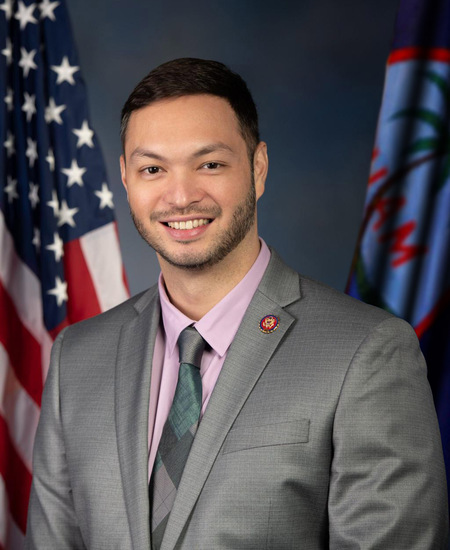
Rep. Michael F. Q. San Nicolas
Sponsored bills
Virtual Peer Support Act of 2021 This bill appropriates funding for grants to transition behavioral health peer support services that are provided at no cost to participants from in-person to virtual platforms or to otherwise expand these kinds of virtual services. Specifically, the Substance Abuse and Mental Health Services Administration must award competitive grants to certain consumer-controlled or consumer-run organizations and tribal communities. Among other eligibility requirements for these grants, entities must have offered certain behavioral health services at no cost to participants before the declaration of the COVID-19 (i.e., coronavirus disease 2019) public health emergency.
Creating Opportunities Now for Necessary and Effective Care Technologies (CONNECT) for Health Act of 2021 or the CONNECT for Health Act of 2021 This bill expands coverage of telehealth services under Medicare. Among other provisions, the bill allows the Centers for Medicare & Medicaid Services (CMS) to waive certain restrictions, such as restrictions on the types of technology that may be used; permanently removes geographic restrictions on originating sites (i.e., the location of the beneficiary) and allows the home of the beneficiary to serve as the originating site for all services; permanently allows federally qualified health centers and rural health clinics to serve as the distant site (i.e., the location of the health care practitioner); and allows the CMS to generally waive coverage restrictions during any public health emergency. Additionally, the CMS must report on the effects of expanded telehealth services during the COVID-19 public health emergency, including with respect to the utilization, quality, and outcomes of services. The Center for Medicare and Medicaid Innovation may also test alternative payment models relating to expanded telehealth services.
Mark Takai Atomic Veterans Healthcare Parity Act This bill includes veterans who participated in the cleanup of Enewetak Atoll in the Marshall Islands between January 1, 1977, and December 31, 1980, as radiation-exposed veterans for purposes of the Department of Veterans Affairs presumption of service-connection for specified cancers. Under a presumption of service-connection, specific conditions diagnosed in certain veterans are presumed to have been caused by the circumstances of their military service. Health care benefits and disability compensation may then be awarded.
This concurrent resolution (1) affirms, on the 400th anniversary of the arrival of the first slave ship, that the nation owes a debt of remembrance not only to those who lived through the injustices of slavery but also to their descendants; and (2) urges the establishment of a U.S. Commission on Truth, Racial Healing, and Transformation to properly acknowledge, memorialize, and be a catalyst for progress, including toward permanently eliminating persistent racial inequities.
This resolution condemns and denounces all forms of anti-Asian sentiment, including those related to COVID-19 (i.e., coronavirus disease 2019), and calls on federal law enforcement officials, working with state and local agencies, to take specified steps. The resolution calls on federal officials to expeditiously investigate and document all credible reports of hate crimes, harassment, bullying, and threats against the Asian American and Pacific Islander communities; the Attorney General to work with state and local agencies and Asian American and Pacific Islander community-based organizations to prevent discrimination and to expand culturally competent and linguistically appropriate education campaigns on public reporting of hate crimes; and the Department of Health and Human Services to issue guidance describing best practices to mitigate racially discriminatory language in describing the pandemic. The resolution recommits the United States to serving as a world leader in building more inclusive, diverse, and tolerant societies by (1) prioritizing language access and inclusivity in communication practices, and (2) combating misinformation and discrimination that put Asian Americans and Pacific Islanders at risk.
Homecare for Seniors Act This bill allows tax-exempt distributions from health savings accounts (HSAs) to be used for qualified home care. Qualified home care means a contract to provide three or more of the following services in the residence of the service recipient assistance with eating, assistance with toileting, assistance with transferring, assistance with bathing, assistance with dressing, assistance with continence, and medication adherence. The Department of Health and Human Services must carry out a campaign to increase public awareness of the in-home service expenses that are eligible for tax-free distribution from HSAs.
No Guns for Abusers Act of 2021 This bill authorizes the Department of Justice (DOJ) to make grants for states, local governments, and tribal governments to implement procedures to remove firearms from individuals who are charged with or convicted of domestic violence or subject to a domestic violence protective order. The National Institute of Justice must report on best practices for implementing such procedures, and DOJ must submit federal legislative recommendations in accordance with the best practices.
Pandemic Heroes Compensation Act of 2021 This bill allows essential workers and their family members to file claims and receive compensation for harm or death suffered as a result of COVID-19 (i.e., coronavirus disease 2019). A Special Master appointed by the Department of Justice must review claims submitted and determine if a claimant is eligible for compensation, the extent of the harm to the claimant, and the amount of compensation to be awarded.
Protect the Youth Vote Act of 2021 This bill outlines specific practices that violate the Twenty-Sixth Amendment to the Constitution, identifies actions that are voting offenses, and provides for the enforcement of the amendment. The Twenty-Sixth Amendment sets the voting age at 18 and prohibits states or the federal government from denying or restricting the right to vote based on age. First, the bill specifies those actions by a state or political subdivision that qualify as a violation of the right to vote based on age, including laws that reduce or restrict the ability of students who attend an institution of higher education and reside in the jurisdiction of the institution to register to vote in that jurisdiction. It also provides for (1) criminal penalties for such violations, and (2) preventive relief such as an injunction or a restraining order. Next, the bill allows for the appointment of federal observers to enforce voting rights related to age. The Department of Justice may monitor and enforce such voting rights whenever federal observers are appointed. Further, the bill specifies other actions that are voting offenses. It also establishes criminal penalties for certain voting offenses, including those related to duplicative voting and the deprivation of voting rights. The bill also sets forth requirements for a state or political subdivision to notify the public about changes with respect to the voting procedures for federal elections.