Respect for Peace Corps Volunteers Act This bill allows the official seal or emblem of the Peace Corps and the name Peace Corps to be used on any death announcement, plaque, grave stone, or other grave marker of a former volunteer, officer, or employee of the Peace Corps.
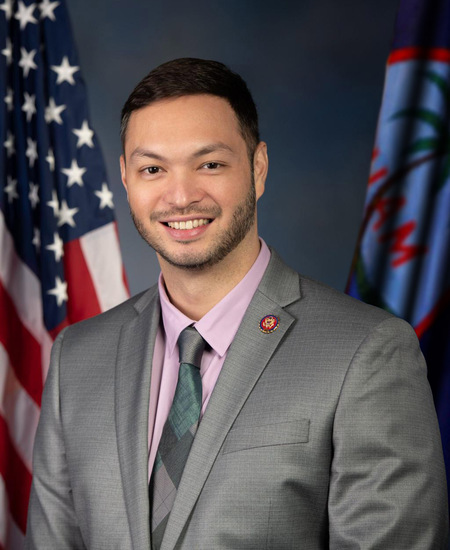
Rep. Michael F. Q. San Nicolas
Sponsored bills
Tax-Free Pell Grant Act This bill excludes from gross income, for income tax purposes, any amount received as a federal Pell Grant. It also expands the definition of qualified tuition and related expenses under the American Opportunity and Lifetime Learning tax credit to include computer or peripheral equipment (up to a maximum of $1,000), child and dependent care expenses, and course materials.
Elder Abuse Protection Act of 2021 This bill provides statutory authority for the Elder Justice Initiative, which coordinates activities of the Department of Justice (DOJ) to combat elder abuse, neglect, and financial fraud. The bill requires DOJ's Elder Justice Coordinator to serve as the head of the initiative. The bill also requires the initiative to establish a national elder fraud telephone hotline, promote civil legal aid to victims of elder fraud and elder abuse, and make resources available online in English and Spanish.
Native CHamoru Equity Act This bill establishes a CHamoru Registry program. It also allows eligible Native CHamoru organizations to qualify for federal contracting opportunities through their participation in certain small business programs that are administered by the Small Business Administration. First, the bill establishes a CHamoru Registry program under the Office of the Governor of Guam. The program must keep a database to serve as a genealogy bank to verify Native CHamoru ancestry requirements. Next, it treats businesses owned by economically disadvantaged Native CHamoru organizations as socially and economically disadvantaged small businesses for purposes of the Minority Small Business and Capital Ownership Development program, which is commonly known as the 8(a) program. Further, it allows businesses that are owned by Native CHamoru organizations to participate in the Historically Underutilized Business Zone Empowerment Contracting (HUBZone) program. The 8(a) program and the HUBZone program each limit competition for certain government contracts to participating small businesses.
Cultivating Opportunity and Recovery from the Pandemic through Service Act or the CORPS Act This bill makes several changes to AmeriCorps programs during the COVID-19 health emergency. Specifically, the bill: increases living allowance payments to program participants; increases educational awards for program participants; relaxes program requirements, including reducing the age requirement for AmeriCorps Seniors to 45 and older; creates a pilot program to allow state commissions to directly place individuals in approved AmeriCorps programs; and allows for targeted AmeriCorps grants to fund recovery projects in communities disproportionately affected by COVID-19. The bill also excludes AmeriCorps living allowance payments and educational awards from taxable income for program participants.
Vanessa Guillén Military Justice Improvement and Increasing Prevention Act This bill modifies the process and policy related to the disposition of charges and convening of courts-martial for certain sexual assault cases and other specified offenses under the Uniform Code of Military Justice (UCMJ). Among other elements, the bill provides that the determinations on the preferral, disposition, and referral of charges for specified offenses under the UCMJ must be made by a commissioned officer of the Armed Forces who is designated as a court-martial convening authority (in grade O-6 or higher) and who is available for detail as trial counsel, has significant trial experience, and is outside the chain of command of the member subject to the charges.
Keep America's Waterfronts Working Act This bill addresses the preservation and accessibility of waterfronts in coastal states. The bill directs the National Oceanic and Atmospheric Administration (NOAA) to establish a Working Waterfront Task Force that will be designed to identify and address critical working waterfront needs with respect to cultural and economic importance, environmental threats, and market conditions for water-dependent businesses. NOAA must also establish a Working Waterfront Grant Program. Under the program, NOAA may award grants to coastal states with approved working waterfront plans in place to preserve and expand access to coastal waters for people engaged in fishing, aquaculture, boat building, and other water-dependent businesses. In addition, NOAA is authorized to award grants to coastal states for the purpose of developing or revising working waterfront plans. States are allowed to allocate any grant money received to eligible Indian tribes, local governments, and other entities. Each state that is awarded a grant must contribute at least 25% of matching funds towards the total cost of the project carried out with the grant, subject to certain exceptions. The bill establishes the Working Waterfronts Preservation Loan Fund to provide loans to coastal states for the purpose of implementing working waterfront plans.

Offshore Wind for Territories Act This bill addresses offshore wind development in certain submerged lands off the U.S. territories and coral reef conservation. Specifically, the bill requires the Department of the Interior to study the feasibility of conducting wind lease sales on the Outer Continental Shelf in the U.S. Exclusive Economic Zone adjacent to U.S. territories. If the study determines that such leases are feasible, then Interior must conduct wind lease sales in those areas as specified by this bill. In addition, the bill establishes the Coral Reef Conservation Fund for the Department of Commerce to carry out the Coral Reef Conservation Act of 2000, including to preserve, sustain, and restore the condition of coral reef ecosystems. The bill also specifies requirements for distributing revenues from the leases authorized by this bill to the Treasury, the Coral Reef Conservation Fund, and U.S. territories.
Renewable Energy for Puerto Rico and the U.S. Virgin Islands Act This bill addresses renewable energy, energy efficiency, and energy storage in Puerto Rico and the Virgin Islands. Specifically, the Department of Agriculture (USDA) must establish a grant program under which USDA may award grants for renewable energy systems, energy efficiency activities, energy storage, smart grids, or microgrids. In addition, USDA may award grants to train residents of Puerto Rico or the Virgin Islands to develop, construct, maintain, or operate renewable energy systems. The Department of Energy must ensure that its national laboratories offer to provide technical assistance to grant recipients. The Government Accountability Office must study and report on renewable energy and energy efficiency in Puerto Rico and the Virgin Islands.
Unsubscribe Act of 20 21 This bill requires that certain consumer protections are included in negative option agreements (i.e., an agreement under which a consumer's failure to take an affirmative action is considered approval to be charged for goods or services). These agreements are prohibited unless the terms provide the consumer with a way to cancel the agreement, in the same manner by which the agreement was entered, before incurring further or increased charges. Further, under free-to-pay conversion contracts, where a consumer is charged a nominal introductory rate and an increased rate after the introductory period ends, the provider of the good or service must require the consumer to perform an additional action, like clicking a confirmation button, before the increased rate takes effect. The bill also requires that certain notifications are provided to consumers in the context of other forms of negative option agreements online, such as notice between two and seven days before an automatic renewal. The bill provides for enforcement of these requirements by the Federal Trade Commission and state attorneys general.