

Maddy summaryThis bill requires U.S. agencies maintaining federal sanctions lists to notify each other within 30 days when an individual or entity is added to one list, then review whether they should be added to other lists within 90 days. It applies to six specific sanctions lists, including Treasury’s blocked persons list, Commerce’s Entity List, and Defense’s military end-user list. Agencies must report to Congress within one year on how they implemented the coordination process and whether it led to additional sanctions. The goal is to prevent gaps where sanctioned parties could evade restrictions by operating outside a single list’s scope.
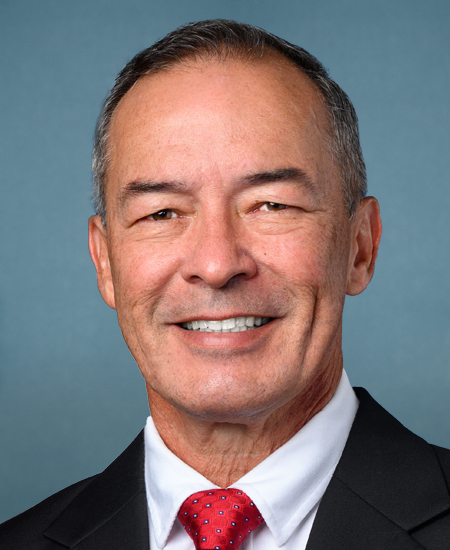
Rep. James C. Moylan
Sponsored bills
Maddy summaryHRES 920 is a ceremonial resolution celebrating the 50th anniversary of the Individuals with Disabilities Education Act (IDEA) on November 29, 2025. It recognizes IDEA’s historical impact - establishing the right to free, appropriate public education in the least restrictive environment for children with disabilities - and notes how it transformed access to education after over 1 million children were previously excluded from schools. The resolution does not create new policy or funding; it solely commemorates IDEA’s legacy, honors the students and families it has served, and acknowledges educators and advocates who advanced its implementation. This is a symbolic gesture with no direct effect on current law or services.
Maddy summaryThis bill grants posthumous U.S. citizenship to noncitizens who served honorably in the U.S. military during World War II while enlisted in the Philippines and died between September 1, 1939, and December 31, 1946. It amends the Immigration and Nationality Act to include these veterans under specific eligibility criteria: they must have died from service-related injuries or diseases, and met enlistment requirements during that historical period. The bill removes barriers by clarifying that the standard naturalization requirements (section 319(d)) and related provisions (section 1703 of the 2004 Defense Act) do not apply to this group. This allows descendants to petition for citizenship on behalf of qualifying deceased service members through a certification from the relevant military department.
Maddy summaryHR 6063 designates the Guam and Western Pacific USDA Rural Development Office as the official representative for USDA Rural Development services in Guam, the Commonwealth of the Northern Mariana Islands, American Samoa, and the Freely Associated States (the Marshall Islands, Palau, and Federated States of Micronesia). Within 90 days of enactment, the Secretary of Agriculture must formally establish this office’s role. The designated office will then have the same authority and responsibilities as a state-level USDA Rural Development office. This change ensures these territories and nations have a dedicated point of contact for rural development programs like loans and grants.
Maddy summaryHR 5562, the Tropical Plant Health Initiative Act, authorizes research and extension grants to address plant health threats affecting specific tropical crops. The bill directly supports researchers and agricultural programs working with crops like coffee, cacao, bananas, mangos, and vanilla by funding science-based tools to combat pests and weeds. Key provisions include developing pest management strategies, collecting production data, and researching biological factors affecting these plants' health. The initiative extends federal funding authorization through 2030, focusing on practical research to protect economically important tropical agriculture.
Give Kids a Chance Act of 2025 This bill expands the Food and Drug Administration’s (FDA’s) authority with respect to research on rare pediatric diseases, including by permitting the FDA to take enforcement action against drug sponsors that fail to satisfy pediatric study requirements and by reauthorizing programs that support pediatric research. Specifically, the bill modifies requirements relating to molecularly targeted pediatric cancer investigations to permit research on new drugs in combination with active ingredients that have already been approved, provided certain conditions are met; permits the FDA to take enforcement action against drug sponsors that fail to comply with pediatric study requirements, if such sponsors demonstrated a lack of due diligence in satisfying the requirement; renews the FDA’s authority to award priority review vouchers to sponsors of new products intended to treat rare pediatric diseases through September 30, 2029; and reauthorizes through FY2027 certain funding for the National Institutes of Health to support priority pediatric research. The bill also provides statutory authority for the FDA’s interpretation of the orphan drug exclusivity period. The bill specifies, consistent with FDA regulations, that the seven-year market exclusivity period for drugs for rare diseases or conditions (i.e., orphan drugs) prohibits the approval of the same drug for the same approved use or indication with respect to the disease or condition. (In Catalyst Pharmaceuticals, Inc. v. Becerra , a court rejected the FDA’s interpretation and held that orphan drug exclusivity extends to all uses or indications for the disease or condition.)
Maddy summaryThe Save the Green to Gold Program Act amends U.S. military law to adjust how enlisted service time is counted for officers who completed the SROTC program. It allows these officers to count their service in the Selected Reserve from either August 1, 1979, or the date the bill becomes law, regardless of which military branch they served in. This change directly affects current and future officers who served in the Selected Reserve before becoming commissioned, potentially extending their counted service time for promotion and retirement. The bill updates section 2106(c) of Title 10, U.S. Code, to provide this new option for computing service length.
Maddy summaryThis bill establishes a federal program to help low-income households pay for drinking water and wastewater services. It provides $500 million annually (2026-2030) in grants to states and tribes that already administer energy assistance programs, allowing them to cover past-due bills or other costs for households meeting specific income criteria (e.g., receiving certain federal benefits or earning ≤150% of the poverty level). The program prohibits using these funds to replace existing assistance and requires technical help to streamline eligibility. It directly affects low-income households in participating states and tribes, particularly those facing water affordability challenges.
Maddy summaryHRES 915 formally recognizes the 1932-1933 Ukrainian famine, known as the Holodomor, as a genocide perpetrated by the Soviet Union. The resolution directly affects Ukrainian victims, survivors, and communities by affirming historical truth and condemning Soviet policies that intentionally starved millions. Key provisions include declaring the Holodomor a genocide, commemorating its victims, and condemning ongoing Russian aggression against Ukraine, including Vladimir Putin’s denial of Ukrainian sovereignty. This symbolic resolution aims to educate the public and align U.S. policy with historical facts about Soviet repression.
Maddy summaryHR 6302, the Whistleblowers Aiding National Security Act of 2025, creates a program rewarding individuals who report defense export rule violations to the State Department. It establishes a secure online portal for submitting original information (including anonymously), with whistleblowers eligible for awards of 10-30% of civil penalties collected from violators. The bill also prohibits employer retaliation against whistleblowers who report violations, requiring reinstatement or double back pay if fired, and creates a special fund to pay rewards using fines collected under the program. This directly affects individuals reporting defense export violations and employers who might retaliate against them.