

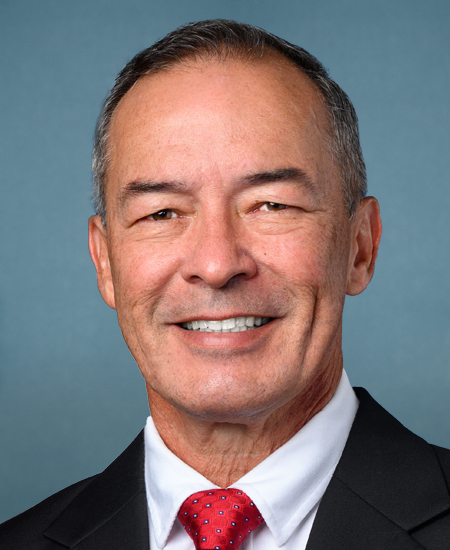
Photo of James C. Moylan
R United States House · District At-Large · Guam

Rep. James C. Moylan

Compare
Total votes
623
all sessions
Attendance
25%
1,291 missed
Among the lowest in the chamber
With party
77%
of cast votes
Among the lowest in the chamber
Bipartisan score
13%
some cross-party votes
Higher than 99% of chamber peers
Sponsored
682
bills & resolutions
Near the chamber average
Committees
9
assignments
682 bills and resolutions

Sponsored bills

Total
682
Primary
61
Co-sponsor
621
This page
682
matching current filters
Co-sponsor HR 7026
In committee · United States House · Co-sponsor
Fiscal State of the Nation Act

Maddy summaryThe Fiscal State of the Nation Act requires the chairs of the House and Senate Budget Committees to hold an annual joint hearing within 45 days after the Treasury submits its annual financial report. At this hearing, the Comptroller General must present a nonpartisan analysis of the federal government's financial condition, including budget deficits, surpluses, and long-term fiscal projections, based on the Treasury's report. The hearing must be open to the public and media, and all members of Congress may participate, regardless of committee membership. This requirement applies to financial reports submitted on or after the bill's enactment date.

In committee Jan 13, 2026 1 co-sponsor
Co-sponsor HR 6716
In committee · United States House · Co-sponsor
SATOS Act of 2025

Maddy summaryThe SATOS Act of 2025 provides federal grants and loans to fund the construction, renovation, or equipment upgrades for animal shelters, clinics, and related facilities in rural areas (defined as communities with populations under 50,000). It prioritizes lower-income rural communities by offering up to 75% federal funding coverage (capped at $10 million annually) for eligible entities like local governments, tribes, and nonprofits. The bill also includes technical assistance grants (3-5% of program funds) to help organizations plan, apply for, and manage these facilities. Recipients must report program outcomes to Congress biennially. This directly affects rural animal welfare infrastructure and the communities relying on these services.

In committee Jan 13, 2026 1 co-sponsor
Co-sponsor HR 5241
In committee · United States House · Co-sponsor
RTCP Revitalization Act

Maddy summaryThe RTCP Revitalization Act amends funding provisions for geographically disadvantaged farmers and ranchers under the Food, Conservation, and Energy Act of 2008. It establishes mandatory annual funding from the Commodity Credit Corporation, starting at $10 million for fiscal year 2026 and increasing to $15 million annually through 2031 and beyond. The bill removes payment limits for eligible farmers when sufficient funds are available, ensuring they receive full payments without arbitrary caps. This directly affects farmers and ranchers in geographically disadvantaged areas who qualify for these payments. The changes provide predictable funding and protect payment access for this specific group.

In committee Jan 13, 2026 1 co-sponsor
Co-sponsor HR 5168
In committee · United States House · Co-sponsor
Puerto Rico Nutrition Assistance Fairness Act

Maddy summaryThis bill updates federal nutrition law to include Puerto Rico in the Supplemental Nutrition Assistance Program (SNAP), allowing it to transition from its current funding method to the same SNAP benefits available to U.S. states. Puerto Rico must submit a 180-day plan to the USDA detailing its transition to SNAP, with approval required within another 180 days. The transition period lasts up to 5 years from the bill's effective date, during which Puerto Rico would continue receiving block grants while preparing for full SNAP participation. This change directly affects Puerto Rico's 1.4 million residents who currently receive nutrition assistance under a separate funding structure.

In committee Jan 13, 2026 1 co-sponsor
Co-sponsor HRES 984
In committee · United States House · Co-sponsor
Supporting the recognition of January 9, 2026, as "National Law Enforcement Appreciation Day".

Maddy summaryHRES 984 is a symbolic resolution designating January 9, 2026, as "National Law Enforcement Appreciation Day." It directly honors all federal, state, local, and tribal law enforcement officers across the United States for their service and sacrifices. The resolution expresses the House's support and gratitude, encourages public observance through ceremonies, and recognizes officers who have made the ultimate sacrifice. As a non-binding resolution, it does not create new laws or policies but serves as a formal expression of appreciation.

In committee Jan 9, 2026 1 co-sponsor
Co-sponsor HR 6962
In committee · United States House · Co-sponsor
Families First Housing Act of 2026

Maddy summaryThis bill requires federal housing agencies (like HUD and Fannie Mae) to prioritize qualified first-time homebuyers when selling single-family homes (1-4 units). For 180 days after listing, properties must be offered only to eligible buyers (individuals, nonprofits, local governments, or community land trusts) at fair market value based on recent third-party appraisals, with public online listings showing the priority window. Covered entities must report quarterly sales data, including prices relative to appraised value, and annual audits will verify compliance. Institutional investors (e.g., rental companies) cannot purchase during the priority period. The law aims to increase access to homeownership for specific groups through transparency and structured sales processes.

In committee Jan 7, 2026 1 co-sponsor
Co-sponsor HR 6826
In committee · United States House · Co-sponsor
Critical Minerals Independence Act

Maddy summaryHR 6826, the Critical Minerals Independence Act, expands a federal tax credit for advanced manufacturing to include "black mass" - the material recovered from processing spent lithium-ion batteries. The bill defines black mass as the intermediate solid material containing metals like lithium, nickel, and cobalt, before it is purified into individual components. This change directly affects battery recycling companies and manufacturers who process spent batteries, allowing them to claim the tax credit for components made from this material. The provision applies to components produced and sold after December 31, 2024.

In committee Dec 17, 2025 1 co-sponsor
Co-sponsor HR 6828
In committee · United States House · Co-sponsor
Transnational Fentanyl Prevention Act

Maddy summaryHR 6828, the Transnational Fentanyl Prevention Act, requires the CIA to produce a detailed intelligence assessment on the Sinaloa and Jalisco cartels within 90 days of the bill’s enactment. The assessment must cover cartel leadership, drug smuggling routes, chemical supply chains for fentanyl production, marketing tactics targeting U.S. consumers, and efforts to undermine U.S. and Mexican counternarcotics operations. It also mandates an annual revenue estimate for these cartels, disaggregated by drug type. This bill does not create new laws or policies but directs Congress to receive this intelligence report to inform future counterdrug strategies. The report will be submitted to specific congressional committees, including intelligence and foreign affairs panels.

In committee Dec 17, 2025 1 co-sponsor
Co-sponsor HR 6827
In committee · United States House · Co-sponsor
All American Metal Act

Maddy summaryThe All American Metal Act (HR 6827) expands a federal tax credit for advanced manufacturing to include copper produced from recycled materials. To qualify, the copper must be purified to at least 99.9% purity by mass and made from recycled sources. This change applies to components sold in taxable years beginning after December 31, 2024. The bill directly affects manufacturers of copper products who use recycled materials meeting these standards, providing them a new pathway to claim the tax credit.

In committee Dec 17, 2025 1 co-sponsor
Co-sponsor HR 6796
In committee · United States House · Co-sponsor
Military CARE Act

Maddy summaryThis bill establishes a digital system for TRICARE members to electronically file and track complaints about access to care at military medical facilities. It requires the Defense Department to create a system where beneficiaries can submit complaints online, view their status in real time, and have complaints automatically aggregated quarterly for review. The system mandates annual reports to Congress comparing complaint types (e.g., specialty vs. primary care, pediatric vs. non-pediatric, administrative hurdles) and detailing facility-level actions taken to address issues. The goal is to improve transparency and accountability in military healthcare access.

In committee Dec 17, 2025 1 co-sponsor
Showing 101 to 110 of 682 bills
Previous 1 … 10 11 12 … 69 Next