

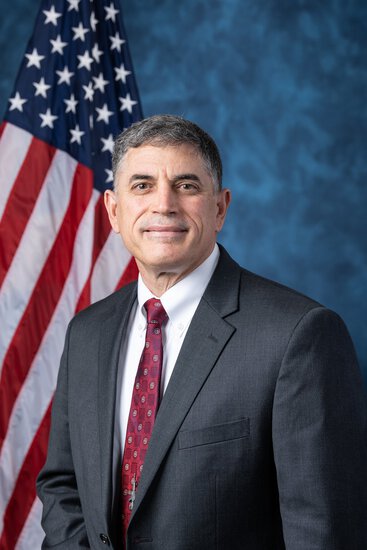
Photo of Andrew S. Clyde
R United States House · District 9 · Georgia On the 2026 ballot

Rep. Andrew S. Clyde

Compare
Total votes
2,837
all sessions
Attendance
98%
63 missed
Lower than 79% of chamber peers
With party
86%
of cast votes
Lower than 95% of chamber peers
Bipartisan score
7%
crosses aisle rarely
Higher than 93% of chamber peers
Sponsored
629
bills & resolutions
Lower than 77% of chamber peers
Committees
4
assignments
629 bills and resolutions

Sponsored bills

Total
629
Primary
68
Co-sponsor
561
This page
629
matching current filters
Co-sponsor HJRES 111
In committee · United States House · Co-sponsor
Disapproving the rule submitted by the Department of Energy relating to "Energy Conservation Program: Energy Conservation Standards for Consumer Furnaces".

Maddy summaryThis resolution disapproves a Department of Energy rule that would have set new energy efficiency standards for consumer furnaces. The rule, published in the Federal Register (88 Fed. Reg. 87502), aimed to require furnace manufacturers to produce models meeting higher energy conservation levels. If enacted, this resolution would cancel the rule, preventing it from taking effect. As a result, current energy efficiency standards for furnaces would remain unchanged, and manufacturers would not face the new requirements.

In committee Feb 2, 2024 1 co-sponsor
Primary HJRES 107
In committee · United States House · Lead sponsor
Providing for congressional disapproval under chapter 8 of title 5, United States Code, of the rule submitted by the Federal Communications Commission relating to "The Infrastructure Investment and Jobs Act: Prevention and Elimination of Digital Discrimination".

Maddy summaryHJRES 107 is a congressional resolution seeking to block a Federal Communications Commission (FCC) rule published on January 22, 2024 (89 Fed. Reg. 4128). The resolution aims to disapprove the FCC's rule implementing digital discrimination protections under the Infrastructure Investment and Jobs Act, which would have required internet providers to prevent discriminatory practices. If passed, this resolution would nullify the FCC rule, preventing it from taking effect under the Congressional Review Act (Chapter 8 of Title 5, U.S. Code). The bill directly affects the FCC's regulatory authority over digital discrimination enforcement in broadband services.

In committee Feb 2, 2024 0 co-sponsors
Co-sponsor HR 7183
In committee · United States House · Co-sponsor
PROTECTS Act of 2024

Maddy summaryHR 7183, the PROTECTS Act of 2024, prohibits federal funding from being used to provide or refer for specific gender transition procedures to individuals under 18. The bill defines prohibited procedures broadly to include surgeries (like hysterectomy, mastectomy, or genital reconstruction), puberty-blocking medications, and hormone treatments administered at supraphysiologic doses. It includes limited exceptions for medically necessary care, such as treating precocious puberty or correcting genetic disorders of sex development. The law directly affects minors seeking gender-affirming medical care covered by federal programs, restricting federal financial support for these services.

In committee Feb 2, 2024 1 co-sponsor
Co-sponsor HJRES 110
In committee · United States House · Co-sponsor
Providing for congressional disapproval under chapter 8 of title 5, United States Code, of the rule submitted by the Department of the Treasury relating to "Coronavirus State and Local Fiscal Recovery Funds".

Maddy summaryThis resolution seeks congressional disapproval of a Treasury Department rule (88 Fed. Reg. 80584, November 2023) that established spending guidelines for $350 billion in federal Coronavirus State and Local Fiscal Recovery Funds. If passed, it would nullify the rule, preventing the Treasury from enforcing its specific restrictions on how states and localities could use these pandemic recovery funds. The bill does not alter the underlying funding program but targets the implementation rules through a procedural disapproval process under Title 5 of the U.S. Code. It directly affects the Treasury Department's authority to administer the fund distribution rules.

In committee Feb 1, 2024 1 co-sponsor
Co-sponsor HR 7195
In committee · United States House · Co-sponsor
Protecting the Mailing of Firearms Act

Maddy summaryThis bill repeals a law (18 U.S.C. § 1715) that previously prohibited mailing firearms without a license. It directly affects the U.S. Postal Service, firearm sellers, and individuals mailing firearms by preventing the Postal Service from creating rules that would block firearm mailings or require disclosure of sensitive records like sales receipts or firearm serial numbers. Key provisions include removing the existing ban on mailing firearms and prohibiting the Postal Service from imposing new restrictions on firearm mailings or demanding customer transaction data. The bill ensures that firearm mailings can proceed without these specific federal restrictions, while applying to ongoing legal cases under the repealed law.

In committee Feb 1, 2024 1 co-sponsor
Co-sponsor HR 7031
In committee · United States House · Co-sponsor
Ultrasound Informed Consent Act

Ultrasound Informed Consent Act This bill requires abortion providers to conduct an ultrasound before performing an abortion. Specifically, before a woman gives informed consent to any part of an abortion, the abortion provider must perform an obstetric ultrasound on the pregnant woman; provide a simultaneous explanation of what the ultrasound is depicting; display the ultrasound images so the woman may view them; and provide a complete medical description of the images, including the dimensions of the embryo or fetus, cardiac activity if present and visible, and the presence of external members and internal organs if present and viewable. Providers are subject to civil actions and penalties for violations. The bill's ultrasound requirements do not apply in cases where a physical disorder, illness, or injury caused by the pregnancy endangers a woman's life. A woman is also not required to view the ultrasound images; nor may she or the provider be penalized if she declines to do so.

In committee Jan 19, 2024 1 co-sponsor
Co-sponsor HR 7035
In committee · United States House · Co-sponsor
Death Tax Repeal Act

Maddy summaryThe Death Tax Repeal Act would eliminate the federal estate tax and generation-skipping transfer tax for estates of people who die on or after the bill's enactment date, and for generation-skipping transfers made after that date. It would also establish a new $10 million lifetime gift tax exemption (adjusted annually for inflation) and replace the existing gift tax rate schedule with a revised structure. These changes would primarily affect high-net-worth individuals and their heirs, as the estate tax and gift tax typically apply to large estates or gifts exceeding the new exemption threshold. The bill's provisions would take effect on the date of enactment, with transitional rules for the year the bill is signed into law.

In committee Jan 18, 2024 1 co-sponsor
Co-sponsor HR 7042
In committee · United States House · Co-sponsor
RIFLE Act of 2024

Maddy summaryThe RIFLE Act of 2024 changes how the federal government handles violations by firearms licensees, affecting gun dealers and manufacturers who hold federal licenses. It creates a graduated penalty system where non-willful violations require the Attorney General to work with licensees to fix issues before taking action, while willful violations may lead to license suspension or revocation only after proper notice, hearing, and evidence of continued noncompliance. The bill establishes new procedures for administrative hearings, defines "willful" violations more clearly, and gives licensees 90 days to liquidate inventory after license expiration or revocation, with extensions possible for reasonable cause. These changes aim to create a more transparent process for addressing violations while maintaining public safety standards.

In committee Jan 18, 2024 1 co-sponsor
Co-sponsor HR 6995
In committee · United States House · Co-sponsor
Funding A Secure America Act

Maddy summaryThis bill provides stopgap funding to maintain pay and operations for specific government personnel if Congress fails to pass full-year budget bills by October 2024. It directly affects military members (including reserves), Defense and Coast Guard civilian staff, border agents (CBP), immigration officers (ICE), Transportation Security Administration staff, air traffic controllers, and Veterans Affairs employees processing benefits. Key provisions ensure continued salaries for these workers during funding gaps, covering mission-critical functions like border security, military support, and VA benefit delivery. The funding expires automatically on October 1, 2024, or earlier if regular appropriations are enacted.

In committee Jan 16, 2024 1 co-sponsor
Co-sponsor HRES 964
In committee Jan 12, 2024 1 co-sponsor
Showing 291 to 300 of 629 bills
Previous 1 … 29 30 31 … 63 Next