

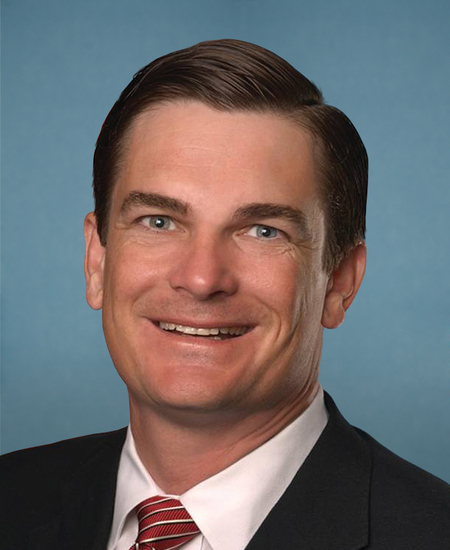
Photo of Austin Scott
R United States House · District 8 · Georgia On the 2026 ballot

Rep. Austin Scott

Compare
Total votes
2,837
all sessions
Attendance
99%
41 missed
Higher than 89% of chamber peers
With party
95%
of cast votes
Higher than 87% of chamber peers
Bipartisan score
3%
crosses aisle rarely
Lower than 88% of chamber peers
Sponsored
611
bills & resolutions
Lower than 83% of chamber peers
Committees
13
assignments
611 bills and resolutions

Sponsored bills

Total
611
Primary
36
Co-sponsor
575
This page
611
matching current filters
Co-sponsor HRES 147
In committee · United States House · Co-sponsor
Expressing support for the designation of February 18 through February 25, 2023, as "National FFA Week", recognizing the important role of the National FFA Organization in developing the next generation of globally conscious leaders who will change the world, and celebrating the 90th anniversary of the iconic FFA jacket.

This resolution supports the designation of National FFA Week. It also (1) recognizes the important role of the National FFA Organization (Future Farmers of America) in developing the next generation of leaders who will change the world, and (2) celebrates the 90th anniversary of the iconic FFA jacket.

In committee Mar 2, 2023 1 co-sponsor
Co-sponsor HR 714
In committee · United States House · Co-sponsor
Feral Swine Act

Feral Swine Act This bill extends through FY2028 the feral swine eradication and control pilot program to respond to the threat feral swine pose to agriculture, native ecosystems, and human and animal health.

In committee Mar 2, 2023 1 co-sponsor
Co-sponsor HR 1250
In committee · United States House · Co-sponsor
Family Farm and Small Business Exemption Act

Maddy summaryThis bill amends the Higher Education Act to exempt certain family-owned assets from being counted when calculating federal student aid eligibility. Specifically, it excludes family farms where the family resides and small businesses with 100 or fewer full-time equivalent employees owned and controlled by the family. These assets will no longer be considered when determining a student's financial need for aid programs. The change directly affects students from qualifying family farms or small businesses when applying for federal financial aid. The exemption applies to assets held by the family, not just the business itself.

In committee Feb 28, 2023 1 co-sponsor
Co-sponsor HR 1200
In committee · United States House · Co-sponsor
National Right-to-Work Act

Maddy summaryHR 1200, the National Right-to-Work Act, prohibits requiring workers to join a union or pay dues as a condition of employment in both private-sector workplaces (covered by the National Labor Relations Act) and railroad industries (covered by the Railway Labor Act). The bill amends key sections of these laws to eliminate provisions that allowed union security agreements, meaning workers in unionized settings would no longer be forced to pay dues to retain their jobs. This directly affects employees in unionized workplaces across the U.S., particularly those in industries with existing union contracts that included mandatory dues. The law changes the legal framework to ensure union membership and dues payment remain voluntary for all workers.

In committee Feb 27, 2023 1 co-sponsor
Co-sponsor HRES 146
In committee · United States House · Co-sponsor
Expressing strong support for the people of Moldova and for the Moldovan Government in their demonstrated commitment to advancing democracy, strengthening civil society, and European integration in the face of Russia's illegal and full-scale invasion of Ukraine.

This resolution reaffirms the U.S. commitment to Moldova in the face of Russia's malign influence and military aggression. The resolution also (1) lauds the strengthening of civil society, democracy, and democratic institutions in Moldova; (2) welcomes the strong mandate given to pro-reform forces in recent elections; and (3) urges the European Union to continue to promote Moldova's accession processes.

In committee Feb 21, 2023 1 co-sponsor
Co-sponsor HR 1122
In committee · United States House · Co-sponsor
CBDC Anti-Surveillance State Act

CBDC Anti-Surveillance State Act This bill limits the ability of the Federal Reserve to (1) provide direct services to individuals, and (2) use a central bank digital currency. A central bank digital currency is a digital currency (e.g., Bitcoin or Ether) issued by a government-backed central bank. Specifically, the bill prohibits the Federal Reserve and the Federal Open Market Committee from using any central bank digital currency to implement monetary policy. In addition, a Federal Reserve bank is prohibited from offering products or services directly to an individual, maintaining an account on behalf of an individual, or issuing a central bank digital currency directly to an individual. The Federal Reserve must (1) consult with each Federal Reserve bank with respect to any central bank digital currency study or pilot program, and (2) issue quarterly reports on the findings and determinations of any such study or program.

In committee Feb 21, 2023 1 co-sponsor
Co-sponsor HR 737
In committee · United States House · Co-sponsor
Ralph David Abernathy, Sr. National Historic Site Act

Maddy summaryThis bill establishes the Ralph David Abernathy, Sr. National Historic Site in Georgia as part of the National Park System. It specifically preserves the West Hunter Street Baptist Church (where Abernathy served as pastor during the civil rights movement) and honors his leadership role. The site cannot be formally established until the National Park Service acquires sufficient land (through donation or purchase), and requires a management plan within 3 years of funding. The bill directly affects the National Park Service, the State of Georgia, and local communities by designating this location for preservation and public interpretation.

In committee Feb 21, 2023 1 co-sponsor
Co-sponsor HR 150
In committee · United States House · Co-sponsor
Protecting American Energy Production Act

Maddy summaryHR 150, the Protecting American Energy Production Act, gives states primary authority to regulate hydraulic fracturing (fracking) for oil and gas on state and private lands, directly affecting state governments and energy producers. The bill requires states to maintain this regulatory role and blocks the President from imposing a fracking moratorium without explicit congressional approval. Key provisions include a Congressional "sense" statement affirming state primacy and a direct prohibition on presidential moratoriums unless authorized by a new law. This bill focuses on shifting regulatory power to states and limiting federal executive action on fracking, without specifying financial impacts or environmental standards.

In committee Feb 21, 2023 1 co-sponsor
Co-sponsor HJRES 33
In committee · United States House · Co-sponsor
To acknowledge the courage and sacrifice of veterans of the Vietnam War and formally apologize for the treatment they received upon returning home.

Maddy summaryHJRES 33 is a symbolic congressional resolution acknowledging Vietnam War veterans' service and formally apologizing for their mistreatment upon returning home. It recognizes the sacrifice of over 58,000 service members killed and 300,000 wounded during the war, including veterans exposed to harmful herbicides like Agent Orange. The resolution urges the President to acknowledge this mistreatment as part of the Vietnam War Commemoration and issues a formal apology on behalf of the American people. It also calls for increased educational efforts in schools to highlight veterans' courage and the lack of support they faced after the war. (Note: This is a non-binding resolution, not a law, so it has no direct legal or financial impact.)

In committee Feb 17, 2023 1 co-sponsor
Co-sponsor HR 830
In committee · United States House · Co-sponsor
HELP Copays Act

Maddy summaryThe HELP Copays Act (HR 830) changes how health insurance plans calculate patient cost-sharing. It requires that payments made by third parties (like pharmacies, charities, or discount programs) toward medical costs count toward a patient's deductible, copay, or out-of-pocket limit. This directly affects insured individuals who receive financial assistance, discounts, or product vouchers for healthcare expenses. The law ensures these external payments reduce the patient's actual out-of-pocket costs more quickly, aligning with existing Affordable Care Act and Public Health Service Act requirements.

In committee Feb 17, 2023 1 co-sponsor
Showing 361 to 370 of 611 bills
Previous 1 … 36 37 38 … 62 Next