

Cover Outstanding Vulnerable Expansion-eligible Residents Now Act or the COVER Now Act This bill establishes a demonstration program to allow local governments to provide health benefits to the Medicaid expansion population in states that have not expanded Medicaid. Under the program, local governments may provide coverage for individuals who are newly eligible for Medicaid under the Patient Protection and Affordable Care Act (i.e., the Medicaid expansion population) for a maximum of 10 years, or until their respective states expand Medicaid. The bill provides a 100% federal matching rate for the first three years of program participation. The bill prohibits states from taking certain actions against participating localities, such as withholding funding, increasing taxes, or restricting provider participation. States that violate these requirements are subject to certain funding penalties.
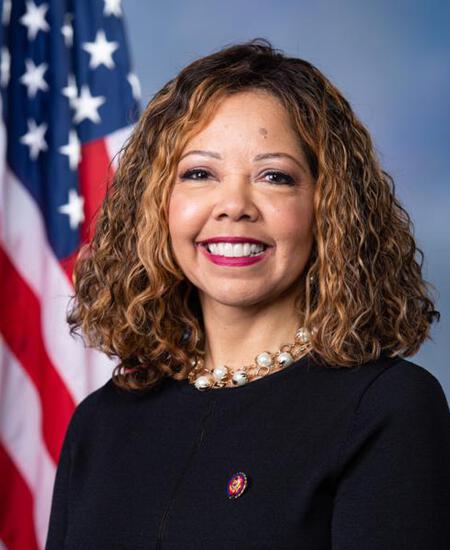
Rep. Lucy McBath
Sponsored bills
This resolution recognizes the historical significance to the nation of Juneteenth Independence Day (commemorating the end of slavery in the United States).
Pell Grant Preservation and Expansion Act of 2021 This bill makes various changes to the Federal Pell Grant program, including by expanding student eligibility for Pell Grants. The bill also revises student eligibility for federal student-aid programs. Specifically, the bill provides funding to increase the maximum Pell Grant award for each eligible student. Further, the bill requires the award amount to be adjusted for inflation. Next, the bill allows students who receive means-tested federal benefits (e.g., Medicaid) to automatically qualify for the maximum Pell Grant award plus an additional award amount. In addition, the bill moves the Iraq and Afghanistan Service Grant program into the Pell Grant program. Next, the bill raises from 12 to 18 the total number of semesters during which a student may receive a Pell Grant. The bill makes Dreamer students (i.e., students who have been granted Deferred Action for Childhood Arrivals status) who entered the United States before the age of 18 and who meet certain educational criteria eligible for federal financial aid. The bill also revises satisfactory academic progress requirements for federal student-aid programs, including by allowing a student who has not been enrolled in an institution of higher education for two years to regain eligibility for federal student aid.
Shark Fin Sales Elimination Act of 20 21 This bill addresses the sale of shark fins and the inclusion of rays and skates in the Seafood Traceability Program. The Seafood Traceability Program has data reporting and recordkeeping requirements at the time of entry for imported fish or fish products entered into U.S. commerce. The bill makes it illegal to possess, buy, or sell shark fins or any product containing shark fins, except for certain dogfish fins. A person may possess a shark fin that was lawfully taken consistent with a license or permit under certain circumstances. Penalties are imposed for violations under the Magnuson-Stevens Fishery Conservation and Management Act. The Department of Commerce must revise its regulations to include rays and skates as species that are subject to the Seafood Traceability Program.
Flexible Financing for Rural America Act This bill allows rural utility service providers to submit to the Department of Agriculture (USDA) a request to adjust the interest rate or modify the terms of certain loans. The request shall include a report summarizing how the adjustment or modification will assist the borrower in providing critical utility services to a rural community. Specifically, on receipt of a request, USDA or the Department of the Treasury (in the case of a loan owned by the Federal Financing Bank) must adjust the interest rate on the loan to match certain interest rates for obligations of comparable maturity to the term remaining on the loan (or a higher rate requested by the borrower), and make modifications to the loan terms as necessary to address changes in the financial position of the borrower due to the COVID-19 public health emergency and to promote the financial sustainability of the borrower. In carrying out the adjustments or modifications, USDA or Treasury shall not impose or collect any fee from, or impose any penalty on, a borrower. The bill also provides funding to implement the adjustments and modifications and for the liquidation of residual intragovernmental amounts owed by the Federal Financing Bank in connection with certain loans.
This resolution expresses support for the goals and ideals of PCOS Awareness Month. Polycystic ovary syndrome (PCOS) is caused by a hormone imbalance. Symptoms can include infertility, weight gain, excess hair growth, and acne.
Teacher Education for Computer Science Act or the Teach CS Act This bill authorizes the Department of Education to award grants to institutions of higher education for establishing and maintaining teacher education programs for computer science. It also includes computer science as an eligible education category with respect to receiving various teacher preparation grants and graduate fellowships.
Protecting our Students in Schools Act of 2021 This bill prohibits the use of corporal punishment in schools that receive federal funding. Specifically, the bill authorizes the Department of Education (ED) to take specified actions (e.g., withholding funds and issuing cease-and-desist orders) for schools that allow school personnel, law enforcement officers, or school security guards to subject students to corporal punishment. The bill also establishes enforcement provisions, including a private right of action for a student who has been subjected to corporal punishment. Each state educational agency (SEA) that receives federal funding must submit specified information to ED, including a school climate report that describes the SEA's policies and procedures related to exclusionary and aversive discipline practices in schools. Additionally, the bill authorizes ED to award three-year grants to SEAs and, through them, subgrants to local educational agencies to implement positive behavioral interventions and supports to address student behavior and reduce exclusionary and aversive discipline practices. ED must promulgate regulations as necessary to ensure compliance with the bill. The Department of Defense and the Department of the Interior must ensure that the schools they operate or fund also comply with these regulations.
Supplemental Security Income Restoration Act of 2021 This bill modifies eligibility for, and other components of, the Supplemental Security Income (SSI) program, including by (1) increasing applicable income and resource limits used to determine SSI eligibility, (2) equalizing treatment of married couples when both spouses receive SSI as compared to two unmarried individuals, and (3) eliminating the penalty on SSI applicants or recipients who transfer resources to another individual for less than fair market value.
Physical Therapist Workforce and Patient Access Act of 2021 This bill makes physical therapists eligible for the National Health Service Corps Loan Repayment Program. This program assists primary care, mental health, and dental providers in repaying eligible student loans in exchange for working in areas with shortages of such providers.