

Expediting Assistance to Renters and Landlords Act of 2021 This bill modifies the Department of the Treasury's Emergency Rental Assistance program by extending time limits on payments, allowing landlords to seek rents and arrears from the program without renter consent, and allowing renters to prove eligibility through attestation. The program provides grants to state and local governments to assist eligible households in paying rent and utility costs and other expenses related to housing incurred due to the COVID-19 pandemic. The bill extends the availability of program assistance from 18 to 24 months for eligible households. The bill also relaxes requirements for proof of eligibility by requiring only that households attest that they meet eligibility requirements instead of requiring proof of eligibility. It also allows for direct payment of funds to eligible households where the landlord refuses direct payment. Additionally, the bill allows a landlord to apply for program funds without the consent of a renter if the landlord agrees to certain terms, including a 120-day bar on evicting the renter for nonpayment. This bill also expands the stable housing services available under the program to additional low-income households. Further, the bill requires Treasury and state and local governments to increase outreach to renters and landlords and allows for coordination with public entities to provide application assistance services.
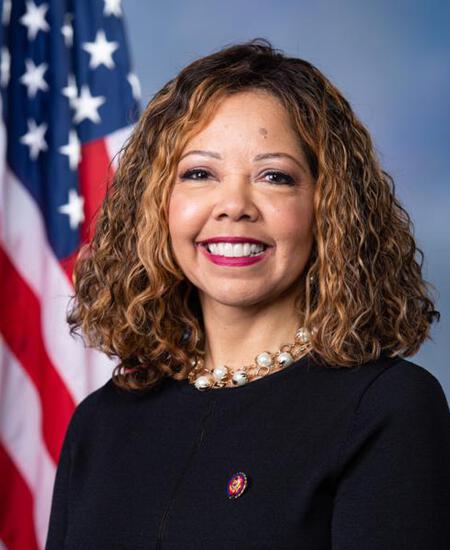
Rep. Lucy McBath
Sponsored bills
John R. Lewis Voting Rights Advancement Act of 2021 This bill establishes new criteria for determining which states and political subdivisions must obtain preclearance before changes to voting practices may take effect. Preclearance is the process of receiving preapproval from the Department of Justice (DOJ) or the U.S. District Court for the District of Columbia before making legal changes that would affect voting rights. A state and all of its political subdivisions shall be subject to preclearance of voting practice changes for a 10-year period if 15 or more voting rights violations occurred in the state during the previous 25 years; 10 or more violations occurred during the previous 25 years, at least 1 of which was committed by the state itself; or 3 or more violations occurred during the previous 25 years and the state administers the elections. A political subdivision as a separate unit shall also be subject to preclearance for a 10-year period if three or more voting rights violations occurred there during the previous 25 years. States and political subdivisions that meet certain thresholds regarding minority groups must preclear covered practices before implementation, such as changes to methods of election and redistricting. Further, states and political subdivisions must notify the public of changes to voting practices. Next, the bill authorizes DOJ to require states or political subdivisions to provide certain documents or answers to questions for enforcing voting rights. The bill also outlines factors courts must consider when hearing challenges to voting practices, such as the extent of any history of official voting discrimination in the state or political subdivision.
This resolution expresses the sense of the House of Representatives that the United States shall recognize kind actions in our country, encourage kindness, spread love, and foster a culture of being kind to one another.
Access to Infertility Treatment and Care Act This bill requires private health insurance plans to cover (1) specified infertility treatments (e.g., in vitro fertilization), if the plan also covers obstetrical services; and (2) fertility preservation services for individuals who undergo medically necessary treatment that may cause impairment of fertility. Private health insurance plans must apply cost sharing for such services that does not exceed the amount for similar services covered by the plan. Further, plans are prohibited from (1) providing incentives for plan holders to forego infertility treatment, or (2) reducing the reimbursement rate to providers of such treatments. The bill also extends infertility treatment and fertility preservation coverage to Medicaid enrollees, federal employees, members of the military, and veterans.
Fair COLA for Seniors Act This bill bases cost-of-living adjustments for certain benefits available through federal and military retirement programs, Social Security, and specified programs for veterans on a price index that tracks the spending patterns of older consumers. The Bureau of Labor Statistics of the Department of Labor must publish that price index on a monthly basis.
This resolution recognizes the 75th anniversary of the Centers for Disease Control and Prevention.
Harlem Hellfighters Congressional Gold Medal Act This bill provides for the award of a Congressional Gold Medal to the 369th Infantry Regiment, commonly known as the Harlem Hellfighters, in recognition of their bravery and outstanding service during World War I.
This resolution supports the designation of National Health Care Awareness Month.
Migratory Bird Protection Act of 2021 This bill prohibits the incidental taking (e.g., capturing or killing) of migratory birds by commercial activities unless the activity is authorized under a permit or is identified as posing de minimis risk to migratory birds. The U.S. Fish and Wildlife Service (USFWS) must regulate such incidental taking, including by (1) issuing general permits for certain industries, (2) creating a mitigation fee for any incidental taking of migratory birds, and (3) identifying categories of de minimis risk activities that are exempt from liability for the taking of migratory birds. In addition, the USFWS must establish and maintain a research program (1) to evaluate the impacts of commercial activities on birds, (2) to evaluate the effectiveness of best management practices and technologies to avoid or minimize such impacts, and (3) to develop new or improved best management practices and technologies.
School Food Modernization Act This bill provides for loan guarantees and grants to support healthy meals under the National School Lunch Program and School Breakfast Program. The bill directs the Department of Agriculture (USDA) to issue loan guarantees to local educational agencies (LEAs), school food authorities, tribal organizations, and other eligible entities to finance infrastructure improvements or equipment purchases to facilitate their provision of healthy meals through the school meal programs. USDA must also award competitive matching grants to assist LEAs, school food authorities, and tribal organizations in purchasing the durable equipment and infrastructure they need to serve healthier meals and improve food safety. USDA must give preference under both programs to applicants that demonstrate a substantial or disproportionate need for food service infrastructure or durable equipment, and shall establish fees for the loan guarantee program. In addition, USDA must award competitive matching grants to experienced third-party training institutions to provide school food service personnel with the training and technical assistance they need to (1) meet or exceed nutrition standards under the school meal programs, and (2) improve the efficacy and efficiency of the school meal programs.