Honoring Harriet Tubman Act This bill requires the Joint Committee on the Library to obtain a statue of Harriet Tubman and place the statue in a suitable permanent location in National Statuary Hall.
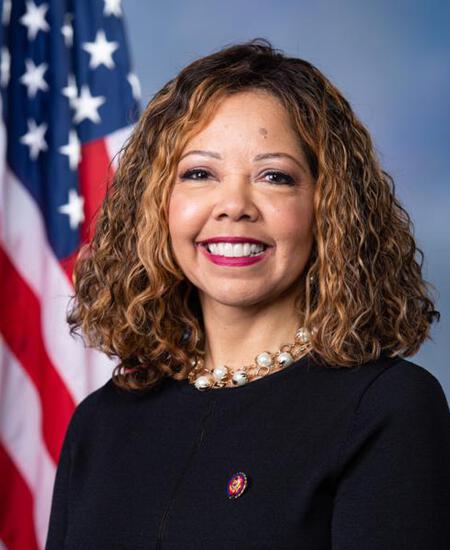
Rep. Lucy McBath
Sponsored bills
This concurrent resolution condemns violence and threats of violence against historically Black colleges and universities (HBCUs) and reaffirms the federal government's commitment to combating violence against HBCU students, faculty, and staff.
School Hunger Elimination Act of 2022 This bill revises requirements under the National School Lunch Program and the School Breakfast Program of the Department of Agriculture, including by expanding mandatory direct certification of low-income children for free or reduced-price meals.
This resolution condemns the terrorist attack on Congregation Beth Israel in Colleyville, Texas, on January 15, 2022. It also expresses support for the affected community, commends the actions of law enforcement and emergency responders, and reaffirms a commitment to combat hate, bigotry, anti-Semitism, and violence against Jewish Americans.
Job Protection Act This bill reduces from 12 months to 90 days the employment period required for employees (including federal employees) to become eligible for family and medical leave. Additionally, the bill makes the family and medical leave requirements applicable to all employers (currently, the requirements apply to employers with 50 or more employees).
Minorities in Aviation Education Act of 2022 This bill establishes grants for increasing the exposure of students who are underrepresented in aviation to that industry. The Department of Transportation must award the grants to state and local governments or educational agencies.
Women's Health Protection Act of 2021 This bill prohibits governmental restrictions on the provision of, and access to, abortion services. Specifically, governments may not limit a provider's ability to prescribe certain drugs, offer abortion services via telemedicine, or immediately provide abortion services when the provider determines a delay risks the patient's health. Furthermore, governments may not require a provider to perform unnecessary medical procedures, provide medically inaccurate information, comply with credentialing or other conditions that do not apply to providers whose services are medically comparable to abortions, or carry out all services connected to an abortion. In addition, governments may not (1) require patients to make medically unnecessary in-person visits before receiving abortion services or disclose their reasons for obtaining such services, or (2) prohibit abortion services before fetal viability or after fetal viability when a provider determines the pregnancy risks the patient's life or health. The bill also prohibits other governmental measures that are similar to the bill's specified restrictions or that otherwise single out and impede access to abortion services, unless a government demonstrates that the measure significantly advances the safety of abortion services or health of patients and cannot be achieved through less restrictive means. The Department of Justice, individuals, or providers may bring a lawsuit to enforce this bill, and states are not immune from suits for violations. The bill applies to restrictions imposed both prior and subsequent to the bill's enactment.

Original Black History Month Resolution of 2022 This resolution recognizes the importance of commemorating Black History Month to acknowledge the achievements of Black Americans throughout history.
Building Civic Bridges Act This bill establishes an office and pilot grant program within the Corporation for National and Community Service to support civic bridge building, which aims to address local issues and polarization within communities.
Maddy summaryHRES 939 is a symbolic House resolution expressing support for designating February 21-25, 2022, as "Public Schools Week." It does not create new policies, allocate funding, or impose requirements on schools or students. The resolution uses supportive language to acknowledge public education's role in democracy but has no legal effect. It was introduced by multiple representatives as a non-binding gesture of appreciation for public schools.