

Maddy summaryThe SAFES Act creates a federal tax credit for individuals who purchase gun safes, allowing them to deduct 90% of the cost, up to $500 per person or $1,000 for joint returns. For purchases made before 2030, any qualifying gun safe qualifies; after 2029, only safes meeting standards set by the Secretary of Health and Human Services (HHS) will be eligible, based on an HHS report required within five years of enactment. The bill prohibits requiring taxpayers to disclose firearm ownership details to claim the credit. This policy directly affects individual firearm owners seeking to reduce tax liability through safe storage purchases.
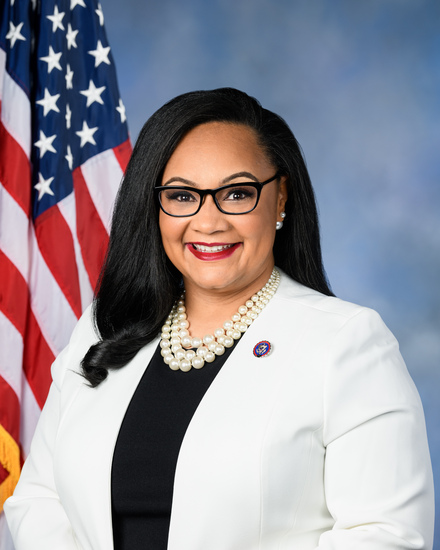
Rep. Nikema Williams
Sponsored bills
Maddy summaryThis bill bans developers and deployers of AI algorithms from using them to deceive voters about election procedures (like voting locations or registration rules) or intimidate people from voting. It requires clear disclaimers - such as "AI Disclaimer: This output was generated by artificial intelligence" - on AI-generated election content, including fake candidate videos or altered voting information. The law sets safety standards for election-related AI, requiring developers to ensure algorithms are "safe and effective" before use. The Federal Trade Commission enforces these rules, with violations potentially leading to fines or up to one year in prison.
Maddy summaryThe Texture Positive Act of 2024 provides federal grants to states to fund subgrants for eligible entities (such as minority- or women-owned businesses with 5+ years of experience) to integrate textured hair training into cosmetology school curricula. It requires these entities to offer students hands-on education in shampooing, deep conditioning, braiding, twisting, and styling naturally coiled, curly, or wavy hair, including developing training materials and hiring specialized instructors. States must report annually on participation numbers, instructor training, and cosmetology schools served. The program runs for 4 years for state grants (renewable) and 6 months for subgrants (renewable based on performance reports).
Maddy summaryThis bill amends an existing provision in the Water Resources Development Act of 1992 to increase federal funding for water infrastructure projects in East Point, Georgia, from $15 million to $20 million. It directly affects East Point by providing additional authorized funding for local water system improvements. The key mechanism is a simple funding amount adjustment within a pre-existing water infrastructure authorization. This change does not create new programs or alter eligibility but increases the maximum available federal support for East Point's water infrastructure needs.
Maddy summaryThis bill amends an existing federal water program by increasing the funding cap for Atlanta's stormwater management from $75 million to $100 million. It directly affects the City of Atlanta's water infrastructure projects under the Water Resources Development Act of 1992. The key provision is a simple monetary adjustment to authorize higher federal funding for stormwater system improvements in Atlanta.
Maddy summaryThis bill creates a federal framework for "extreme risk protection orders" (ERPOs) that temporarily remove firearms from individuals who pose a risk of harming themselves or others. Family members or law enforcement officers can petition a federal court for a temporary order (up to 14 days) based on probable cause, followed by a hearing within 72 hours to determine if a longer-term order (up to 180 days) is warranted. The bill requires clear and convincing evidence of risk at the hearing and mandates respondents to surrender firearms to law enforcement within 48 hours. It also includes provisions for reporting, training law enforcement on ERPOs, and a federal grant program to support state ERPO implementation, without preempting state laws.
Maddy summaryThis resolution expresses the U.S. House of Representatives' support for designating June 28, 2024, as "Stonewall Day" to commemorate the anniversary of the 1969 Stonewall Uprising in New York City, a pivotal event in LGBTQ+ rights history. It recognizes the significance of the uprising in sparking the modern LGBTQ+ civil rights movement and acknowledges the upcoming opening of the Stonewall National Monument Visitor Center on Christopher Street. The resolution does not create new laws or policies but formally supports the commemorative designation and the Visitor Center's role in honoring this history. It directly affects no individuals or groups, as it is a symbolic gesture of recognition. The resolution was introduced by multiple House members and referred to the Judiciary Committee.
Maddy summaryHR 8830, the High Court Gift Ban Act, sets strict limits on gifts federal judges may accept. It prohibits judges from receiving gifts valued over $50 from a single source in a year, unless the total from that source stays under $100 annually. Key exceptions include gifts paid for by the judge, gifts from relatives, honorary degrees from educational institutions, and public opportunities available to all federal employees. The bill also outlines enforcement mechanisms, requiring the Judicial Conference to refer violations to the Attorney General for civil or criminal penalties. This directly affects all federal judges, including Supreme Court justices and lower court judges, by restricting gifts from sources that may have business before them.
Maddy summaryThis resolution, introduced around World Refugee Day, expresses congressional support for U.S. efforts to protect refugees and displaced persons globally and within the United States. It highlights that over 117 million people are displaced worldwide, references the U.S. resettling 60,000 refugees in fiscal year 2024, and calls on federal agencies to maintain the Refugee Admissions Program, uphold asylum protections, and support host countries. The resolution does not create new laws but reaffirms existing commitments to refugee resettlement, safety, and integration through current programs.
Maddy summaryThe Pell Grant Preservation and Expansion Act of 2024 would double Federal Pell Grants, increasing the maximum award to $10,000 for the 2025-2026 academic year with annual inflation adjustments, and make Pell Grants a fully mandatory program rather than requiring annual appropriations. It would expand eligibility for students with negative student aid indexes (those with the lowest expected family contributions), provide Pell Grant eligibility for "Dreamer" students protected under DACA, and restore eligibility for students who previously lost it due to academic progress issues. The bill would also increase the total semesters of Pell Grant eligibility from 12 to 18. These changes would directly affect millions of undergraduate students, particularly students of color who currently rely on Pell Grants, with 3 in 5 African American students and half of Latino students depending on these grants. The bill would take effect for the 2025-2026 academic year.