

Fair Transportation Act This bill addresses the disbursement of surface transportation funding in an equitable way by federal, state, and local entities. Specifically, the Government Accountability Office (GAO) must review the extent to which states consider equity and improve equity outcomes in the use of federal surface transportation funds at all phases of project delivery, including the diverse transportation needs of economically disadvantaged and underserved populations. Additionally, the Department of Transportation (DOT) must carry out a transportation equity research program for research and demonstration activities that focus on the impacts that surface transportation planning, investment, and operations have on economically disadvantaged and underserved populations, including communities of color, low-income communities, and individuals with disabilities. The GAO must also review discretionary grant programs for surface transportation projects to determine the extent to which DOT is awarding funding through such programs to projects that serve groups or populations experiencing differential impacts in the transportation sector. Further, DOT must issue guidance on equity consideration metrics and best practices while disbursing federal funds.
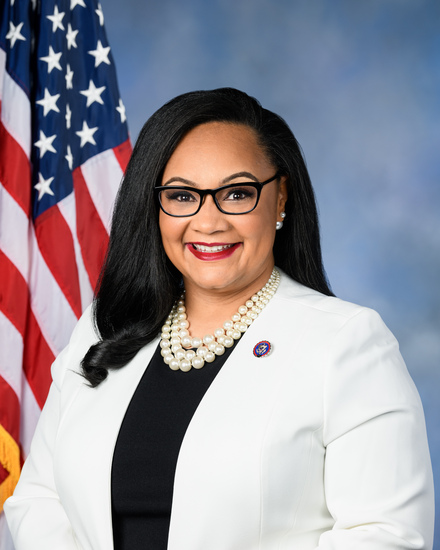
Rep. Nikema Williams
Sponsored bills
Quit Because of COVID-19 Act This bill provides for Medicaid and Children's Health Insurance Program (CHIP) coverage of certain tobacco cessation services. Specifically, the bill provides for coverage, without cost-sharing, of diagnostic, therapy, and counseling services and pharmacotherapy, including prescription and nonprescription tobacco cessation agents, that are provided under medical supervision and in accordance with specified guidelines. It also applies a 100% Federal Medical Assistance Percentage (i.e., federal matching rate) for such items and services during the public health emergency relating to COVID-19 and for two years after the emergency period ends.
Minority Diabetes Initiative Act This bill authorizes grants for diabetes-related health care services in minority communities. The Department of Health and Human Services may make these grants to public and nonprofit health care providers.
Affordable Insulin for the COVID-19 Emergency Act This bill eliminates cost-sharing under the Medicare prescription drug benefit and Medicare Advantage for insulin and associated medical supplies during the public health emergency relating to COVID-19 (i.e., coronavirus disease 2019). The bill also allows beneficiaries to receive their insulin and supplies via mail order during the emergency period.
This resolution recognizes the disparity between wages paid to men and women, and its impact on women, families, and the nation and reaffirms Congress' commitment to supporting equal pay and to narrowing the gender wage gap.
This resolution expresses congressional disapproval of the rule submitted by the Equal Employment Opportunity Commission (EEOC) that revises the EEOC settlement process to provide employers with the factual and legal basis that the EEOC relied on to make a reasonable cause finding of a discriminatory practice.
This joint resolution eliminates the deadline for the ratification of the Equal Rights Amendment, which prohibits discrimination based on sex. The amendment was proposed to the states in House Joint Resolution 208 of the 92nd Congress, as agreed to in the Senate on March 22, 1972. The amendment shall be part of the Constitution whenever ratified by the legislatures of three-fourths of the states.
Neighborhood Homes Investment Act This bill establishes a new business-related tax credit to finance home building and rehabilitation in neighborhoods that meet certain eligibility criteria relating to poverty rates, income, and home values. The credit is limited to 35% of the lesser of the qualified development cost (i.e., the cost of construction, substantial rehabilitation, demolition, and environmental remediation of residential properties) or 80% of the national median sale price for new homes. The credit applies to single family homes containing four or fewer residential units, condominiums, or houses or apartments owned by cooperative housing corporations.
Safe Step Act This bill requires a group health plan to establish an exception to medication step-therapy protocol in specified cases. A medication step-therapy protocol establishes a specific sequence in which prescription drugs are covered by a group health plan or a health insurance issuer. A request for such an exception to the protocol must be granted if (1) an otherwise required treatment has been ineffective, (2) such treatment is expected to be ineffective and delaying effective treatment would lead to irreversible consequences, (3) such treatment will cause or is likely to cause an adverse reaction to the individual, (4) such treatment is expected to prevent the individual from performing daily activities or occupational responsibilities, (5) the individual is stable based on the prescription drugs already selected, or (6) there are other circumstances as determined by the Employee Benefits Security Administration. The bill requires a group health plan to implement and make readily available a clear process for an individual to request an exception to the protocol, including required information and criteria for granting an exception. The bill further specifies timelines under which plans must respond to such requests.
Housing Supply and Affordability Act This bill allows the Department of Housing and Urban Development to award grants to states, local governments, Indian tribes, and Native Hawaiian organizations for the development and implementation of housing policy plans. These plans must increase the housing supply while avoiding resident displacement, increase housing affordability, and reduce barriers to housing development. The amounts provided by the bill are designated as an emergency requirement pursuant to the Statutory Pay-As-You-Go Act of 2010 (PAYGO) and the Senate PAYGO rule. (This excludes the budget effects from being counted for the purposes of enforcing the PAYGO rules.)