

America's Clean Future Fund Act This bill establishes requirements and incentives to reduce greenhouse gas emissions and assist industries, communities, and workers transition to a low-carbon economy, including by establishing (1) the Climate Change Finance Corporation (C2FC); (2) the America's Clean Future Fund; and (3) a carbon fee on the use, sale, or transfer of certain fuels by covered entities. The bill provides appropriations to the C2FC, an independent agency, which must finance clean energy and climate change resiliency activities in order to meet the goal of eliminating greenhouse gas emissions by 2050. The bill also provides appropriations for the America's Clean Future Fund. Amounts in the fund may be used for the C2FC, stimulus payments (i.e., tax rebates) to individuals whose gross incomes do not exceed specified thresholds, decarbonization transition payments to the agricultural sector, and grants to help certain communities and workers transition to a low-carbon economy. Revenues generated from the carbon fee must also be deposited into the America's Clean Future Fund. Beginning in 2023, covered entities (e.g., entities that use, sell, or transfer fossil fuels) must pay a carbon fee of $25 per metric ton of carbon dioxide or carbon dioxide equivalent. The fee increases by $10 each year, multiplied by the cost-of-living adjustment. The fees further increase if the entities miss cumulative greenhouse gas emission targets established by the bill. Refund payments may be provided for carbon capture, sequestration, and utilization.
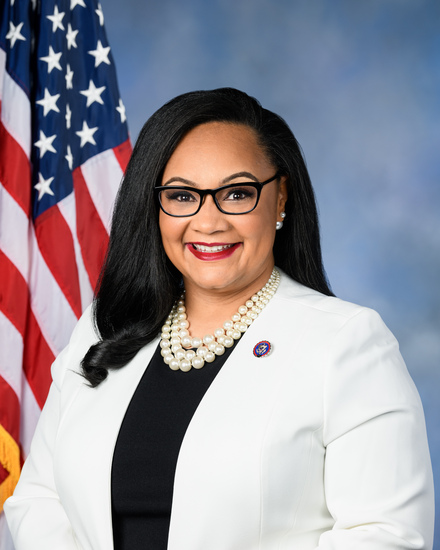
Rep. Nikema Williams
Sponsored bills
This resolution recognizes the Islamic faith as one of the great religions of the world, acknowledges the onset of Ramadan (the holy month of fasting and spiritual renewal for Muslims), and expresses respect to Muslims in the United States and throughout the world on this occasion.
This resolution expresses support for the designation of Welcome Home Vietnam Veterans Day. It also honors and recognizes the contributions of veterans who served in Vietnam.
Taxpayer Research and Coronavirus Knowledge Act of 2021 This bill requires the Department of Health and Human Services (HHS) to coordinate with specified federal entities to compile a public database of federal contracts, tax benefits, and other support for COVID-19 (i.e., coronavirus disease 2019) biomedical research and development. HHS must develop the database within one month and update it every two weeks.
Supporting Eating Disorders Recovery Through Vital Expansion Act or the SERVE Act This bill provides for inpatient and outpatient treatment of eating disorders under TRICARE for dependents of members of the uniformed services. Dependents are eligible for such care regardless of (1) their age, except with respect to residential service; and (2) whether the eating disorder is their primary or secondary diagnosis. The bill also requires the Department of Defense (DOD) and the Department of Homeland Security (with respect to the Coast Guard) to identify, treat, and rehabilitate members of the armed forces who have an eating disorder. Finally, DOD and the Department of Veterans Affairs must jointly develop, publish, and disseminate clinical practice criteria and guidelines on the identification and treatment of eating disorders.
Stay in Line To Vote Act This bill prohibits states from restricting the provision of food or drink to individuals who are at a polling place to cast their ballots in a federal election.
Providing Responsible Emergency Plans for Animals at Risk of E merging Disasters Act or the PREPARED Act This bill establishes requirements governing the care of animals by entities, such as zoos, in emergencies or disasters. Specifically, the bill requires each research facility, dealer, exhibitor, intermediate handler, and carrier to develop and follow a contingency plan to provide for the humane handling, treatment, transportation, housing, and care of their animals in the event of an emergency or disaster.
This resolution recognizes Nowruz (the Iranian New Year) and expresses support for Iranian Americans.
This resolution condemns Iranian state-sponsored terrorist attacks against U.S. citizens and officials and Iranian dissidents and expresses support for the people of Iran who are engaged in legitimate and peaceful protests against the Iranian regime.
HIV Epidemic Loan-Repayment Program Act of 2021 or the HELP Act of 2021 This bill directs the Health Resources and Services Administration (HRSA) to carry out a loan repayment program for certain health care providers who agree to provide HIV treatment or HIV dental care in (1) a designated health professional shortage area, (2) a clinical site that is funded under the Ryan White HIV/AIDS Program, or (3) an area that meets requirements specified by HRSA. For each qualifying year of service, HRSA pays one-fifth of the principal and interest on any eligible loan, with total loan repayment after five years; repayment is capped at $250,000 per borrower.