Gold Star Children Act This bill broadens the categories of individuals eligible for veterans' preference in the civil service. Specifically, it makes children of certain permanently disabled or deceased veterans eligible for veterans' preference treatment in the federal civil service.
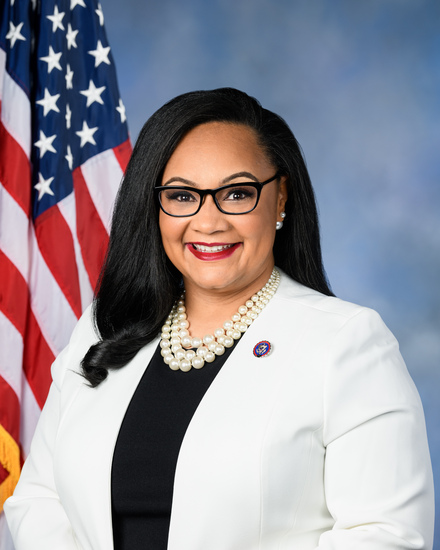
Rep. Nikema Williams
Sponsored bills
Air America Act of 2021 This bill establishes the service of Air America employees as qualifying service for purposes of the Civil Service Retirement System. (Air America was a government-owned airline that provided air transport for certain covert operations in Southeast Asia, including Laos and Vietnam, between 1950 and 1976.) The bill applies to U.S. citizens who were employees of Air America or another affiliated company, as specified, between January 1, 1950 and December 31, 1976. Benefit applications must be filed within two years of the date of enactment of this bill.
Dentist and Optometric Care Access Act of 2021 or the DOC Access Act of 20 21 This bill prohibits private health insurance plans from setting rates for items and services, except for dental cleanings, provided by a doctor of optometry, of dental surgery, or of dental medicine for which the plan does not pay a substantial amount. Additionally, an agreement between a plan and such a doctor for limited scope dental or vision benefits may last longer than two years only with the prior acceptance of the doctor for each term extension. Plans also may not restrict such a doctor's choice of laboratories or suppliers. Such doctors may elect to waive the application of the payment amount and choice of laboratories provisions of this bill. The bill establishes a private right of action for a person adversely affected by a violation of this bill. The bill does not supersede state laws regarding health insurers and dental or vision benefit plans.
This resolution acknowledges the safety and efficacy of COVID-19 (i.e., coronavirus disease 2019) vaccines and encourages all eligible individuals to receive a vaccination.
Civics Learning Act of 2021 This bill expands the use of American History and Civics Education—National Activities grants to prioritize innovative civics learning and teaching. Specifically, the bill expands the allowable uses of these grants to include before-, during-, and after-school activities and extracurricular activities; activities that include service learning and community service projects that are linked to school curriculum; activities that encourage and support student participation in school governance; and online and video game-based learning. Further, the Department of Education must ensure that specified percentages of grant funds are awarded on a diverse basis to eligible entities (e.g., institutions of higher education) that serve students and teachers at elementary schools, middle schools, and high schools.
Opportunity To Address College Hunger Act This bill requires institutions of higher education (IHEs) that receive grants to operate work-study programs to notify a student receiving work-study assistance that the student may be eligible for participation in the Supplemental Nutrition Assistance Program (SNAP). The Department of Education must provide guidance to states and IHEs on how to identify and communicate with students who are potentially eligible for SNAP.
This resolution condemns the acts of gun violence that led to the tragic loss of eight lives in Georgia on March 16, 2021.
Real Education and Access for Healthy Youth Act of 2021 This bill requires the Department of Health and Human Services (HHS) to establish grants to support sex education and sexual health services for young people (ages 10 through 29) and repeals requirements that apply to certain federally funded sex education programs. HHS must award grants, in coordination with the Department of Education, to (1) provide sex education to young people through elementary and secondary schools, institutions of higher education, and youth-serving organizations; and (2) train education professionals to effectively teach, and otherwise support, sex education. Sex education refers to high quality teaching and learning that follows, to the maximum extent practicable, specified educational standards; covers a variety of topics concerning sex and sexuality; explores values and beliefs about those topics; and helps young people gain skills to navigate relationships and manage sexual health. Additionally, HHS must award grants for the provision of sexual health services to marginalized youth to youth-serving organizations and health care entities that are eligible to receive covered outpatient drugs at reduced prices through the 340B drug discount program. Recipients of any of these grants must comply with certain nondiscrimination requirements. In addition, they may not use funds for sex education programs or sexual health services that provide incomplete or inaccurate medical information or fail to address specified issues. The bill also eliminates prohibitions regarding the content of specified federally funded sexual health education and information programs and repeals the Abstinence Only Until Marriage program.

MSI STEM Achievement Act (Sec. 4) This bill supports efforts to increase science, technology, engineering, and mathematics (STEM) education at minority-serving institutions of higher education (IHEs), including Historically Black Colleges and Universities and Tribal Colleges or Universities. The bill requires the National Science Foundation to award grants for purposes including building the capacity of such IHEs to increase the number and success of their students in the STEM workforce. (Sec. 5) The Office of Science and Technology Policy (OSTP) shall develop a uniform set of policy guidelines for federal science agencies to carry out a program of outreach activities to increase clarity, transparency, and accountability for federal science agency investments in STEM education and research activities at minority-serving IHEs. The OSTP shall submit to Congress a report containing a strategic plan for each federal science agency to increase the capacity of minority-serving IHEs to compete for grants, contracts, or cooperative agreements and to encourage such IHEs to participate in federal programs.
Financial Inclusion in Banking Act of 2021 This bill expands the duties of the Office of Community Affairs within the Consumer Financial Protection Bureau regarding under-banked, un-banked, and underserved consumers. Specifically, the office must (1) report on impeding factors for individuals and families that do not participate in the banking system, and (2) develop strategies to increase such participation. The bill also decreases, beginning September 30, 2031, the cap on the surplus funds of the Federal Reserve banks. (Amounts exceeding this cap are deposited in the general fund of the Treasury.)