This resolution reaffirms the House of Representatives' commitment to media diversity and expresses its pledge to eliminate barriers to such diversity.
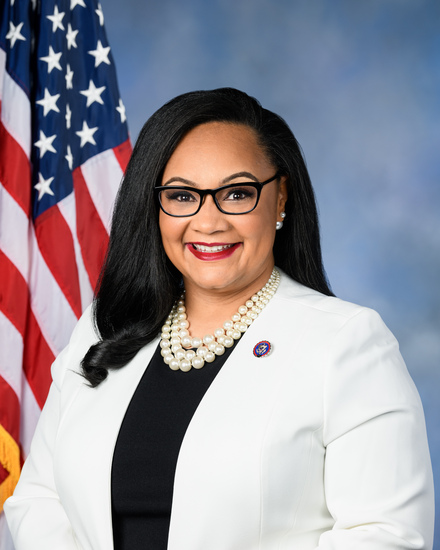
Rep. Nikema Williams
Sponsored bills
Generating Resilient, Environmentally Exceptional National Streets Act or the GREEN Streets Act This bill establishes national goals to reduce carbon dioxide and other greenhouse gas emissions and improve the resilience of the transportation system. Specifically, the bill directs the Department of Transportation (DOT) to establish minimum standards for states to decrease greenhouse gas emissions and per capita vehicle miles traveled (VMTs) on the National Highway System; DOT to establish measures for states to assess and reduce carbon dioxide; states and metropolitan planning organizations (MPOs) to consider projects and strategies that reduce carbon dioxide and other greenhouse gas emissions and decrease per capita VMT's; states and MPOs to publish an analysis of the impact on per capita VMTs and mobile source greenhouse gas emissions for each project that adds new lanes or otherwise increases traffic capacity and costs more than $25 million; states that are out of compliance with the per capita VMT standards or carbon dioxide or greenhouse gas emission measures to dedicate federal highway funding to achieve compliance; and DOT to establish national transit access standards and performance measures for transit accessibility, transit stop distance, and transit mode share.
Comprehensive Paid Leave for Federal Employees Act This bill provides paid family and medical leave to federal employees. Currently, federal employees are entitled to 12 weeks of administrative leave for one or more of the following reasons: (1) the birth of a child, (2) the adoption or foster care of a child, (3) the care of an immediate family member with a serious health condition, (4) inability to work due to a serious health condition, and (5) exigencies relating to an immediate family member's active duty service in the Armed Forces. However, of these reasons, employees are entitled to paid administrative leave only in connection with the birth, adoption, or foster care of a child (i.e., parental leave). The bill provides 12 weeks of paid administrative leave for any of these reasons, and specifies that this leave is in addition to any annual or sick leave to which employees are entitled.
End Double Taxation of Successful Consumer Claims Act This bill allows a deduction from gross income (above-the-line deduction) for attorney fees and court costs in connection with a claim of a consumer protection violation.
Green New Deal for Public Schools Act of 2021 This bill provides environmental and educational resources to public elementary and secondary schools and Bureau of Indian Education (BIE) schools. Specifically, the bill requires the Department of Energy's (DOE's) Office of Energy Efficiency and Renewable Energy to provide climate capital facilities grants to eligible entities (e.g., public schools and BIE schools). Grant recipients must use these funds to construct new, or convert existing facilities into, healthy zero-carbon schools. Healthy zero-carbon school refers to a school with highly energy-efficient facilities that produce or procure sufficient carbon-free and pollution-free renewable energy to meet the school's needs. Next, the bill directs the Department of Education (ED) to award resource block grants to qualified local educational agencies (LEAs) to hire and retain educators and support staff in high-need schools. ED must award grants to eligible consortia of LEAs for educational equity planning and implementation. In addition, ED must establish the Climate Change Resiliency Program to increase the resiliency of public and BIE schools during climate change-related events, natural disasters, and public health crises. Further, ED must establish a related grant program for state educational agencies. Grant recipients must use these funds for certain activities (e.g., green infrastructure projects). The bill establishes the Office of Sustainable Schools within ED to (1) administer the resource block grant and educational equity grant programs, and (2) coordinate with DOE and the White House Office of Domestic Climate Policy on climate capital facilities grants and the Climate Change Resiliency Program.
Social Determinants Accelerator Act of 2021 This bill establishes the Social Determinants Accelerator Interagency Council to increase coordination among health and social service programs and provide technical assistance to increase the impact of such programs. The council must also assist the Centers for Medicare & Medicaid Services to award up to 25 grants to state, local, or tribal health or human services agencies for social determinants accelerator plans. These plans must address at least one health and one social outcome for a specified target population.
Protecting Seniors Through Immunization Act of 2021 This bill specifies that certain deductible, coinsurance, initial coverage limit, and cost-sharing requirements that apply under the Medicare prescription drug benefit shall not apply with respect to vaccines that are recommended by the Advisory Committee on Immunization Practices of the Centers for Disease Control and Prevention. The Centers for Medicare & Medicaid Services must provide to Medicare beneficiaries specified information regarding (1) coverage of vaccines for seniors, and (2) access to recommended vaccines without cost-sharing.
Data to Save Moms Act This bill expands data collection and research on maternal morbidity and mortality among minority populations. Specifically, the bill adds requirements to a program within the Centers for Disease Control and Prevention (CDC) that supports maternal mortality review committees. To the extent practicable, the committees must use the most up-to-date indicators of severe maternal morbidity; review deaths caused by suicide, overdose, or other behavioral health conditions attributed to or aggravated by pregnancy or childbirth; and consult with representatives of communities about nonclinical factors that may contribute to adverse maternal outcomes. The CDC may also award grants to committees to increase their engagement with local communities, such as by bringing on community representatives as committee members. Additionally, the Centers for Medicare & Medicaid Services and the Agency for Healthcare Research and Quality must consult with diverse stakeholders to review maternal health data collection processes and quality measures and make recommendations to improve them. The Indian Health Service and the Department of Health and Human Services must also arrange for studies on adverse maternal health outcomes among tribal and minority populations, respectively.
Semiquincentennial Commemorative Coin Act This bill directs the Department of the Treasury to mint and issue $25.00 gold coins, $2.50 silver coins, 25 cent clad coins, and proof silver $2.50 coins in commemoration of the 250th anniversary of the establishment of the United States. The designs of the coins shall be emblematic of the semiquincentennial anniversary of the establishment of the United States of America and celebrate 250 years of our nation. On each coin there shall be a designation of the value of the coin; an inscription of the years 1776-2026; and inscriptions of the words Liberty , In God We Trust , United States of America , and E Pluribus Unum . Treasury may issue coins under this bill only during the period beginning on January 1, 2026, and ending on December 31, 2026. All sales of coins issued shall include a surcharge as prescribed by this bill. All surcharges received by Treasury from the sale of such coins shall be paid to the America 250 Foundation to fund the restoration, rehabilitation, and interpretation of units of the U.S. National Park System and its related areas, as a legacy of the semiquincentennial commemoration.

This resolution expresses support for the designation of Journeyman Lineworkers Recognition Day. (A journeyman lineworker is a person who builds and maintains electrical power systems.)