

LGBTQ I+ Data Inclusion Act This bill addresses federal data collection of voluntary, self-disclosed information on sexual orientation, gender identity, and variations in sex characteristics. Specifically, the bill requires federal agencies that collect information through a survey for statistical purposes that includes demographic data (where subjects self-report information or a proxy provides information about the subject or responds for all persons in a household) to review existing data sets to determine which data sets do not include information about sexual orientation, gender identity, and variations in sex characteristics. Such agencies must assess needed changes in survey methods related to asking questions on such matters. Agencies that publish reports relying on survey demographic data must include information on sexual orientation, gender identity, and variations in sex characteristics. Agencies may waive this publication requirement on a case-by-case basis if the confidentiality of the information cannot be maintained or if adding such information to the survey would impair the agency's ability to preserve the utility, accuracy, or objectivity of the survey while also generating relevant evidence about the LGBTQI+ community. The Government Accountability Office must report to Congress on the implementation of this bill's requirements by agencies.
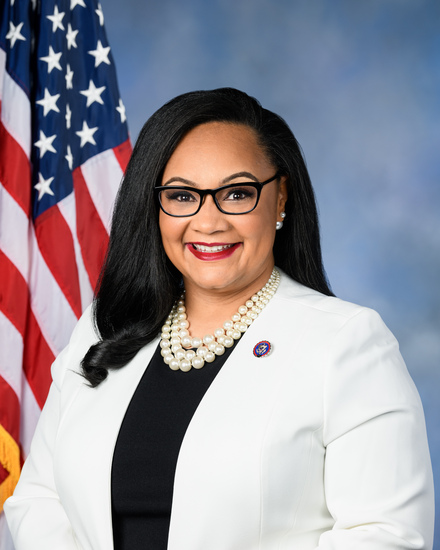
Rep. Nikema Williams
Sponsored bills
This resolution expresses support for the designation of Journeyman Lineworkers Recognition Day. (A journeyman lineworker is a person who builds and maintains electrical power systems.)
Military Housing Affordability Act of 2022 This bill extends certain authorities of the Department of Defense (DOD) to adjust basic housing allowances for military housing in certain areas. Specifically, the bill extends to December 31, 2024, DOD's authority to increase the rates of basic housing allowance in areas of a declared major disaster or areas containing one or more military installations that are experiencing a sudden increase in the number of members assigned to the installation. The bill also extends to September 30, 2024, DOD's authority to prescribe a temporary adjustment to basic housing allowance rates if DOD determines the costs of adequate housing for civilians in that military housing area differs from the current allowance rates by more than 20%.
Health Equity and Accountability Act of 2022 This bill directs the Department of Health and Human Services (HHS) and others to undertake efforts to reduce health disparities. For example, the bill (1) requires more detailed reporting of demographic and health disparities data, including related to public health emergencies; (2) directs certain components of HHS to support health workforce diversity; and (3) increases access to culturally and linguistically appropriate health care. The bill also modifies eligibility and other requirements for Medicare, Medicaid, private health insurance, nutrition assistance, and other programs to reduce health disparities among vulnerable populations. The bill includes specific provisions with respect to noncitizens; maternal, infant, and child health; mental and behavioral health; specified conditions that disproportionately affect racial and ethnic minority groups, such as certain cancers, HIV/AIDS, kidney disease, and diabetes; investments in communities facing health and other inequities; and nondiscrimination in the provision of services in federally supported health programs. Additionally, the bill (1) revises health information technology programs to address health disparities, and (2) supports health impact assessments and other efforts pertaining to environmental justice and social determinants of health (i.e., nonmedical factors that influence health outcomes, such as income and educational attainment). The bill also requires various studies and reports on issues related to health care and health disparities, including a report by the Government Accountability Office on health workforce diversity.
This resolution affirms the leadership and commitment of the U.S. government in efforts to prevent conflict-related sexual violence and to support and protect survivors of such violence. The resolution calls on the United States to ensure mechanisms to hold perpetrators of sexual violence accountable are included in peacebuilding resolutions, and that women participate fully in such peace processes in accordance with the Women, Peace, and Security Act of 2017.
This resolution calls on the Russian government to immediately release Brittney Griner. The resolution urges the United States, in all interactions with the Russian government, to raise the case of Brittney Griner and to press for her release. The resolution further urges the Russian government to provide consular access to Brittney Griner while she remains in detention and to respect her human rights. Finally, the resolution expresses support to the family of Brittney Griner and a commitment to bringing her home.
Telemental Health Parity Act of 2022 This bill requires private health insurance plans to apply benefits for mental health or substance use disorder services that are furnished via telehealth in the same manner as those services that are furnished in person. Under current mental health parity rules, insurance plans that provide benefits for mental health or substance use disorder services are generally required to make those benefits comparable to the benefits the plan provides for medical and surgical care.
Stop Anti-Abortion Disinformation Act or the SAD Act This bill prohibits advertisements that use deceptive or misleading statements related to the provision of abortion services. Abortion services include (1) surgical and non-surgical procedures to terminate a pregnancy, or (2) providing referrals for such procedures. The Federal Trade Commission must promulgate rules to implement the prohibition, and the bill provides for enforcement by the commission.
My Body, My Data Act of 2022 This bill establishes protections, subject to certain limits, for personal reproductive or sexual health information. This includes information relating to past, present, or future surgeries or procedures, such as the termination of a pregnancy. Specifically, commercial entities, including individuals, nonprofits, and common carriers, may not collect, retain, use, or disclose personal reproductive or sexual health information except (1) with the express written consent of the individual to whom such information relates, or (2) as is strictly necessary to provide a requested product or service. Commercial entities also must provide individuals with access to, and a reasonable mechanism to delete, any of their reproductive or sexual health information upon request. Further, commercial entities must maintain and publish a privacy policy describing their practices with respect to such information. The bill's provisions do not apply to entities that are subject to certain existing health-related privacy regulations, such as the privacy regulations issued under the Health Insurance Portability and Accountability Act of 1996. Additionally, the provisions do not apply to the disclosure of personal reproductive or sexual health information for the publication of newsworthy information of legitimate public concern. The bill provides for enforcement by the Federal Trade Commission and by private civil actions.
Advanced Research Project s Agency-Health Act or the ARPA-H Act This bill establishes within the Department of Health and Human Services (HHS) the Advanced Research Projects Agency-Health to accelerate health and medical innovation by investing in high-risk, high-reward research. The bill also establishes a committee to advise on agency activities. HHS must transfer all authorities, functions, funds, and personnel from a similar entity within the National Institutes of Health to a new, independent agency. Additionally, the President must appoint a director to lead the agency. The director may submit testimony and recommendations concerning the agency to Congress without review or approval by other federal officers or agencies. The director must appoint personnel to administer the agency's research programs, including by selecting projects to support and making recommendations about terminating or continuing projects. The agency may use grants, prize competitions, and a variety of other mechanisms to support the research projects. The agency's budget is separate from that of HHS. The agency must coordinate with the Food and Drug Administration and the Centers for Medicare & Medicaid Services to expedite development and coverage of high-need cures. Additionally, the agency may partner with other public and private entities (e.g., institutions of higher education and patient advocacy organizations). The bill also requires the agency to develop and periodically update a strategic plan and annually report on its activities. Furthermore, (1) the National Academies of Sciences, Engineering, and Medicine must evaluate the agency's performance; and (2) the Government Accountability Office must review the research portfolio of HHS and its components, including the new agency.