

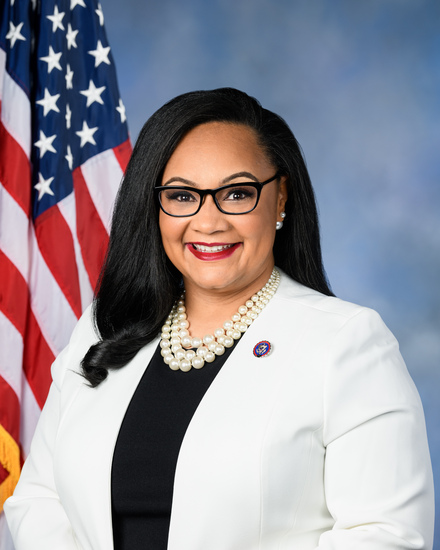
Photo of Nikema Williams
D United States House · District 5 · Georgia On the 2026 ballot

Rep. Nikema Williams

Compare
Total votes
2,837
all sessions
Attendance
99%
32 missed
Near the chamber average
With party
97%
of cast votes
Near the chamber average
Bipartisan score
1%
crosses aisle rarely
Near the chamber average
Sponsored
2,182
bills & resolutions
Higher than 85% of chamber peers
Committees
3
assignments
2,182 bills and resolutions

Sponsored bills

Total
2,182
Primary
162
Co-sponsor
2,020
This page
2,182
matching current filters
Primary HR 973
In committee · United States House · Lead sponsor
Thomas W. Dortch, Jr. Congressional Gold Medal Act

Thomas W. Dortch, Jr. Congressional Gold Medal Act This bill provides for the award of a Congressional Gold Medal to Thomas W. Dortch, Jr., in recognition of his contributions in helping marginalized people, communities, and institutions.

In committee Feb 9, 2023 0 co-sponsors
Co-sponsor HR 927
In committee · United States House · Co-sponsor
Supreme Court Ethics Act.

Maddy summaryHR 927, the Supreme Court Ethics Act, establishes new ethics rules and oversight for Supreme Court justices. It requires the Judicial Conference to create a binding code of conduct within one year and mandates the appointment of an Ethics Investigations Counsel to receive public complaints, investigate potential violations, and issue annual public reports. The bill also requires justices to publicly disclose their reasons for recusing themselves or denying recusal motions in cases. These provisions directly affect Supreme Court justices by creating a formal process for handling ethics concerns and increasing transparency around their conduct.

In committee Feb 9, 2023 1 co-sponsor
Co-sponsor HR 953
In committee · United States House · Co-sponsor
Child Care for Every Community Act

Maddy summaryThe Child Care for Every Community Act establishes a federal program to provide universal, high-quality child care and early learning services for all young children not yet required to attend school. It provides 90% federal funding for most programs (100% for migrant/seasonal farmworkers and Native American children) with a sliding fee scale based on family income (maximum 7% of income). The bill requires states, tribes, and localities to develop comprehensive plans ensuring services are accessible, culturally appropriate, and meet national quality standards. It specifically focuses on serving low-income children, children with disabilities, dual language learners, homeless children, and children in foster care. The program emphasizes coordination with schools and other community services to support children's development and school readiness.

In committee Feb 9, 2023 1 co-sponsor
Co-sponsor HR 926
In committee · United States House · Co-sponsor
Supreme Court Ethics, Recusal, and Transparency Act of 2023

Maddy summaryHR 926 would require the Supreme Court to establish a code of conduct for justices within 180 days of enactment, along with procedures for handling ethics complaints against them. The bill mandates minimum disclosure standards for gifts, income, and reimbursements received by justices and their law clerks, and requires justices to recuse themselves when they or their family received gifts from parties in a case. It would also require parties and amici curiae to disclose gifts given to justices and lobbying contacts related to justices' nominations, and establish a judicial investigation panel to review complaints against justices. The legislation aims to increase transparency in Supreme Court ethics processes and provide clearer recusal standards for justices.

In committee Feb 9, 2023 1 co-sponsor
Co-sponsor HR 884
In committee · United States House · Co-sponsor
No Tax Breaks for Outsourcing Act

Maddy summaryThis bill makes significant changes to US corporate tax rules to prevent tax avoidance through foreign operations. It requires corporations to calculate foreign income tax liabilities country-by-country, limits interest deductions for large international financial reporting groups, and modifies rules for "inverted corporations" (where US companies move tax residence abroad). The bill also creates new rules treating foreign corporations managed primarily in the US as domestic corporations for tax purposes. These changes aim to close tax loopholes related to outsourcing and foreign tax planning.

In committee Feb 9, 2023 1 co-sponsor
Co-sponsor HR 908
In committee · United States House · Co-sponsor
Presidential Tax Transparency Act

Presidential Tax Transparency Act This bill requires the President, the Vice President, and certain candidates for President and Vice President to disclose federal income tax returns for the ten most recent taxable years. The returns must be disclosed to the Federal Election Commission (FEC), which must make the returns publicly available after redacting information that is necessary for protecting against identity theft, such as Social Security numbers. If the tax returns are not disclosed to the FEC as required by this bill, the Internal Revenue Service must provide the returns to the FEC upon receiving a written request from the FEC.

In committee Feb 9, 2023 1 co-sponsor
Co-sponsor HR 882
In committee · United States House · Co-sponsor
American Teacher Act

Maddy summaryHR 882, the American Teacher Act, requires states to ensure full-time teachers in public elementary and secondary schools earn at least $60,000 annually (adjusted for inflation), with part-time teachers receiving proportional pay. It provides federal grants to states to fund these salary increases, mandating sustainability plans beyond the 4-year grant period and prioritizing schools in high-poverty areas. The bill also includes cost-of-living adjustments tied to the Consumer Price Index and funds a national campaign to promote teaching as a career. It explicitly states grant funds must supplement existing education budgets without reducing current teacher pay or state loan forgiveness programs.

In committee Feb 8, 2023 1 co-sponsor
Co-sponsor HR 856
In committee · United States House · Co-sponsor
Comprehensive Paid Leave for Federal Employees Act

Maddy summaryThis bill expands paid family and medical leave for federal employees by increasing total entitlement from 12 to 26 weeks annually. It modifies existing laws to cover all federal workers (including those at the GAO, USPS, Library of Congress, and congressional staff), replacing "parental leave" with broader "family and medical leave" and adding 14 additional weeks for qualifying events like childbirth, adoption, or serious health conditions. Employees who already used paid leave under other programs will have their new entitlement reduced by the days already taken. The changes apply immediately to most federal employees, with specific timelines for agencies like the Veterans Affairs Department and District of Columbia courts.

In committee Feb 7, 2023 1 co-sponsor
Co-sponsor HR 547
In committee · United States House · Co-sponsor
Better Care Better Jobs Act

Maddy summaryThe Better Care Better Jobs Act (HR 547) aims to improve access to home and community-based services (HCBS) for Medicaid beneficiaries by providing states with planning grants and enhanced federal funding. States that develop approved HCBS infrastructure improvement plans will receive a 10 percentage point increase in federal Medicaid funding for HCBS services, with additional incentives for self-directed care programs. The bill requires states to address barriers to access, expand workforce development, improve payment rates for direct care workers, and track demographic data on service utilization. It also establishes quality measurement requirements and mandates regular reporting on progress toward improving HCBS access and quality.

In committee Feb 3, 2023 1 co-sponsor
Co-sponsor HR 770
In committee · United States House · Co-sponsor
ESP Family Leave Act

Maddy summaryHR 770, the ESP Family Leave Act, amends the Family and Medical Leave Act (FMLA) to create specific eligibility rules for education support professionals and school support staff in public schools and public higher education institutions. It changes the standard FMLA work-hour requirement (1,250 hours) to a new threshold: these workers qualify if they've worked at least 60% of their expected monthly hours for the previous school year. Employers must maintain records of each employee's expected monthly hours, and the bill defines "education support professionals" to include roles like paraeducators, secretaries, custodians, food service workers, security staff, and health support staff. The bill directly affects these support staff members, making it easier for them to qualify for FMLA leave under the revised hours calculation.

In committee Feb 2, 2023 1 co-sponsor
Showing 1,251 to 1,260 of 2,182 bills