

Maddy summaryHRES 439 is a non-binding resolution expressing the House of Representatives' support for keeping the U.S. Postal Service (USPS) as an independent federal agency, not subject to privatization. It highlights USPS's constitutional role, self-sustaining nature (relying on service revenue, not taxpayer funds), and its importance to rural communities, e-commerce, and over 600,000 employees. The resolution urges Congress to take action to preserve USPS's independence, emphasizing that privatization could raise prices, reduce services, and harm the nation's mail infrastructure. As a procedural resolution, it does not change law but formally states the House's position.
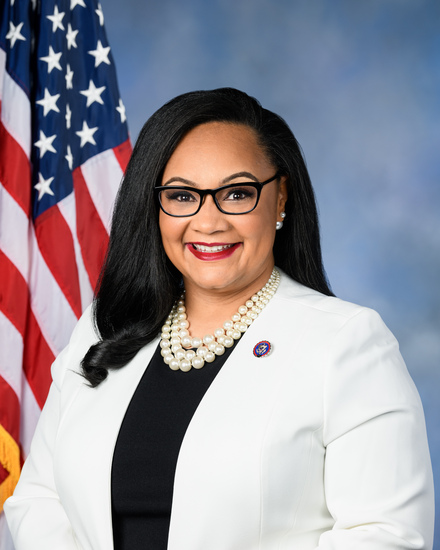
Rep. Nikema Williams
Sponsored bills
Maddy summaryThe AIR PUMP Act requires airlines to provide nursing crew members (like flight attendants and pilots) with reasonable break time to express breast milk for up to one year after their child's birth, as well as a private, non-bathroom space for this purpose. It specifically excludes breaks during critical flight phases and ensures accommodations won't compromise safety, security, or require significant costs (e.g., aircraft modifications). The bill includes anti-retaliation protections for employees who request accommodations or file complaints, and enforces these requirements through the Department of Labor using existing Fair Labor Standards Act mechanisms. This directly affects airline employees who are nursing parents and their employers, aligning airline workplace policies with federal breastfeeding protections.
This resolution encourages the U.S. Holocaust Memorial Museum to continue its work in educating the public about the dangers of antisemitism and the origins of the Holocaust, congratulates those responsible for the creation of the museum, condemns antisemitism, supports educational and community-based programs that counter antisemitism and hate, and supports the designation of a U.S. Holocaust Memorial Museum Day.
Maddy summaryHRES 425 is a non-binding House resolution designating July 19, 2023, as "Glioblastoma Awareness Day" to increase public recognition of glioblastoma, an aggressive brain cancer. It directly supports patients, caregivers, and families affected by the disease, which has a low 5-year survival rate (6.9%) and no effective screening methods. The resolution encourages greater public awareness, honors those impacted by the disease, and urges continued research investments, including through the Glioblastoma Therapeutics Network. It does not create new laws or alter funding but serves as a symbolic statement to advance understanding and support for glioblastoma research.
This resolution expresses support for the designation of DIPG Awareness Day. DIPG is diffuse intrinsic pontine glioma, a terminal childhood brain cancer.
This resolution supports the goals and ideals of National Honor Our LGBT Elders Day to increase awareness of health disparities and other challenges facing lesbian, gay, bisexual, and transgender (LGBT) elders.
Maddy summaryThe Kids Fly Safe Act (HR 3551) requires the Federal Aviation Administration (FAA) to conduct a study on child safety during air travel, collaborating with health, safety, and transportation agencies. The study will examine specific issues like age-appropriate safety seats, evacuation procedures for children, protection of strollers and child equipment in cargo, accessibility of airport facilities (such as diaper-changing stations), and airport safety measures for children. The FAA must submit a report with findings and recommendations to Congress within 180 days of the bill’s enactment. This bill does not create new regulations but aims to inform future policy through a detailed review of current child safety practices in aviation.
Maddy summaryHR 3523, the Perinatal Workforce Act, provides $15 million annually from 2024 to 2028 to expand and diversify maternity care providers. It directs HHS to issue guidance for states on recruiting diverse providers (including midwives, nurses, and community health workers) and requires grant recipients to prioritize students from racial/ethnic minority groups, implement bias training, and target health professional shortage areas. The bill also mandates annual reporting on workforce diversity and outcomes, and requires a GAO report assessing barriers to equitable access in maternal healthcare. This legislation directly affects hospitals, nursing schools, midwifery programs, and insurers by funding targeted workforce development to address racial disparities in maternal care.
Maddy summaryThis bill requires that AM radio receivers be included as standard equipment in all new motor vehicles (such as cars and trucks) sold in the United States, with a rule to be issued by the Department of Transportation within one year. The rule must ensure AM radio is easily accessible on the dashboard and allows manufacturers to use digital AM radio technology instead of traditional AM. During the one-year period between the bill's enactment and the rule's effective date, manufacturers must clearly label vehicles without AM radio. The bill also directs a study to evaluate whether an alternative system could deliver emergency alerts as reliably as AM radio across the country, especially during crises.
Maddy summaryHR 3420, the My Body, My Data Act of 2023, restricts how companies can handle reproductive and sexual health data - such as pregnancy details, contraceptive use, or abortion-related information - by requiring them to collect only what’s necessary for requested services and limiting employee access. It gives individuals the right to access, correct, or delete their data, see which third parties received it, and get clear privacy policies explaining data practices. The Federal Trade Commission enforces the law, with penalties for violations including $100-$1,000 per violation per day, and bans retaliation for exercising these rights. The law applies to companies (like health apps or insurers) but excludes HIPAA-covered healthcare providers and entities subject to existing federal health privacy rules.