

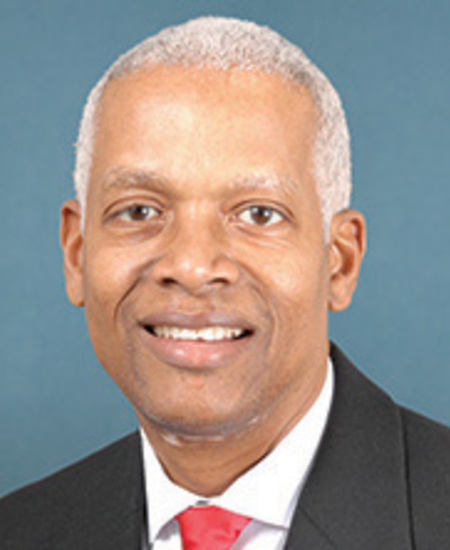
Photo of Henry C. "Hank" Johnson, Jr.
D United States House · District 4 · Georgia On the 2026 ballot

Rep. Henry C. "Hank" Johnson, Jr.

Compare
Total votes
2,837
all sessions
Attendance
97%
72 missed
Near the chamber average
With party
97%
of cast votes
Near the chamber average
Bipartisan score
2%
crosses aisle rarely
Near the chamber average
Sponsored
2,473
bills & resolutions
Higher than 98% of chamber peers
Committees
8
assignments
2,473 bills and resolutions

Sponsored bills

Total
2,473
Primary
84
Co-sponsor
2,389
This page
2,473
matching current filters
Co-sponsor HRES 1133
In committee · United States House · Co-sponsor
Recognizing National Foster Care Month as an opportunity to raise awareness about the challenges of children in the foster care system and encouraging Congress to implement policy to improve the lives of children in, or at risk of entering, the foster care system.

Maddy summaryHRES 1133 is a symbolic resolution recognizing May as National Foster Care Month. It raises awareness about challenges faced by children in foster care, such as instability, educational disruptions, and the high number aging out without permanent connections. The resolution encourages Congress to implement policies improving outcomes for these children and acknowledges the work of foster parents, social workers, and advocates. It does not create new laws but urges legislative action aligned with existing programs under the Social Security Act focused on prevention, reunification, and support for youth transitioning to adulthood.

In committee May 19, 2022 1 co-sponsor
Co-sponsor HR 7814
In committee · United States House · Co-sponsor
Health Care Providers Safety Act of 2022

Health Care Providers Safety Act of 2022 This bill authorizes the Department of Health and Human Services to award grants to health care providers for security services and other expenses related to physical security and cybersecurity.

In committee May 18, 2022 1 co-sponsor
Co-sponsor HR 7309
Passed · United States House · Co-sponsor
Workforce Innovation and Opportunity Act of 2022

Workforce Innovation and Opportunity Act of 2022 This bill reauthorizes through FY2028 and expands programs under the Workforce Innovation and Opportunity Act (WIOA). The bill also revises workforce investment, vocational rehabilitation, employment, training, and literacy programs for eligible individuals. For example, the bill increases workforce representation on state and local workforce investment boards from 20% to 30%; reworks one-stop center infrastructure funding by requiring costs to be covered by state allocations of WIOA funds; establishes subsidized youth employment programs that include work-readiness training and mentoring; allows states and localities to partner with educational institutions to address the skill needs for in-demand jobs; establishes grants to connect youth in communities disproportionately affected by gun violence with in-demand jobs; eliminates a requirement that the Department of Labor ensure that individuals participating in WIOA activities comply with Selective Service laws; modifies the allotment of youth workforce investment funds to states; requires Labor to prioritize providing access to certain services to girls and women and applications for assistance from minority-serving institutions; expands the Job Corps program, including by serving individuals in outlying areas and relaxing age requirements; establishes grants to expand training programs through industry or sector partnerships; expands grants for integrated English literacy and civics education to outlying areas; and expands Wagner-Peyser employment services to the Northern Mariana Islands and American Samoa. The bill also provides statutory authority for Labor to award competitive grants, contracts, and cooperative agreements to improve employment and training outcomes and reduce recidivism of justice-involved youth; and competitive grants for states to create workforce longitudinal administrative databases.

Passed May 18, 2022 1 co-sponsor
Co-sponsor HR 7769
In committee · United States House · Co-sponsor
Helicopter Safety and Noise Management Act

Helicopter Safety and Noise Management Act This bill establishes a commission comprised of the Federal Aviation Administration, members of local and state government, and helicopter noise and safety advocates to develop a helicopter usage management plan to substantially reduce the number of nonessential civil rotorcraft (i.e., a helicopter) that can operate in certain airspace at any given time. The plan shall not apply any limitation or requirement to the operation of a civil rotorcraft for purposes of public health and safety, including (1) law enforcement, (2) emergency response, (3) disaster response, (4) medical services, (5) scientific research, and (6) official purposes by a news organization.

In committee May 16, 2022 1 co-sponsor
Co-sponsor HR 903
Passed · United States House · Co-sponsor
Rights for the TSA Workforce Act of 2021

Rights for the Transportation Security Administration Workforce Act of 2022 or the Rights for the TSA Workforce Act of 2022 This bill modifies the workplace rights, protections, and benefits applicable to Transportation Security Administration (TSA) personnel. Specifically, the bill by December 31, 2022, eliminates personnel authorities of the Department of Homeland Security (DHS) and the Department of Transportation governing the conditions of employment for TSA employees, thus making TSA employees subject to the personnel management system applicable to other federal employees; sets forth transition rules that protect the pay rates, leave rights, and other rights of TSA employees; and requires DHS to consult with the exclusive representative of TSA screening employees to carry out the conversion of those positions. The bill also permits the TSA to consult with organizations representing federal air marshals to address concerns, including mental health and suicide rates; directs the TSA to ensure its employees are provided proper guidance regarding prevention and protections against COVID-19; requires the TSA to provide a one-time bonus payment of $3,000 to each TSA employee carrying out duties that require substantial contact with the public during the COVID-19 national emergency; and requires the Government Accountability Office to report on implementation of the bill, TSA recruitment efforts, and specified TSA personnel policies.

Passed May 16, 2022 1 co-sponsor
Co-sponsor HRES 1110
In committee · United States House · Co-sponsor
Honoring one million deaths from COVID-19 in the United States.

Maddy summaryHRES 1110 is a non-binding resolution passed by the U.S. House of Representatives on May 12, 2022, to recognize and mourn the 1,000,000 Americans who died from COVID-19. It formally honors the deceased and extends condolences to their families and loved ones without creating new laws or policies. The resolution does not directly affect any specific group or alter existing legislation, as it serves solely as a commemorative expression of national grief. Its key mechanism is the House’s formal acknowledgment of the pandemic’s human toll, referencing the milestone of one million deaths.

In committee May 12, 2022 1 co-sponsor
Co-sponsor HR 7736
In committee · United States House · Co-sponsor
Price Gouging Prevention Act of 2022

Price Gouging Prevention Act of 2022 This bill generally makes it unlawful to sell or offer for sale a good or service at an unconscionably excessive price during an exceptional market shock. The bill also provides additional funding to the Federal Trade Commission.

In committee May 12, 2022 1 co-sponsor
Co-sponsor HR 7739
In committee · United States House · Co-sponsor
Affordable Housing and Area Median Income Fairness Act of 2022

Affordable Housing and Area Median Income Fairness Act of 2022 This bill reauthorizes through FY2032 the Community Development Block Grant and other specified programs that support affordable housing. The bill also requires the Department of Housing and Urban Development (HUD) to assess alternative methods of calculating area median income (i.e., any metric used to refer to the median income level for a given area or jurisdiction for purposes of any program administered by HUD) and the use of alternative metrics in order to make housing more affordable for low-income families in urban areas.

In committee May 12, 2022 1 co-sponsor
Co-sponsor HR 2499
Passed · United States House · Co-sponsor
Federal Firefighters Fairness Act of 2022

Federal Firefighters Fairness Act of 2022 This bill makes it easier for federally employed firefighters who contract certain illnesses to qualify for federal workers' compensation. Specifically, the bill provides that chronic obstructive pulmonary disease, mesothelioma, and specified other cancers of those employed in fire protection activities for at least five years are presumed to be proximately caused by such employment for purposes of a disability or death claim under the federal workers' compensation program. This presumption also applies to federal employees employed in fire protection activities for at least five years who experience a sudden cardiac event or stroke within 24 hours of performing a fire protection activity. The bill also requires the Department of Labor to conduct a review to determine whether breast cancer, gynecological cancer, and rhabdomyolysis should be included under the presumption and to conduct periodic reviews to determine whether other diseases should be included. In addition, a person may petition Labor to include another disease under the presumption. An employee in fire protection activities is a firefighter, paramedic, emergency medical technician, rescue worker, ambulance personnel, or hazardous material worker who (1) is trained in fire suppression; (2) has the legal authority and responsibility to engage in fire suppression; (3) is engaged in the prevention, control, and extinguishing of fires or response to emergency situations where life, property, or the environment is at risk, including the prevention, control, suppression, or management of wildland fires; and (4) performs such activities as a primary responsibility.

Passed May 12, 2022 1 co-sponsor
Primary HR 7647
In committee · United States House · Lead sponsor
Supreme Court Ethics, Recusal, and Transparency Act of 2022

Supreme Court Ethics, Recusal, and Transparency Act of 2022 This bill provides for the establishment of a code of conduct for Supreme Court Justices, judges of the courts of appeals, judges of the district courts, and judges of the Court of International Trade.

In committee May 11, 2022 0 co-sponsors
Showing 1,941 to 1,950 of 2,473 bills