

Historic Tax Credit Growth and Opportunity Act of 2021 This bill increases the rehabilitation tax credit and modifies certain requirements for the credit. The bill increases the rate of the credit for qualified rehabilitation expenditures in taxable years beginning after December 31, 2019, and before January 1, 2027, after which the rate reverts to 20%. The bill increases the rate of the credit to 30% for certain small projects whose qualified rehabilitation expenditures do not exceed $2.5 million. The bill also expands the types of buildings eligible for rehabilitation by decreasing the rehabilitation threshold from 100% to 50% of project expenses. It also eliminates the basis adjustment requirement for the credit and modifies rules relating to tax-exempt use property eligible for the credit.
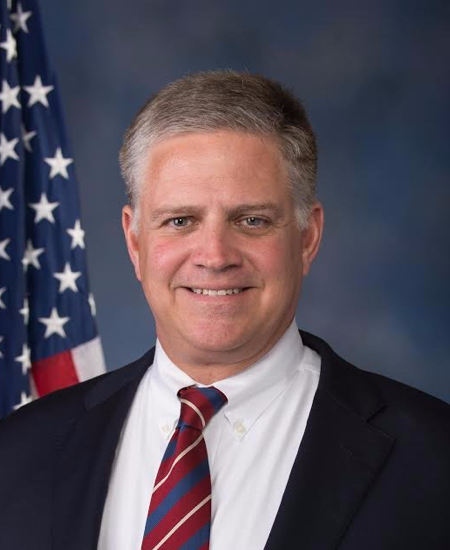
Rep. A. Drew Ferguson IV
Sponsored bills
Freight Rail Assistance and Investment to Launch Coronavirus-era Activity and Recovery Act of 2021 or the Freight RAILCAR Act of 2021 This bill provides a new tax credit for 50% of freight railcar fleet modernization expenses. The bill defines freight railcar fleet modernization expenses to include amounts for railcar replacement and modernization, railcar scrap amounts, and for railcar facility and technology modernization. The Department of the Treasury must report to Congress on the credit to provide information on the number of times the credit was claimed and the number of railcars scrapped or built as a result of the credit.
Reopening America by Supporting Workers and Businesses Act of 2021 This bill permits states to provide a one-time lump sum payment, through July 1, 2021, to individuals who (1) were eligible for COVID-19 pandemic unemployment compensation during any week after enactment of this bill, and (2) are no longer eligible as a result of becoming thereafter reemployed. Payments of $1,200 shall be paid to individuals who work at least 30 hours and $600 to individuals who work at least 20 hours but less than 30. The payments are available for claimants (1) who are not employed by a government entity, (2) who return to work for at least four consecutive weeks, and (3) whose annual salary does not exceed $75,000. Before receipt of a payment, the individuals' employers must verify their hours and earnings. Additionally, the bill (1) accelerates a scheduled increase in funding for reemployment services and eligibility assessments (RESEA), (2) allows states to use RESEA funds to serve all workers receiving unemployment benefits, and not just those most likely to exhaust their benefits; and (3) allows states to provide reemployment services to individuals receiving pandemic unemployment assistance and pandemic emergency unemployment compensation. Finally, the bill reinstates the requirement that unemployment claimants certify they are able, available, and actively seeking work.
This bill directs the Department of State to include additional information in its annual reports concerning Taiwan's participation at the World Health Organization's World Health Assembly (WHA) as an observer. The report shall describe changes and improvements to the State Department's plan to support Taiwan's observer status at the WHA, following any meetings at which Taiwan did not participate under such status. (China has opposed Taiwan's participation in the WHA.)
Ensuring Parity in MA and PACE for Audio-Only Telehealth Act of 2021 This bill allows audio-only diagnoses that are made via telehealth to be used for purposes of determining risk adjustments to payments under Medicare Advantage. Additionally, the bill requires payments for Medicare telehealth services that are furnished during the public health emergency relating to COVID-19 (i.e., coronavirus disease 2019) to be made in the same amounts as those for in-person services.
Promoting Apprenticeships through Regional Training Networks for Employers Required Skills Act of 2021 or the PARTNERS Act This bill establishes a grant program to promote registered apprenticeships and other work-based learning opportunities for small and medium-sized businesses within in-demand industry sectors, through the establishment and support of eligible partnerships.
Born-Alive Abortion Survivors Protection Act This bill establishes requirements for the degree of care a health care practitioner must provide in the case of a child born alive following an abortion or attempted abortion. Specifically, a health care practitioner who is present must (1) exercise the same degree of care as would reasonably be provided to any other child born alive at the same gestational age, and (2) ensure the child is immediately admitted to a hospital. Additionally, a health care practitioner or other employee who has knowledge of a failure to comply with the degree-of-care requirements must immediately report such failure to law enforcement. A health care practitioner who fails to provide the required degree of care, or a health care practitioner or other employee who fails to report such failure, is subject to criminal penalties—a fine, up to five years in prison, or both. An individual who intentionally kills or attempts to kill a child born alive is subject to prosecution for murder. The bill bars the criminal prosecution of a mother of a child born alive under this bill and allows her to bring a civil action against a health care practitioner or other employee for violations.
Protecting American Jobs Act This bill limits the authority of the National Labor Relations Board. Specifically, it repeals the authority of the General Counsel ofthe board to issue, and prosecute before the board, complaints of unfair labor practices. The bill also limits the board's rulemaking authority to rules concerning the internal functions of the board and prohibits the board from promulgating regulations affecting the substantive or procedural rights of any person, employer, employee, or labor organization, including rules concerning unfair labor practices and representation elections. Not later than six months after this bill is enacted, the board must review existing regulations and revise or rescind such regulations as necessary to implement these modifications to the board's rulemaking authority. In addition, the bill repeals the board's authority to issue orders preventing unfair labor practices, replacing it with a more limited authority to investigate allegations of such practices. Finally, it repeals the board's authority to petition courts for enforcement of its orders, seek injunctions, or hold hearings on jurisdictional strikes.
Saving Us from Pandemic Era Resistance by Building a Unified Global Strategy Act of 2021 or the SUPER BUGS Act of 2021 This bill requires the Department of Health and Human Services (HHS) to seek to enter into agreements with foreign countries to develop and commercialize new drugs to address pandemics. HHS shall report to Congress a strategy for achieving this goal.
This bill excludes from gross income, for income tax purposes, gains from distributions of intangible property by controlled foreign corporations to U.S. domestic corporations. The bill defines intangible property to include patents, copyrights, licenses, formulas, computer software, and similar items with substantial value.