

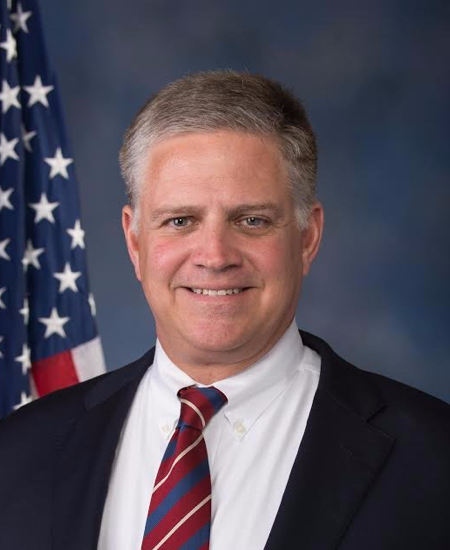
Photo of A. Drew Ferguson IV
R United States House · District 3 · Georgia

Rep. A. Drew Ferguson IV

Compare
Total votes
2,168
all sessions
Attendance
96%
81 missed
Lower than 81% of chamber peers
With party
94%
of cast votes
Near the chamber average
Bipartisan score
3%
crosses aisle rarely
Near the chamber average
Sponsored
456
bills & resolutions
Lower than 80% of chamber peers
Committees
0
assignments
456 bills and resolutions

Sponsored bills

Total
456
Primary
26
Co-sponsor
430
This page
456
matching current filters
Co-sponsor HR 838
In committee · United States House · Co-sponsor
Freight RAILCAR Act of 2023

Freight Rail Assistance and Investment to Launch Coronavirus-Era Activity and Recovery Act of 2023 or the Freight RAILCAR Act of 2023 This bill provides a new tax credit through 2025 for 10% of freight railcar fleet modernization expenses (i.e., railcar replacement and modernization expenses for meeting fuel efficiency and performance standards). The bill provides that no more than 2,000 freight railcars per taxpayer may be taken into account for purposes of determining the credit in a taxable year. The Department of the Treasury must report to Congress on the credit to provide information on the number of times the credit was claimed and the number of railcars scrapped or built as a result of the credit.

In committee Feb 6, 2023 1 co-sponsor
Primary HR 781
In committee · United States House · Lead sponsor
GIG Act

Maddy summaryHR 781, the GIG Act, clarifies the definition of an independent contractor under federal law. It adds specific factors the Secretary of Labor must consider when determining if a worker is an independent contractor, such as whether the worker has substantial control over their work, can earn profits or losses based on their initiative, and whether their services require specialized skills performed continuously. The bill explicitly states that the Secretary cannot consider unmet contractual terms or unrelated services when making this determination. This directly affects workers classified as independent contractors and the businesses that hire them, by establishing a clearer, more objective standard for classification. The change aims to reduce misclassification disputes under the Fair Labor Standards Act.

In committee Feb 2, 2023 0 co-sponsors
Co-sponsor HR 139
Passed · United States House · Co-sponsor
SHOW UP Act of 2023

Maddy summaryHR 139, the SHOW UP Act of 2023, requires U.S. federal executive agencies to revert to their pre-pandemic telework policies and levels by January 30, 2024 (30 days after enactment). Agencies must conduct a study on pandemic-era telework impacts - including effects on mission performance, costs from underused offices or incorrect pay classifications, and employee productivity - and submit a new plan to Congress if they seek to expand telework beyond 2019 levels. This plan requires certification from the Office of Personnel Management (OPM) Director confirming it will improve mission performance, reduce real property costs, lower locality pay expenses, and ensure secure remote work tools without increasing overall costs. The bill directly affects all federal executive agencies and their telework policies, mandating a return to pre-2020 practices while creating a formal process for any future telework expansion.

Passed Feb 2, 2023 1 co-sponsor
Co-sponsor HR 700
In committee · United States House · Co-sponsor
Supply Chain Disruptions Relief Act

Maddy summaryThis bill helps new car dealers affected by pandemic-era supply chain disruptions by changing tax rules for inventory sales. It allows dealers using LIFO accounting to treat certain sales of unsold vehicles (liquidations) between March 2020 and December 2021 as "qualified" for tax purposes. Dealers can defer recognizing income from these sales and have until 2026 to replace the sold vehicles before potential tax adjustments apply. The provision specifically targets dealers who couldn't replenish inventory during the supply chain crisis.

In committee Feb 1, 2023 1 co-sponsor
Co-sponsor HR 382
Passed · United States House · Co-sponsor
Pandemic is Over Act

Maddy summaryHR 382, the "Pandemic is Over Act," terminates the federal public health emergency declaration for the COVID-19 pandemic. The bill ends the emergency status declared on January 31, 2020, effective upon the bill's enactment. This action directly ends the federal authority tied to the emergency, including related public health measures and funding mechanisms under the Public Health Service Act.

Passed Feb 1, 2023 1 co-sponsor
Co-sponsor HR 655
In committee · United States House · Co-sponsor
Disaster Reforestation Act

Disaster Reforestation Act This bill sets forth a special rule for the tax deduction for casualty losses of uncut timber (including pre-merchantable timber). It provides that in losses of any uncut timber from fire, storm, insects, invasive species, drought, or other casualty, or from theft, the basis for determining the amount of the deduction for such loss shall not be less than the excess of the value of such timber determined immediately before such loss was sustained, over the salvage value of such timber. To be eligible for the casualty loss deduction, the uncut timber subject to the loss must be reforested not later than the close of the five-year period beginning on the date of the loss.

In committee Jan 31, 2023 1 co-sponsor
Co-sponsor HRES 72
In committee · United States House · Co-sponsor
Recognizing the contributions of independent workers and contractors to the American economy.

Maddy summaryThis symbolic House resolution (HRES 72) recognizes independent workers, contractors, and freelancers for their economic contributions to the U.S. It highlights their role in the growing flexible work economy and acknowledges the benefits of flexible work arrangements, such as freedom in hours and locations. The resolution does not create new laws or alter existing policies - it solely serves as a formal acknowledgment of these workers' significance to the economy. It references their $1.35 trillion economic contribution in 2022 and their growing share of the workforce (39% of U.S. workers).

In committee Jan 30, 2023 1 co-sponsor
Co-sponsor HR 603
In committee · United States House · Co-sponsor
HEAL Act

Maddy summaryThe HEAL Act (HR 603) requires the U.S. Holocaust Memorial Museum Director to study how public elementary and secondary schools teach about the Holocaust and related antisemitism. The study will examine curriculum requirements, teaching methods (like project-based learning), instructional materials, and assessment approaches across states and school districts. It specifically analyzes whether Holocaust education is mandatory, optional, or integrated across subjects, and how schools address antisemitism and genocide prevention. The resulting report, due within 180 days of the study or three years after enactment, will inform Congress but does not change current school policies. This is a data-gathering measure, not a policy mandate.

In committee Jan 27, 2023 1 co-sponsor
Co-sponsor HR 531
In committee · United States House · Co-sponsor
Educational Choice for Children Act

Maddy summaryThe Educational Choice for Children Act creates tax credits for individuals and corporations that contribute to scholarship granting organizations providing education scholarships. Individuals can claim a credit up to $5,000 or 10% of their income, while corporations can claim up to 5% of taxable income. The scholarships are available to students from households with income up to 300% of the area median income, and can be used for private school tuition, tutoring, and other educational expenses at elementary and secondary schools. The bill includes strict requirements for scholarship organizations to verify income, conduct audits, and prevent misuse of funds, while also prohibiting government control over these organizations and protecting private and religious schools from discrimination in the program. It establishes a $10 billion annual cap on the total tax credits available.

In committee Jan 26, 2023 1 co-sponsor
Co-sponsor HR 26
Passed · United States House · Co-sponsor
Born-Alive Abortion Survivors Protection Act

Maddy summaryThis bill requires healthcare providers to give the same medical care to infants born alive during abortions as they would to any newborn, and to immediately admit such infants to a hospital. It mandates reporting of non-compliance to law enforcement and imposes penalties including up to 5 years in prison for violations. Women who undergo abortions can file civil lawsuits seeking money damages for injuries, three times the abortion cost, and punitive damages if care standards are not met. The bill also clarifies that abortion includes intentionally killing an unborn child or terminating pregnancy without specific exceptions (e.g., after viability to preserve life or removing a dead fetus).

Passed Jan 25, 2023 1 co-sponsor
Showing 201 to 210 of 456 bills
Previous 1 … 20 21 22 … 46 Next