

Stand Your Ground Act of 2021 This bill establishes affirmative defenses for individuals who use (or threaten or attempt to use) force in the commission of certain federal criminal violations. First, an individual is justified in using (or threatening or attempting to use) non-deadly force if the individual reasonably believes it is necessary to defend against an imminent use of unlawful force. An individual who uses or threatens to use non-deadly force in accordance with this affirmative defense does not have a duty to retreat before using or threatening to use such force. Second, an individual is justified in using (or threatening or attempting to use) deadly force if the individual reasonably believes it is necessary to prevent imminent death or great bodily harm or to prevent the imminent commission of a forcible felony. An individual who uses, threatens, or attempts to use deadly force in accordance with this affirmative defense does not have a duty to retreat and has the right to stand his or her ground so long as the individual is not engaged in a criminal activity and is in a place where he or she has a right to be.
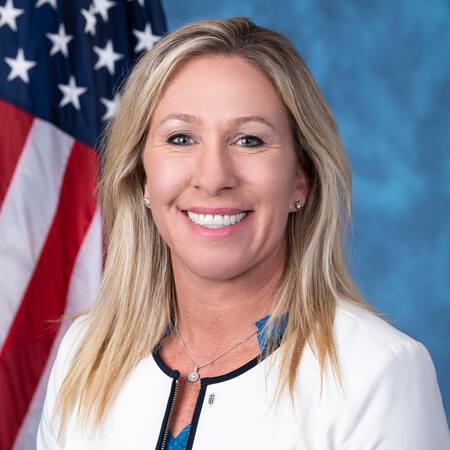
Rep. Marjorie Taylor Greene
Sponsored bills
Restoring America's Leadership in Innovation Act of 2021 This bill revises several aspects of patent law. The bill changes the U.S. patent system back to a first-to-invent system, in which the first inventor to conceive of an invention is entitled to a patent. Currently, the first person to file an application that meets all the necessary requirements is entitled to the patent. Several types of administrative patent challenge proceedings are abolished, as well as the Patent and Trademark Office (PTO) body that decides those proceedings. The bill relaxes the standard for what constitutes patent-eligible subject matter. The only ineligible inventions shall be those that exist in nature independent or prior to human activity or that exist solely in the human mind. The bill also makes it easier for a patent owner that has won an infringement case in court to secure a permanent injunction against the infringing defendant. Specifically, there shall be a presumption that further infringement would cause irreparable harm to the prevailing patent owner, and the burden shall be on the infringer to prove otherwise. (Currently, a prevailing patent owner seeking a permanent injunction must prove, among other things, that further infringement would cause irreparable harm.) The bill limits what types of publications shall be treated as prior art that could be used to make an invention be considered to be anticipated or obvious (and therefore not patentable). The bill authorizes the PTO to keep and spend all the fees that it collects.
Fentanyl Penalties Parity Act This bill modifies the drug quantity thresholds that trigger a mandatory minimum prison term for a defendant who manufactures, distributes, imports, exports, or possesses with intent to distribute fentanyl. Specifically, the bill reduces from 400 to 20 grams the fentanyl quantity and from 100 to 5 grams the fentanyl analogue quantity that trigger a mandatory minimum prison term for high-level first-time or repeat offenders. It also reduces from 40 to 2 grams the fentanyl quantity and from 10 to 0.5 grams the fentanyl analogue quantity that trigger a mandatory minimum prison term for low-level first-time or repeat offenders.
Defending Students' Civil Rights Act of 2021 This bill prohibits the use of critical race theory or critical race pedagogy in any federally funded program or activity. Specifically, the bill includes the use of critical race theory or critical race pedagogy as a violation of Title VI of the Civil Rights Act of 1964, which prohibits discrimination based on race, color, or national origin in federally funded programs or activities. The bill defines critical race pedagogy as the separation of students or teachers, or the assignment of characteristics or assumptions, based on race, color, or national origin. The bill defines critical race theory as a curriculum that establishes specified principles relating to race or sex, including that (1) one race or sex is inherently superior to another, (2) the United States is fundamentally racist or sexist, and (3) an individual bears responsibility for the past actions of others of the same race or sex.
Criminal Alien Removal Clarification Act of 2021 This bill subjects to deportation an alien who at any time after admission has been convicted of a felony or two misdemeanors under state or federal law. Currently, an alien is subject to deportation for a single conviction for certain felonies (such as an aggravated felony), two or more convictions for crimes involving moral turpitude, or being a drug addict.
No Fly for Illegals Act This bill limits using federal funds to compensate an airline for transporting an alien who is not lawfully present in the United States. Specifically, federal funds may not be used to compensate an airline for such an individual's entry into the United States or for relocation within the United States unless the transportation is to remove the individual from the United States or to protect the individual from an imminent threat to life or physical safety.
Securing the Homeland from International Entrants with Life-threatening Diseases Act or the SHIELD Act This bill suspends for one year the admission and parole into the United States of certain categories of individuals who are from or were recently in a country that fails to meet certain criteria related to COVID-19. This restriction applies to certain individuals entering the United States from Mexico or Canada through a port of entry or U.S. Border Patrol station and (1) whose country of origin has not been categorized by the Centers for Disease Control and Prevention as a low-risk country for COVID-19, or (2) who was in such a country at any time in the 30 days before arriving in the United States. The bill exempts certain individuals from this restriction, including U.S. citizens and lawful permanent residents, members of the Armed Forces, and persons from a foreign country who arrive at a designated port of entry with valid travel documents. The Department of Homeland Security shall transport barred individuals to a foreign location, such as an individual's country of origin, to the extent practicable.
Separation of Powers Restoration Act This bill restricts the scope of presidential orders. A presidential order means any executive order, presidential proclamation, or presidential directive, as well as any other presidential or executive action issued under the authority of the President or other federal officer or employee that purports to effect standards and norms outside of the executive branch. Specifically, the bill limits the application of a presidential order to the executive branch unless the order is issued pursuant to certain presidential powers under the Constitution or statutory authority. The bill further specifies that the President may not issue an order under a ratified or unratified treaty (or bilateral or multilateral agreement) if the treaty (1) violates constitutional protections for rights retained by the people or powers reserved to the states, or (2) delegates power to a foreign government or international body absent constitutional authority. When issuing a presidential order, the President must cite to the applicable constitutional or statutory authority. A presidential order without this citation is invalid. Members of Congress, nonfederal government officials, and aggrieved persons may challenge an order's validity on the basis that it exceeds the President's constitutional or statutory authority. The bill also repeals the War Powers Resolution (a joint resolution that outlines procedures for Congress and the President to participate in decisions to send Armed Forces into hostilities) and terminates emergency authorities available to the President and other federal officers and employees for responding to a declared national emergency.
No Taxpayer Funding for the Central American Minors Program Act This bill prohibits using federal funds to carry out the Central American Minors program, a Department of Homeland Security and Department of State program that reunites qualified children from El Salvador, Guatemala, and Honduras with their parent who is lawfully present in the United States.
Cutting Unnecessary Regulatory Burdens Act This bill generally requires agencies to repeal at least two rules before promulgating a major rule (i.e., a rule with a significant economic impact, cost to consumers, or adverse effects on competition). Further, unless required by law, an agency may not issue a rule that exceeds the total cost of the rules to be repealed without approval by the Office of Management and Budget. These requirements do not apply to major rules related to agency procedures, the Armed Forces, national security, or foreign affairs.