

U.S. Military Right to Carry Act This bill requires a state that receives funds under the Edward Byrne Memorial Justice Assistance Grant Program to have implemented (1) a law or policy authorizing members of the Armed Forces who are outside of their state of residence under orders to renew a permit to carry a concealed firearm through the mail, and (2) a law or policy that treats members of the Armed Forces on active duty in the state as residents of the state for purposes of issuing a permit to carry a concealed firearm in the state. The Department of Justice must reduce by 5% the amount that a state would otherwise receive under the grant program if the state fails to comply with either requirement.
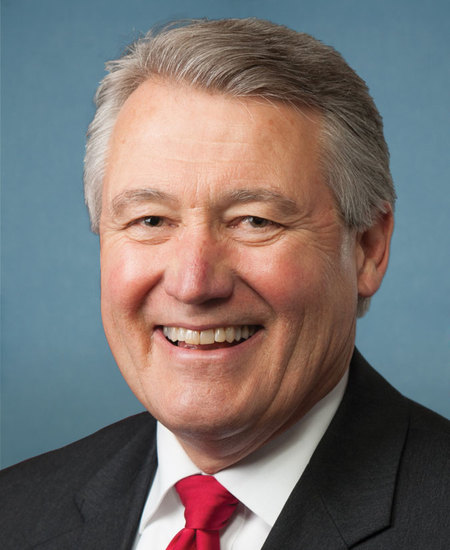
Rep. Rick W. Allen
Sponsored bills
Lawful Interstate Transportation of Firearms Act This bill revises criminal provisions related to the interstate transportation of firearms and ammunition. An individual may transport a firearm between two places (e.g., states) where it is legal to possess, carry, or transport the firearm. During transport, the firearm must be unloaded and secured or securely stored. Additionally, an individual may transport ammunition, or a detachable magazine or feeding device, between two places where it is legal to possess, carry, or transport the ammunition, magazine, or feeding device. During transport, the ammunition, magazine, or feeding device must not be loaded into a firearm and must be securely stored. The term transport includes staying in temporary lodging; stopping for food, fuel, vehicle maintenance, an emergency, or medical treatment; or any other activity incidental to the transport. The bill prohibits the arrest or detention of an individual for a state or local firearm or ammunition violation unless there is probable cause to believe the individual failed to comply with the provisions of this bill, and there is probable cause to believe the individual committed another crime.
Foreign Influence Transparency Act This bill addresses foreign influence in higher education and in certain other academic, religious, and artistic pursuits. Current law exempts from foreign agent registration requirements a person engaging in activities in furtherance of religious, scholastic, academic, or scientific pursuits or of the fine arts. The bill specifies that this exemption applies only to those activities that do not promote the political agenda of a foreign government. Under current law, an institution of higher education (IHE) must disclose to the Department of Education (ED) a gift or contract that is from a foreign source and is valued at $250,000 or more, considered alone or in combination with all other gifts from or contracts with the foreign source. The bill instead requires an IHE to disclose such a gift or contract that is valued at $50,000 or more, considered alone or in combination with all other gifts or contracts. An IHE must include in its disclosure report the contents of any such contract and make the contents available for public disclosure. Additionally, an IHE that enters into an agreement with a Confucius Institute (i.e., a cultural institute directly or indirectly funded by the Chinese government) must immediately make available the full text of the agreement to the public, ED, and Congress. Finally, the bill prohibits an IHE that does not comply with these disclosure requirements from enrolling foreign students under the Student and Exchange Visitor Program.
This concurrent resolution expresses the sense of Congress that a carbon tax would be detrimental to American families and businesses and is not in the best interest of the United States.
Middle Class Savings Act This bill modifies the tax brackets that apply to taxes on capital gains. The bill aligns the thresholds with the brackets for the regular income tax rates enacted in P.L. 115-97 (commonly known as the Tax Cuts and Jobs Act).
This resolution calls on the Office for Civil Rights within the Department of Education and state attorneys general to assist elementary and secondary schools in complying with existing civil rights laws and investigate and enforce such laws. In addition, the resolution condemns the practice of requiring teachers to receive education in critical race theory as a condition of certification.
This bill prohibits any executive agency from contravening Executive Order 13950 (Combating Race and Sex Stereotyping), except as such order relates to contractors and grant recipients.
Save Local Business Act This bill provides that a person may be considered a joint employer in relation to an employee under federal labor law only if such person directly, actually, and immediately (and not in a limited and routine manner) exercises significant control over the essential terms and conditions of employment. Such control may by demonstrated by hiring and discharging employees, determining individual employee rates of pay and benefits, day-to-day supervision of employees, assigning individual work schedules, positions, and tasks, and administering employee discipline.
Freedom to Work Act This bill requires federal agencies to review and reduce occupational licensing requirements. Specifically, each executive agency must review relevant laws, policies, and regulations that institute occupational licensing requirements for agency positions, or that cause a state, local, or tribal government to adopt licensing requirements for positions within their jurisdictions, and identify possible changes to eliminate such requirements or to provide alternatives that are the least restrictive while also maintaining consumer protection. Agencies must implement changes to the extent permissible under law. The bill also requires states to describe their plans to reduce occupational licensing barriers as part of their unified state plans for programs under the Workforce Innovation and Opportunity Act. Several executive orders have required similar review of occupational licensing requirements. For example, the executive order titled Increasing Economic and Geographic Mobility, which was issued on December 14, 2020, outlined certain principles for occupational licensing requirements, including that such requirements should be the least restrictive to competition while also maintaining consumer protection; the order directed executive agencies to review and identify changes to their regulations, guidance, and policies in accordance with these principles. Additionally, the executive order titled Promoting Competition in the American Economy , which was issued on July 9, 2021, directs the Federal Trade Commission to consider addressing practices that inhibit competition, including unfair occupational licensing restrictions, through regulations.
Fight Radicalization of Elementary Education (FREE) Act This bill prohibits the federal government from conditioning or incentivizing financial support upon the adoption of specific instructional content, academic standards and assessments, curricula, or programs of instruction related to the priorities in the Department of Education's proposed rule titled Proposed Priorities-American History and Civics Education , published on April 19, 2021, or related to critical race theory.