

Trillion Trees Act This bills establishes a variety of requirements and incentives to plant trees and conduct other land management practices for the purposes of capturing and storing carbon in domestic and international trees and forests. Additionally, the bill provides incentives to research or develop other carbon sequestration tools. Specifically, the bill directs the Department of Agriculture (USDA) to set targets to increase forest carbon stock through January 1, 2100, for the purposes of sequestering and storing carbon in U.S. forests. It also establishes and provides funding for the Trillion Trees Challenge Fund to provide grants to nonfederal entities for activities related to reforestation efforts on public or private lands. In addition, it raises the cap on the Reforestation Trust Fund to enhance forest health in the National Forest System and requires the USDA to establish a Tree City USA Grant Program. The bill also allows the U.S. Agency for International Development to enter into an agreement with a nonprofit organization to establish an International Forest Foundation to promote reforestation and prevent deforestation. Additionally, it establishes requirements and incentives to address seedling shortages and support nurseries. Finally, the bill provides market incentives to research or develop other carbon sequestration tools relating to biochar, sustainable building practices, biochemical and bioplastic products, and biomass energy.
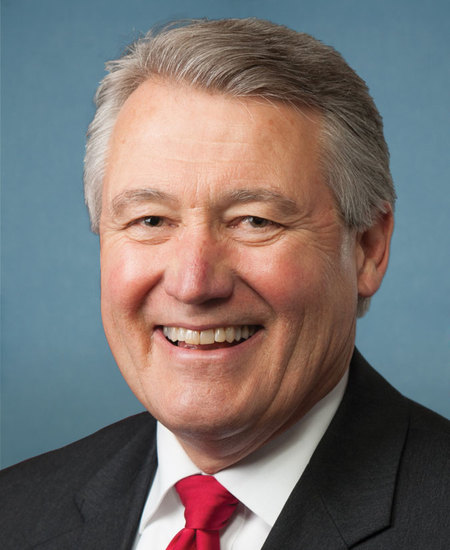
Rep. Rick W. Allen
Sponsored bills
Flexible Financing for Rural America Act This bill allows rural utility service providers to submit to the Department of Agriculture (USDA) a request to adjust the interest rate or modify the terms of certain loans. The request shall include a report summarizing how the adjustment or modification will assist the borrower in providing critical utility services to a rural community. Specifically, on receipt of a request, USDA or the Department of the Treasury (in the case of a loan owned by the Federal Financing Bank) must adjust the interest rate on the loan to match certain interest rates for obligations of comparable maturity to the term remaining on the loan (or a higher rate requested by the borrower), and make modifications to the loan terms as necessary to address changes in the financial position of the borrower due to the COVID-19 public health emergency and to promote the financial sustainability of the borrower. In carrying out the adjustments or modifications, USDA or Treasury shall not impose or collect any fee from, or impose any penalty on, a borrower. The bill also provides funding to implement the adjustments and modifications and for the liquidation of residual intragovernmental amounts owed by the Federal Financing Bank in connection with certain loans.
National Heritage Area Act of 2021 This bill establishes a National Heritage Areas System to recognize certain areas of the United States that tell nationally significant stories and to conserve, enhance, and interpret the areas' natural, historic, scenic, and cultural resources that illustrate significant aspects of U.S. heritage, and authorizes appropriations through FY2034 for each National Heritage Area. Through such system, the Department of the Interior may provide technical and financial assistance to local coordinating entities to support the establishment, development, and continuity of such areas. The bill extends the authority for the Erie Canalway National Heritage Corridor Commission and the Gullah/Geechee Cultural Heritage Corridor Commission until September 30, 2034. The local coordinating entity of a National Heritage Area, not later than three years after the area is included in the National Heritage Area System, shall submit to Interior a management plan for approval. Interior, not later than one year before the authorization for federal funding expires for a National Heritage Area, shall (1) conduct an evaluation of the accomplishments of that area, and (2) submit a report detailing the evaluation to specified congressional committees. Based upon the evaluation, Interior shall prepare a report with recommendations for the National Park Service's continued role, if any, with respect to the area. Interior may carry out or certify a study to assess the suitability and feasibility of designating a specific geographic area as a National Heritage Area to be included in the National Heritage Area System.
This resolution expresses support for the goals and ideals of PCOS Awareness Month. Polycystic ovary syndrome (PCOS) is caused by a hormone imbalance. Symptoms can include infertility, weight gain, excess hair growth, and acne.
Saving American History Act of 2021 This bill prohibits the use of federal funds by an elementary or secondary school to teach the 1619 Project or by a local educational agency (LEA) to support its teaching in public schools. (The 1619 Project is an initiative that addresses the beginning of slavery in the United States.) Specified federal agencies must reduce federal funds in a prorated amount to an elementary or secondary school that teaches this project or an LEA that supports its teaching in public schools. However, federal funding shall not be reduced for programs for low-income students (e.g., free or reduced-price lunch) or students with disabilities.
Military Education and Values Act This bill requires the Department of Defense (DOD) to issue guidance prohibiting the use of any education or training methodology within DOD and the Armed Forces that promotes or causes a racial divide or lack of equality. Such guidance must also reiterate that members of the Armed Forces of all races will be treated equally and update service members on the core tenets of the U.S. military. DOD must report on the status of critical race-theory and other race-based training education methodologies in the Armed Forces.
This resolution calls on the people of the United States to observe Memorial Day to honor the men and women who died in the pursuit of freedom and peace.
This resolution condemns the rocket attacks by Hamas against Israel beginning the week of May 9, 2021. It also states that the United States must continue to invest in and support Israel's security and sovereignty.
Pharmacy DIR Reform To Reduce Senior Drug Costs Act This bill establishes certain requirements for prescription drug plans and the prices of covered drugs under the Medicare prescription drug benefit. Specifically, the bill requires price concessions, payments, and fees that are negotiated with a pharmacy to be included in a drug's negotiated price, excluding incentive payments, and for this price to be provided at the point of sale. Additionally, prescription drug plans must report price concessions or incentive payments that are made after payment for covered drugs at the point of sale, including by contracted intermediaries, to the pharmacy at least annually. The Centers for Medicare & Medicaid Services must establish standardized pharmacy performance measures with respect to incentive payments and price concessions; such measures must account for all pharmacy types, including specialty pharmacies, and focus on patient health outcomes and other targeted areas.
This bill prohibits any program for which federal funds are appropriated on a discretionary basis from providing federal funds to a state that has implemented a program to provide assistance to individuals who are unlawfully present in the United States.