

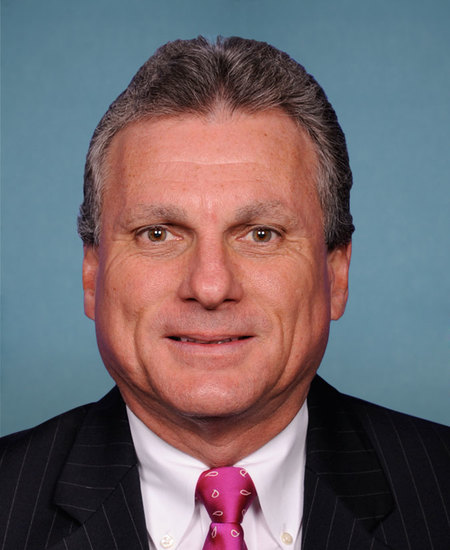
Photo of Earl L. "Buddy" Carter
R United States House · District 1 · Georgia

Rep. Earl L. "Buddy" Carter

Compare
Total votes
2,837
all sessions
Attendance
96%
104 missed
Lower than 83% of chamber peers
With party
96%
of cast votes
Higher than 92% of chamber peers
Bipartisan score
2%
crosses aisle rarely
Lower than 93% of chamber peers
Sponsored
1,351
bills & resolutions
Higher than 78% of chamber peers
Committees
5
assignments
1,351 bills and resolutions

Sponsored bills

Total
1,351
Primary
159
Co-sponsor
1,192
This page
1,351
matching current filters
Co-sponsor HRES 346
In committee · United States House · Co-sponsor
Reaffirming the support of the United States to our strongest ally in the region, Israel, and recognizing the authoritarian and extremist regime of the Islamic Republic of Iran as a threat to Israel, the region, the United States, and global stability.

This resolution expresses U.S. support for Israel and its efforts to defend its right to existence. The resolution also declares that the United States and international community must prevent Iran from acquiring or building nuclear weapons.

In committee Apr 28, 2023 1 co-sponsor
Co-sponsor HR 2962
In committee · United States House · Co-sponsor
Hydrogen Permitting Simplification Act

Maddy summaryHR 2962, the Hydrogen Permitting Simplification Act, exempts certain federal hydrogen production projects from the National Environmental Policy Act (NEPA) review process. It directly affects developers of hydrogen facilities using nuclear, solar, wind, or geothermal energy by removing the requirement for environmental impact assessments under NEPA for projects under this specific energy policy title. The key provision amends the Energy Policy Act of 2005 to add a new section stating that major federal actions involving these hydrogen production sources are not subject to NEPA. This simplifies permitting for qualifying clean hydrogen projects by eliminating a standard federal environmental review step.

In committee Apr 28, 2023 1 co-sponsor
Co-sponsor HR 2923
In committee · United States House · Co-sponsor
Living Donor Protection Act of 2023

Maddy summaryThis bill protects living organ donors from insurance discrimination by prohibiting life, disability, and long-term care insurers from denying coverage, raising premiums, or altering policy terms solely because someone donated an organ while alive. It also updates the Family and Medical Leave Act to include recovery from organ donation surgery as a qualifying health condition, allowing donors to take protected leave for this purpose. Additionally, the bill requires the Health and Human Services Secretary to update public educational materials about living donation benefits, risks, and insurance protections within six months of enactment. These changes directly affect living organ donors, insurers, employers, and healthcare systems by ensuring fair access to insurance and workplace leave.

In committee Apr 28, 2023 1 co-sponsor
Co-sponsor HR 2955
In committee · United States House · Co-sponsor
Stop Institutional Child Abuse Act

Maddy summaryHR 2955, the Stop Institutional Child Abuse Act, establishes a Federal Work Group to improve data collection and best practices for youth in residential programs (like therapeutic schools, treatment centers, and group homes). The Work Group, composed of federal agency representatives and diverse stakeholders, must develop national data standards, create risk assessment tools, and issue biennial reports with recommendations to enhance safety, reduce restraints, and expand community-based alternatives. It directly affects youth with mental health, substance use, or disability needs placed in these facilities, as well as agencies overseeing them. The bill also mandates a National Academies study to examine funding, oversight, and barriers to community care. These mechanisms aim to standardize data tracking and promote less restrictive, trauma-informed care for youth in residential programs.

In committee Apr 28, 2023 1 co-sponsor
Co-sponsor HR 2700
In committee · United States House · Co-sponsor
Employee Rights Act

Maddy summaryThe Employee Rights Act (HR 2700) amends key labor laws to strengthen employee rights in collective bargaining and privacy. It requires employers to use secret ballot elections for selecting bargaining representatives and to provide labor organizations with voter lists containing employee names and one form of contact information (chosen by the employee) within two business days of an election. The bill prohibits employers from using employee personal information for non-organizing purposes and mandates written authorization for using union dues on non-bargaining activities, with authorizations expiring after one year. Additionally, it clarifies joint employment standards to prevent misclassification and adds tribal sovereignty protections to labor law definitions.

In committee Apr 28, 2023 1 co-sponsor
Co-sponsor HR 2928
In committee · United States House · Co-sponsor
Responsible Borrower Protection Act of 2023

Maddy summaryHR 2928, the Responsible Borrower Protection Act of 2023, blocks the Federal Housing Finance Agency (FHFA) and mortgage enterprises (Fannie Mae and Freddie Mac) from implementing specific changes to mortgage credit fees announced in January 2023. The bill directly affects mortgage borrowers and lenders by reversing a pricing framework update that would have altered fees for single-family mortgages. It prohibits the FHFA from enforcing the January 2023 pricing changes detailed in FHFA's announcement and related lender letters. The bill clarifies that enterprises may still use risk-based pricing for mortgage fees, but the specific fee adjustments from the 2023 framework are canceled. This is a direct policy change to mortgage fee structures, not a broader reform.

In committee Apr 27, 2023 1 co-sponsor
Primary HR 1343
Passed · United States House · Lead sponsor
ITS Codification Act

Maddy summaryHR 1343, the ITS Codification Act, establishes the Institute for Telecommunication Sciences (ITS) within the National Telecommunications and Information Administration (NTIA) as the federal government's primary lab for spectrum research. It directs ITS to study radio signal behavior, test spectrum-sharing technologies between government and commercial users, and improve interference tolerance for federal systems. The bill also creates a new initiative to develop better emergency communication tools for locating people trapped in places like collapsed buildings or mines, requiring a report to Congress within 18 months. This directly affects federal agencies managing spectrum and commercial entities seeking access to spectrum resources.

Passed Apr 26, 2023 0 co-sponsors
Co-sponsor HJRES 59
In committee · United States House · Co-sponsor
Providing for congressional disapproval under chapter 8 of title 5, United States Code, of the rule submitted by the Department of Labor relating to "Adverse Effect Wage Rate Methodology for the Temporary Employment of H-2A Nonimmigrants in Non-Range Occupations in the United States".

This joint resolution nullifies a Department of Labor final rule entitled Adverse Effect Wage Rate Methodology for the Temporary Employment of H-2A Nonimmigrants in Non-Range Occupations in the United States and published on February 28, 2023. This rule makes changes to the methodology used to set adverse effect wage rates for H-2A workers (temporary agricultural workers), including by using Bureau of Labor Statistics wage surveys in certain instances. (Generally, the minimum wage for an H-2A worker is the highest of the adverse effect wage rate, the applicable minimum wage, the prevailing wage for that occupation in that area, or any agreed-upon collective bargaining wage.)

In committee Apr 25, 2023 1 co-sponsor
Co-sponsor HR 2849
In committee · United States House · Co-sponsor
Rare Earth Magnet Manufacturing Production Tax Credit Act of 2023

Maddy summaryHR 2849 creates a tax credit for U.S. manufacturers producing rare earth magnets. The credit offers $20 per kilogram for magnets made with domestically sourced materials, or $30 per kilogram if at least 90% of the rare earth components are produced in the U.S. The credit phases out over time, reducing to 70% in 2033, 35% in 2034-2035, and ending after 2035. To qualify, manufacturers must not use materials from non-allied foreign nations and must produce magnets as part of their regular business operations.

In committee Apr 25, 2023 1 co-sponsor
Co-sponsor HR 2827
In committee · United States House · Co-sponsor
Partner with Korea Act

Partner with Korea Act This bill creates an E-4 treaty trader visa category for up to 15,000 nationals of South Korea each fiscal year who are coming to the United States solely to perform specialty occupation services, subject to various requirements. The 15,000 limit shall only apply to principal recipients of such visas and not their accompanying spouses or children. (A specialty occupation is one that requires the theoretical and practical application of highly specialized knowledge and a bachelor's degree or higher.)

In committee Apr 25, 2023 1 co-sponsor
Showing 791 to 800 of 1,351 bills
Previous 1 … 79 80 81 … 136 Next