

This resolution expresses the sense of the House of Representatives that the Department of Homeland Security (DHS) provides essential protection for our country from foreign and domestic threats and that defunding DHS would be detrimental to our national security.
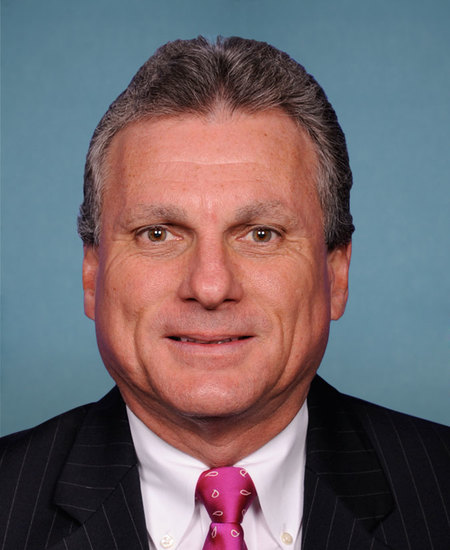
Rep. Earl L. "Buddy" Carter
Sponsored bills
This resolution expresses support for the designation of Journeyman Lineworkers Recognition Day. (A journeyman lineworker is a person who builds and maintains electrical power systems.)
American Broadband Act This bill addresses broadband and other communications services. The bill limits applicable state and local regulatory authority. Limitations include setting (and providing statutory authority for) deadlines for reviews and decisions related to personal wireless and other telecommunication service facilities, as well as cable franchises and services. Further, a state or locality may not provide broadband services in areas with more than one other commercial provider. The bill exempts certain telecommunications infrastructure projects from environmental and historic preservation reviews, including projects carried out after a declared disaster or emergency (e.g., a wildfire). The bill also establishes a rebuttable presumption that a request for a review of the effects of deploying wireless service on historically, culturally, or religiously significant tribal or Native Hawaiian land is complete if the tribe or Native Hawaiian organization receives certain forms. The bill enhances criminal penalties for willful or malicious destruction of a communication facility. Furthermore, the General Services Administration must establish a common fee schedule for deploying wireless facilities that affect federal property. Additionally, the National Telecommunications and Information Administration must award grants for expanding high-speed broadband access, facilitate through an interagency strike force timely reviews of telecommunications-related requests that affect federal property (e.g., a request for an easement or right-of-way), and report on certain requests concerning communications facilities on federal real property. The bill also requires collaboration among federal agencies that support broadband deployment.
Broadband for Rural America Act This bill modifies and consolidates Department of Agriculture (USDA) programs for expanding broadband internet in rural areas. Specifically, the bill modifies a program that provides grants, loans, and loan guarantees to support broadband expansion in rural areas. Modifications include revising the criteria used to prioritize applications and projects and changing the name of the program to the ReConnect Rural Broadband Program. Additionally, the bill terminates on June 30, 2022, a Department of Agriculture (USDA) COVID-19 response program that supports broadband expansion in rural areas for distance learning and telemedicine. Any remaining program funds available after the termination date shall be used for the ReConnect Rural Broadband Program. The bill also expands coordination requirements that apply to the Department of Commerce, USDA, the Federal Communications Commission (FCC), and the National Telecommunications and Information Administration. This includes requiring the use of specified FCC maps when assessing a community's access to broadband.
Supporting Working Mothers Act This bill extends protections for a working mother who expresses breast milk for the employee's nursing child to cover salaried employees and other types of workers not covered under existing law. Further, time spent to express breast milk must be considered hours worked if the nursing mother is also working. The Government Accountability Office must report on the implementation and expansion of the workplace accommodations under this bill.
USA Workforce Tax Credit Act This bill allows tax credits for charitable contributions to certain nonprofit organizations with the exclusive purpose of providing (1) workforce development and apprenticeship training, or (2) scholarships for elementary and secondary education expenses of students from households with income that does not exceed 200% of the median gross income. The bill limits the credits to specified amounts for individuals and corporations. It also (1) imposes a tax on workforce development, apprenticeship training, and scholarship granting organizations that fail to distribute a specified portion of their receipts; and (2) establishes a $2 billion annual volume cap for the tax credits allowed under this bill.
This resolution calls on the Russian government to immediately release Trevor Reed, a U.S. citizen, and all other political prisoners. It also condemns the Russian government's use of politically motivated imprisonment.
Rebuilding Communities After Disasters Act This bill requires the Small Business Administration (SBA) to increase the loan limits for the disaster loan program and to communicate certain information about the program following disasters. Specifically, the bill raises from $40,000 to $75,000 the loan amount for repair or replacement of household and personal effects and from $200,000 to $400,000 the loan amount for repair or replacement of a primary residence. Further, the bill requires the SBA to communicate through radio, television, print, and web-based outlets all relevant information needed by disaster loan applicants if a disaster is declared or the SBA declares eligibility for additional disaster assistance. (Currently, the SBA is only required to endeavor to communicate such information.) The SBA must submit a report on the disaster loan program that includes information such as the number and dollar value of program loans and the average estimated dollar value of damage sustained by borrowers.
Disaster Reforestation Act This bill sets forth a special rule for the tax deduction for casualty losses of uncut timber (including pre-merchantable timber). It provides that in losses of any uncut timber from fire, storm, insects, invasive species, drought, or other casualty, or from theft, the basis for determining the amount of the deduction for such loss shall not be less than the excess of the value of such timber determined immediately before such loss was sustained, over the salvage value of such timber. To be eligible for the casualty loss deduction, the uncut timber subject to the loss must be reforested not later than the close of the five-year period beginning on the date of the loss.
Save Rural Hospitals Act of 2021 This bill establishes an area wage adjustment floor for Medicare hospital payments in states that are not frontier states and excludes such adjustments from certain budget neutrality rules.