

National R & D Strategy for Distributed Ledger Technology Act of 2022 This bill provides for a national strategy and research and development regarding technologies related to distributed ledgers (e.g., blockchain or Bitcoin). A distributed ledger is a ledger that is shared across and synchronized between a set of distributed nodes (i.e., devices or processes) in a network that store a complete or partial replica of the ledger and meet other requirements. The Office of Science and Technology Policy must develop a national strategy for the research and development of distributed ledger technologies and their applications, including applications of public and permissionless distributed ledgers. The office must coordinate with the National Science and Technology Council and other relevant federal agencies, as appropriate, on the strategy. The national strategy shall include plans to support public and private sector investment and partnerships in research and technology development for societally beneficial applications of distributed ledger technologies, and an identification of additional resources, administrative action, or legislative action recommended to assist with the implementation of such strategy. The National Science Foundation shall make competitive awards to institutions of higher education or nonprofit organizations (or their consortia) to support research, including interdisciplinary research, on distributed ledger technologies and their applications. The National Institute of Standards and Technology may carry out an applied research project to study and demonstrate the potential benefits and unique capabilities of distributed ledger technologies.
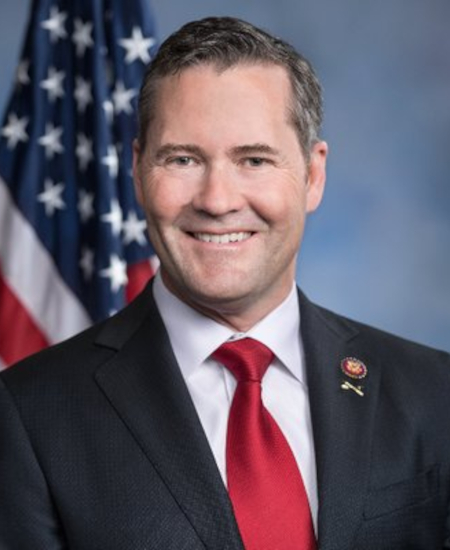
Rep. Michael Waltz
Sponsored bills
This concurrent resolution recognizes the historic significance of the 70th anniversary of the founding of the U.S. Army Special Forces and honors Colonel Aaron Bank for his role in establishing the U.S. Army Special Forces. The concurrent resolution also recognizes the sacrifices and accomplishments of U.S. Army Special Forces soldiers and other special operations soldiers in the Armed Forces.
Keeping Russia's Energy and Military Liable for Invading its Neighbors Act or the KREMLIN Act This bill temporarily prohibits federal agencies from contracting with persons that have business operations with the government of Russia or with fossil fuel companies that operate there, with exceptions where necessary to provide humanitarian assistance or disaster relief or where vital to U.S. national security interests. The bill terminates the prohibition when the President submits to specified congressional committees a written certification determining that Russia has reached an agreement relating to the withdrawal of Russian forces and cessation of military hostilities that is accepted by the Ukrainian government, poses no immediate military threat of aggression to any North Atlantic Treaty Organization member, and recognizes the right of the people of Ukraine to independently and freely choose their own government.
Protecting American Sovereignty Act This bill prohibits the federal government from implementing any obligations upon the United States that may be contained in a draft report by a World Health Organization (WHO) working group on strengthening the WHO's preparedness and response to health emergencies. This prohibition shall also apply to any related or successor reports and recommendations regarding pandemics.
Prohibition of Agricultural Land for the People's Republic of China Act This bill requires the President to prohibit nonresident aliens, foreign businesses, and agents associated with China's government from (1) purchasing agricultural (including ranching) real estate located in the United States, or (2) participating in Department of Agriculture programs that are unrelated to food and safety regulatory requirements.
Alzheimer's Accountability and Investment Act This bill requires the National Institutes of Health to annually submit, beginning in FY2024, an estimate of its budget and personnel needs for carrying out initiatives pursuant to the National Alzheimer's Project. This project supports coordination of federal planning, research, and other efforts to address Alzheimer's disease and related dementias.
NAPA Reauthorization Act This bill extends through 2035 and makes other changes to the National Alzheimer's Project. This project supports coordination of federal planning, programs, and other efforts to address Alzheimer's disease and related dementias. In particular, the bill incorporates a focus on promoting healthy aging and reducing risk factors associated with cognitive decline. The bill also expands the membership of the Advisory Council on Alzheimer's Research, Care, and Services to include (1) a researcher with experience recruiting and retaining diverse clinical trial participants, (2) an individual diagnosed with Alzheimer's disease, and (3) representatives from additional federal agencies (e.g., the Department of Justice and the Office of Management and Budget).
This resolution condemns the unauthorized leak of a draft Supreme Court opinion concerning abortion and the related violence, property damage, and attempted intimidation of Supreme Court Justices by activists. It also encourages the enforcement of federal criminal laws that prohibit protests and picketing outside of the homes of federal judges, jurors, witnesses, and others involved in the U.S. court system.
Combatting Painful Inflation (CPI) Act This bill directs the National Science Foundation to commission a study on the effects of inflation. Among other requirements, the study must measure the economic impact of inflation on the American people, including an analysis of cost-of-living impacts; assess how the increase in inflation has harmed the American workforce through decreased, less valuable wages; evaluate the impact of inflation on rural and underserved communities throughout the country; and make recommendations to Congress on the impact of further government spending with regard to inflation.
Security Clearance Portability for Departing Servicemembers Act of 2022 This bill addresses the security clearance of former members of the Armed Forces or former civilian employees of the Department of Defense (DOD) after separation or retirement who require security clearance for employment as covered DOD contractors. Specifically, during the one-year period following the separation or retirement, DOD must treat the previously held security clearance as an active clearance for purposes of former members or employees retaining employment with covered DOD contractors. During the two-year period following that year, DOD must ensure the adjudication of any request submitted by such employee for reactivation of a previously held security clearance for purposes of employment is completed not later than 180 days after the date of submission.