

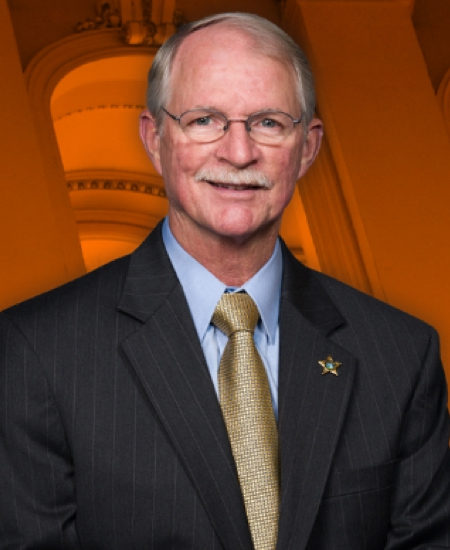
Photo of John H. Rutherford
R United States House · District 5 · Florida On the 2026 ballot

Rep. John H. Rutherford

Compare
Total votes
2,837
all sessions
Attendance
96%
125 missed
Lower than 91% of chamber peers
With party
94%
of cast votes
Higher than 87% of chamber peers
Bipartisan score
3%
crosses aisle rarely
Lower than 88% of chamber peers
Sponsored
1,242
bills & resolutions
Near the chamber average
Committees
4
assignments
1,242 bills and resolutions

Sponsored bills

Total
1,242
Primary
29
Co-sponsor
1,213
This page
1,242
matching current filters
Co-sponsor HR 1227
In committee · United States House · Co-sponsor
Alternatives to PAIN Act

Alternatives to Prevent Addiction In the Nation Act or the Alternatives to PAIN Act This bill reduces cost-sharing and prohibits the imposition of certain utilization requirements under the Medicare prescription drug benefit for certain non-opioid pain management drugs. Specifically, the bill requires such drugs to be covered without a deductible and to be placed on the lowest cost-sharing tier (if any). The bill also prohibits the imposition of prior authorization requirements (i.e., requiring prior approval from a plan) or step therapy requirements (i.e., requiring the use of alternative drugs before a drug is covered under a plan) with respect to such drugs.

In committee Feb 12, 2025 1 co-sponsor
Co-sponsor HR 1232
In committee · United States House · Co-sponsor
National Right-to-Work Act

Maddy summaryHR 1232, the National Right-to-Work Act, would make union membership voluntary for workers in most private-sector jobs by removing legal requirements for employees to join a union or pay dues as a condition of employment. It directly affects workers in unionized workplaces covered by the National Labor Relations Act (including most private employers) and railroad workers covered by the Railway Labor Act. The key change eliminates provisions that allowed "union security agreements" (requiring dues or membership), meaning workers could no longer be forced to pay union fees to keep their jobs. This bill does not change other labor rights or create new programs - it only modifies existing laws to allow workers to opt out of union membership and financial obligations.

In committee Feb 12, 2025 1 co-sponsor
Co-sponsor HR 1268
In committee · United States House · Co-sponsor
Extending Limits of U.S. Customs Waters Act

Maddy summaryHR 1268 updates the legal definition of U.S. customs waters in two key laws (the Tariff Act of 1930 and the Anti-Smuggling Act) to align with current international maritime standards. It replaces the outdated "four leagues from the coast" language with specific references to the U.S. territorial sea (per Presidential Proclamation 5928, 1988) and contiguous zone (per Presidential Proclamation 7219, 1999). This change directly affects U.S. Customs and Border Protection enforcement activities in coastal waters. The bill makes no new policy or tax changes - it only clarifies existing legal boundaries for customs jurisdiction. The update takes effect upon the bill's enactment.

In committee Feb 12, 2025 1 co-sponsor
Co-sponsor HR 1193
In committee · United States House · Co-sponsor
Future in Logging Careers Act

Maddy summaryThis bill amends the Fair Labor Standards Act to create child labor exemptions for specific logging work. It allows 16- and 17-year-olds to work in mechanized timber harvesting operations (like felling, processing, and transporting timber using machinery) that the Secretary of Labor deems particularly hazardous, provided the employer is not owned or operated by a parent or guardian. The exemption applies to jobs involving equipment such as feller-bunchers, forwarders, and whole tree processors, but excludes children working for non-family-owned logging businesses. It does not create new career programs but modifies existing child labor restrictions for certain logging occupations.

In committee Feb 11, 2025 1 co-sponsor
Co-sponsor HR 1192
In committee · United States House · Co-sponsor
To ensure that Big Cypress National Preserve may not be designated as wilderness or as a component of the National Wilderness Preservation System, and for other purposes.

This bill prohibits the Big Cypress National Preserve in Florida from being designated as wilderness or as a component of the National Wilderness Preservation System. The National Park Service currently manages Big Cypress National Preserve, which is a freshwater swamp ecosystem of 729,000 acres.  In general, development activities, commercial activities, permanent structures, and roads are prohibited in wilderness areas. In contrast, natural preserves typically allow some development activities, such as hunting or oil and gas exploration.

In committee Feb 11, 2025 1 co-sponsor
Co-sponsor HR 1175
In committee · United States House · Co-sponsor
Blind Americans Return to Work Act of 2025

Blind Americans Return to Work Act of 2025 This bill requires the Social Security Administration to carry out a demonstration project during which blind Social Security Disability Insurance (SSDI) beneficiaries receive reduced benefits commensurate with income above certain thresholds. Under current law, only individuals who earn under a specified monthly income, known as the substantial gainful activity (SGA) threshold, are considered disabled and thereby eligible for SSDI benefits. For blind workers, this limit is $2,700 per month in 2025. SSDI beneficiaries may earn beyond the SGA threshold for a limited period of time, known as the trial work period , before their benefits are suspended and ultimately terminate. The bill establishes a 20-year demonstration project during which individuals who are entitled to SSDI benefits by reason of blindness and who earn above the SGA threshold continue to receive benefits at an amount gradually reduced commensurate with their earnings beyond a specified amount. During this period, blind workers’ SSDI benefits must be reduced by $1 for every $2 that a worker earns above the sum of (1) the SGA threshold, and (2) the worker’s expenses reasonably attributable to their work. The SGA threshold may not be used to determine whether an individual is disabled during this period, and blind workers’ SSDI benefits may not be terminated due to work-related earnings. The trial work period also must not apply.  After 10 years, affected beneficiaries may opt out of the modified benefits structure.

In committee Feb 10, 2025 1 co-sponsor
Co-sponsor HR 1138
In committee · United States House · Co-sponsor
Payment Choice Act of 2025

Maddy summaryHR 1138, the Payment Choice Act of 2025, requires most retail businesses to accept cash for in-person purchases up to $500 per transaction and prohibits charging higher prices for cash payments compared to other methods. Businesses may temporarily refuse cash only due to system failures, insufficient change, or if they offer a prepaid card conversion device meeting strict conditions (no fees, no minimum deposit, no expiration). The bill allows businesses a 5-year period to phase in accepting $50 bills or larger, after which the Treasury Secretary must mandate acceptance of $1-$20 bills. Consumers can send a 45-day notice to businesses for violations before pursuing legal action, with potential damages of at least $250 per violation. The law does not override stricter state cash acceptance protections.

In committee Feb 7, 2025 1 co-sponsor
Co-sponsor HR 1151
In committee · United States House · Co-sponsor
Freedom to Invest in Tomorrow’s Workforce Act

Maddy summaryThis bill expands 529 college savings account flexibility by allowing funds to cover costs for industry-recognized postsecondary credentials, not just traditional degrees. It defines "qualified expenses" to include tuition/fees for recognized credential programs (like certifications or apprenticeships), required testing fees, and continuing education needed to maintain credentials. To qualify, programs must meet specific criteria, such as appearing on state lists under the Workforce Innovation and Opportunity Act or being listed in VA or Defense directories. The change applies to 529 distributions made after the law's enactment, giving families more options to use these accounts for job-focused training.

In committee Feb 7, 2025 1 co-sponsor
Co-sponsor HR 1060
In committee · United States House · Co-sponsor
Modern Authentication of Pharmaceuticals Act of 2025

Maddy summaryThis bill requires manufacturers to include a unique physical or chemical identifier on each pill of certain controlled substances in solid oral dosage form (like tablets or capsules). It directly affects pharmaceutical companies producing these specific medications, mandating the identifier to be added to every dose manufactured five years after the bill's enactment. The identifier must be machine-readable and help verify the product's authenticity throughout the supply chain. This change aims to improve tracking and combat counterfeit drugs in the distribution system.

In committee Feb 6, 2025 1 co-sponsor
Co-sponsor HR 1046
In committee · United States House · Co-sponsor
Marc Fischer Memorial Act

Maddy summaryHR 1046, the Marc Fischer Memorial Act, requires the Bureau of Prisons to implement digital mail scanning technology at all federal prisons to detect fentanyl and other synthetic drugs in inmate mail. It mandates a strategy within 90 days of an evaluation, including 100% scanning of all mail, digital copies of mail to inmates within 24 hours, and physical mail delivery within 30 days for non-contaminated items. The bill directly affects federal prison staff, inmates, and the Bureau of Prisons by aiming to reduce drug-related overdoses and alleviate staff workload tied to mail processing. Implementation must be completed within three years, with annual reports tracking detected drugs and strategy efficiency. The legislation focuses on concrete technological and procedural changes to enhance safety, referencing a successful pilot program at two facilities.

In committee Feb 6, 2025 1 co-sponsor
Showing 281 to 290 of 1,242 bills
Previous 1 … 28 29 30 … 125 Next