

Save Money on Auto Repair Transportation Act or the SMART Act This bill limits design patent infringement liability for component parts used to repair the exterior of a motor vehicle. Specifically, the bill limits liability for infringement of a design patent that claims the appearance of a component part of a motor vehicle's exterior, such as a hood or fender. The act of making, offering to sell within the United States, or importing into the United States an article of manufacture (such as an exterior component part from an aftermarket manufacturer) that would otherwise infringe such a design patent shall not constitute infringement if the purpose of the article of manufacture is to repair a motor vehicle to restore it to its original appearance. In addition, 30 months after a motor vehicle with an exterior component part covered by a design patent is offered for sale in any country, it shall not constitute design patent infringement to use or sell within the United States an otherwise-infringing article of manufacture if the purpose of that article of manufacture is to repair the motor vehicle to restore it to its original appearance.
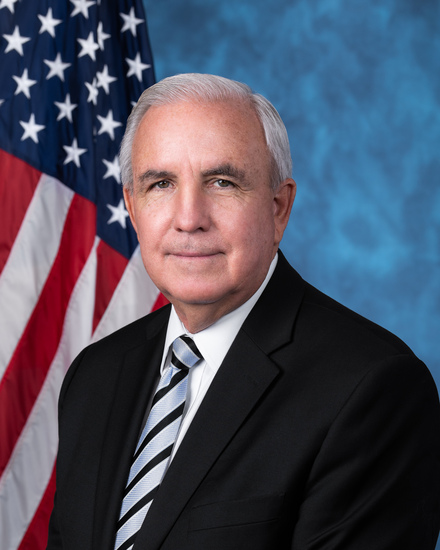
Rep. Carlos A. Gimenez
Sponsored bills
Maddy summaryH.J. Res. 26 is a congressional disapproval resolution blocking the District of Columbia Council's approval of its Revised Criminal Code Act of 2022 (D.C. Act 24-789). It directly affects the District of Columbia by preventing the new criminal code from taking effect, as Congress disapproved the Council's action under the Home Rule Act. The resolution formally rejects the Council's enactment of the code, which was transmitted to Congress on January 27, 2023. This procedural action stops the District from implementing the revised criminal code without further congressional action.
Maddy summaryThis bill adds a new section to federal law making murder of law enforcement officers a capital offense. It mandates death or life imprisonment for individuals who murder federal officers during official duties, or state/local officers when the crime involves interstate activity (like using a weapon that crossed state lines). Key provisions include specific aggravating factors considered for sentencing, such as ambush tactics, prior violent advocacy, or ties to extremist groups. The bill explicitly states it does not affect state court jurisdiction over such cases.
Maddy summaryThis bill authorizes a Congressional Gold Medal to honor the "Hello Girls" - female telephone operators who served in the Army Signal Corps during World War I. They provided critical battlefield communications in France (connecting 26 million calls), wore military uniforms, and faced combat risks, but were denied veteran benefits for 60 years due to being classified as civilian contractors. The medal recognizes their pioneering service, devotion, and the decades-long struggle to gain military recognition. The award follows similar recognition for other WWII women veterans and aims to correct the historical injustice they faced.
Maddy summaryThis bill expands the use of 529 college savings accounts to cover career training and credentialing costs. It allows funds to pay for tuition, fees, books, and testing expenses related to recognized postsecondary credential programs (like vocational certifications) that meet specific standards under the Workforce Innovation and Opportunity Act. The change directly affects workers seeking industry-recognized credentials - such as nursing certifications or IT certifications - instead of traditional degrees. It treats these expenses the same as traditional college costs for 529 account withdrawals, making it easier to save for career-focused training. The provision applies to expenses paid after the bill's enactment date.
Maddy summaryHR 1388 authorizes the minting of commemorative coins to honor the 1865 Sultana steamboat disaster, the deadliest maritime tragedy in U.S. history. It specifies three coin types ($5 gold, $1 silver, and half-dollar) with defined weights and compositions, to be sold at face value plus surcharges ($35, $10, and $5 per coin, respectively). All surcharges collected will fund the Sultana Historical Preservation Society for museum development, including exhibits, artifact preservation, and facility construction. The coins are legal tender but intended for collectors, with sales limited to a one-year period starting January 2023.
Maddy summaryHR 1348 removes a deadline for the Secretary of Defense to decide on joint use of Homestead Air Reserve Base with civil aviation. It amends the National Defense Authorization Act for Fiscal Year 2023 by deleting the requirement that this decision be made by September 30, 2026. This change allows the Department of Defense to proceed without a fixed timeline for managing the base's dual military-civilian use. The bill does not alter the underlying policy on base operations but eliminates the specific deadline for the Secretary's action.
Maddy summaryThis bill (HR 1239) renames a specific street segment in Washington, D.C., between 16th Street NW and Fuller Street NW to "Oswaldo Payá Way." It also redesignates the address 2630 16th Street NW as 2630 Oswaldo Payá Way for all official references. The bill is procedural, with no policy changes beyond the symbolic renaming to honor Cuban dissident Oswaldo Payá Sardiñas. The change affects District of Columbia street signage and official records referencing that location.
Maddy summaryHRES 132 is a non-binding House resolution expressing condolences for the over 36,000 earthquake victims in Türkiye and Syria and commending humanitarian response efforts. It specifically condemns the Assad regime for obstructing aid delivery and exploiting the disaster, urging the Biden administration to open all UN border crossings for aid and prevent U.S.-funded assistance from being diverted to Syria’s government. The resolution also calls for continued enforcement of the Caesar Syria Civilian Protection Act to protect Syrian civilians. As a symbolic resolution, it does not create new law but formally directs the administration’s diplomatic approach to the crisis.
Maddy summaryThe Stop the Cartels Act (HR 597) aims to disrupt drug trafficking organizations and related criminal activities by requiring enhanced intelligence gathering on cartels in Mexico and Central American countries, mandating improved U.S.-Mexico law enforcement cooperation, and cutting federal funding from jurisdictions that restrict immigration enforcement. The bill creates a "Special Transnational Criminal Organization" designation for major cartels like the Sinaloa Cartel and Jalisco New Generation Cartel, requires monthly reports on migrant encounters at the border, and establishes refugee processing centers in Mexico and Central America. It also increases staffing for immigration courts by 500 judges, prohibits asylum applications from nationals of countries with refugee processing centers, and reauthorizes substance abuse prevention funding at higher levels while repealing several existing drug programs. These provisions directly affect U.S. intelligence and law enforcement agencies, Mexican and Central American governments, local jurisdictions receiving federal funds, and migrants seeking asylum or refugee status.