

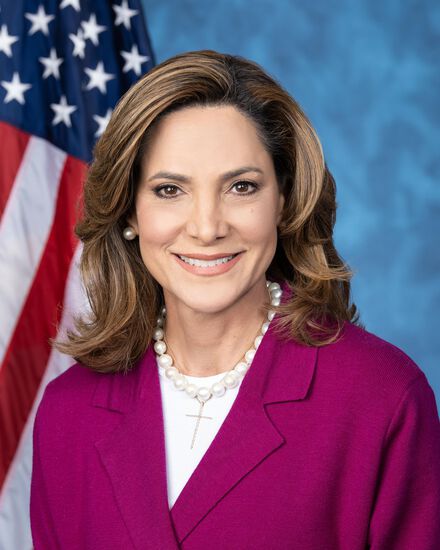
Photo of Maria Elvira Salazar
R United States House · District 27 · Florida On the 2026 ballot

Rep. Maria Elvira Salazar

Compare
Total votes
2,831
all sessions
Attendance
92%
221 missed
Lower than 95% of chamber peers
With party
90%
of cast votes
Near the chamber average
Bipartisan score
5%
crosses aisle rarely
Near the chamber average
Sponsored
1,439
bills & resolutions
Near the chamber average
Committees
7
assignments
1,439 bills and resolutions

Sponsored bills

Total
1,439
Primary
73
Co-sponsor
1,366
This page
1,439
matching current filters
Co-sponsor HRES 1351
In committee · United States House · Co-sponsor
Commending the courage, bravery, and resolve of the fathers, mothers, sons, and daughters of Cuba, who, three years ago, stood in the face of brutal harassment, beatings, and torture to protest against the Communist Cuban regime, demanding access to their fundamental rights to life, dignity, and freedom.

Maddy summaryHRES 1351 is a symbolic resolution commending Cuban citizens who protested against the Communist regime on July 11, 2021. It honors their courage in demanding fundamental rights, while condemning the regime's crackdown - including detaining over 1,400 protesters, cutting internet access, and subjecting activists like José Daniel Ferrer García to torture. The resolution calls for the immediate release of imprisoned protesters and urges the U.S. government to prioritize democracy and human rights in Cuba policy over "unilateral concessions." As a non-binding resolution, it does not create new laws or policies but expresses congressional support for Cuban pro-democracy activists.

In committee Jul 10, 2024 1 co-sponsor
Co-sponsor HRES 1349
In committee · United States House · Co-sponsor
Recognizing the continued success of the Food for Peace Act.

Maddy summaryHRES 1349 is a symbolic House resolution recognizing the success of the Food for Peace Act, which provides U.S. humanitarian food aid to global populations facing hunger. It does not create new policy or funding but formally acknowledges the program’s impact - such as reaching 53 million people with emergency aid in 2022 - and highlights global hunger statistics (e.g., 783 million people hungry in 2022). The resolution urges continued U.S. funding prioritization for the program but has no binding effect or direct policy changes. It directly affects no new groups, as it solely expresses congressional support for an existing aid program.

In committee Jul 10, 2024 1 co-sponsor
Co-sponsor HR 8992
In committee · United States House · Co-sponsor
Stop Fentanyl at the Border Act

Maddy summaryHR 8992, the Stop Fentanyl at the Border Act, allocates $5.8 billion in federal funding to enhance border security efforts focused on intercepting fentanyl and other illegal drugs. The bill provides $3.4 billion for U.S. Customs and Border Protection (CBP) staffing, including hiring bonuses, mental health support, and processing coordinators, and $1.09 billion for advanced scanning technology and drug interdiction capabilities at land borders. Additional funds target disrupting fentanyl trafficking networks ($223 million for ICE), outbound firearm/currency inspections ($285 million), and law enforcement coordination (DEA, DOJ, U.S. Marshals). These provisions directly affect CBP officers, ICE agents, and border ports of entry by expanding personnel, technology, and interdiction strategies. The bill requires annual reports to Congress on the effectiveness of new staffing, scanning systems, and outbound inspection programs.

In committee Jul 10, 2024 1 co-sponsor
Co-sponsor HR 8978
In committee · United States House · Co-sponsor
Voluntary Sustainable Apparel Labeling Act

Maddy summaryHR 8978, the Voluntary Sustainable Apparel Labeling Act, establishes a voluntary EPA-run program for apparel companies to display standardized sustainability labels on products. The labels must show a numerical summary of full life cycle greenhouse gas emissions (from farming to disposal) and include a QR code linking to detailed data, all verified using international environmental standards. Participating apparel manufacturers and retailers (not end consumers) directly affect the labeling requirements, though participation is optional. The program mandates clear disclosure of who reports specific emission data (manufacturer vs. retailer) and requires EPA verification to prevent misleading claims. The bill also includes penalties for fraudulent label use and requires the EPA to publish effectiveness reports every 5 years.

In committee Jul 10, 2024 1 co-sponsor
Primary HR 8989
In committee · United States House · Lead sponsor
TAKE IT DOWN Act

Maddy summaryThe TAKE IT DOWN Act (HR 8989) creates new federal criminal penalties for publishing nonconsensual intimate images or deepfakes without consent, directly affecting platforms hosting user-generated content and individuals who share such material. It defines "deepfake" as AI-generated intimate content falsely depicting someone, and prohibits publishing these without consent - especially when the victim expected privacy - imposing fines or up to 3 years in prison for offenses involving minors. The bill also requires "covered platforms" (like social media sites) to establish a 48-hour removal process for reported nonconsensual content and shields platforms from liability when removing content in good faith. The Federal Trade Commission enforces these provisions as unfair or deceptive practices.

In committee Jul 10, 2024 0 co-sponsors
Co-sponsor HR 4132
Passed · United States House · Co-sponsor
Falun Gong Protection Act

Maddy summaryHR 4132 would require the U.S. to impose sanctions on Chinese officials responsible for forced organ harvesting from Falun Gong practitioners, including blocking their property and denying visas. It mandates a report on China's organ transplant system within one year, assessing organ sources, procurement timelines, and whether persecution of Falun Gong constitutes an atrocity. The bill directs the U.S. to avoid all cooperation with China's organ transplantation system while the Chinese Communist Party remains in power. It cites findings of systemic persecution and alleged organ harvesting as justification for these policy measures.

Passed Jul 8, 2024 1 co-sponsor
Co-sponsor HR 2365
Signed into law · United States House · Co-sponsor
Dr. Emmanuel Bilirakis and Honorable Jennifer Wexton National Plan to End Parkinson’s Act

Maddy summaryThis bill (HR 2365, Public Law 118-66) directs the U.S. Department of Health and Human Services (HHS) to establish the National Parkinson’s Project. It requires HHS to create and update a coordinated national plan for preventing, diagnosing, treating, and researching Parkinson’s disease and related disorders (including multiple system atrophy and progressive supranuclear palsy), while coordinating federal research and care efforts across agencies like the NIH, CDC, and VA. The law mandates annual progress assessments, an advisory council with patient advocates and diverse experts, and annual reports to Congress on federal Parkinson’s programs and recommendations for improvement. It affects federal agencies managing Parkinson’s-related programs and aims to improve care coordination and research efficiency for patients and caregivers, with the law sunsetting in 2035.

Signed into law Jul 2, 2024 1 co-sponsor
Co-sponsor HR 8206
In committee · United States House · Co-sponsor
To ensure that Big Cypress National Preserve may not be designated as wilderness or as a component of the National Wilderness Preservation System, and for other purposes.

Maddy summaryHR 8206 prohibits Big Cypress National Preserve in Florida from being designated as wilderness or added to the National Wilderness Preservation System. This means the preserve will not receive wilderness protections, which typically restrict activities like off-road vehicle use and logging. The bill directly affects future management decisions for the preserve by legally blocking federal wilderness designations. It is a specific policy change preventing new restrictions on land use within the preserve.

In committee Jun 27, 2024 1 co-sponsor
Co-sponsor HR 7925
In committee · United States House · Co-sponsor
Modernizing Access to Our Public Oceans Act

Maddy summaryThis bill requires the Secretary of Commerce to standardize and publish geospatial data about public ocean and waterway access rules on a public website within 4 years. It mandates detailed information on where fishing is restricted, waterway closures, speed limits, allowed vessel types (like motorboats or kayaks), and fishing method rules. The data will include geographic boundaries of protected areas, seasonal closures, and navigation details like depth charts. This directly affects recreational users (boaters, anglers) and commercial operators who need clear, up-to-date access information for Federal waterways and fishing areas. The bill does not change existing fishing regulations but makes compliance information more accessible.

In committee Jun 27, 2024 1 co-sponsor
Co-sponsor HR 8851
In committee · United States House · Co-sponsor
Strengthening Citizenship Services for Veterans Act

Maddy summaryHR 8851, the Strengthening Citizenship Services for Veterans Act, requires U.S. Citizenship and Immigration Services (USCIS) to conduct citizenship tests, fingerprinting, and oath ceremonies for eligible veteran noncitizens at accessible U.S. ports of entry or overseas embassies/consulates. It directly affects noncitizen veterans who are either outside the U.S., previously removed from the U.S., or deemed inadmissible under immigration law. The bill mandates joint guidance from the Homeland Security and State Departments on implementation methods and requires a report on effectiveness within 180 days of enactment. These changes aim to streamline the naturalization process for veteran noncitizens with pending or future citizenship applications.

In committee Jun 26, 2024 1 co-sponsor
Showing 511 to 520 of 1,439 bills
Previous 1 … 51 52 53 … 144 Next