

Maddy summaryThis bill (HR 6633) renames a U.S. Postal Service facility at 9355 113th Street in Seminole, Florida, as the "Army SSG Ryan Christian Knauss Memorial Post Office Building." It directly affects the postal service location and all official federal references to it. The bill requires all government documents, maps, and records to use the new name moving forward. As a commemorative resolution, it has no policy or funding impact - it solely honors Army Specialist Ryan Christian Knauss through the building name.
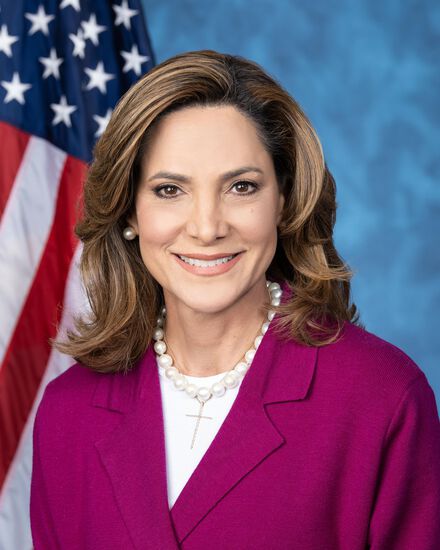
Rep. Maria Elvira Salazar
Sponsored bills
Maddy summaryThis bill designates the U.S. Postal Service facility at 14280 South Military Trail in Delray Beach, Florida, as the "Benjamin Berell Ferencz Post Office Building." It is a ceremonial naming resolution with no substantive policy changes or impacts on residents, services, or regulations. The bill simply updates official references (such as maps or documents) to use the new name for this specific post office location. It was enacted on January 2, 2025, following passage by both House and Senate in December 2024.
Maddy summaryThis bill designates the U.S. Postal Service facility at 109 Live Oaks Boulevard in Casselberry, Florida, as the "Colonel Joseph William Kittinger II Post Office Building." It directly affects the postal facility and all official U.S. government references to it. The key provision changes the building's official name in all federal laws, documents, maps, and records to reflect this designation. The bill does not create new policies or funding; it is purely a ceremonial naming action.
Maddy summaryThis bill (HR 1823) officially renames the U.S. Postal Service facility at 207 East Fort Dade Avenue in Brooksville, Florida, as the "Specialist Justin Dean Coleman Memorial Post Office Building." It directly affects the building's official name and all future references to it in government documents, maps, or records. The key provision is a simple name change to honor Specialist Justin Dean Coleman, a U.S. Army veteran. This is a procedural bill with no new policies or funding, solely commemorating an individual through the building's designation.
Maddy summaryThis bill allows Members of Congress to use Department of Veterans Affairs (VA) facilities for meetings with veterans who are their constituents. It requires the VA Secretary to create regulations within 90 days, ensuring spaces are visible, accessible during business hours, and rented at rates similar to standard office space in the area. The regulations prohibit campaigning, political discussions, photographing patients without consent, and meetings during the 60 days before federal elections. It directly affects veterans seeking congressional assistance and Members of Congress who can now hold constituent meetings at VA locations. The bill does not change VA benefits or services but streamlines access to representatives for veterans.
Maddy summaryThe Autism CARES Act of 2024 reauthorizes and enhances federal programs supporting individuals with autism spectrum disorder. It requires the National Institutes of Health to expand research to include more fields like gerontology and psychiatry, and to ensure research reflects the full range of needs of people with autism, including those with co-occurring conditions. The bill mandates regular reports to Congress on progress, mental health needs, and transition services for young adults with autism, while increasing funding for autism-related programs from fiscal year 2025 through 2029. This legislation directly affects individuals with autism, their families, caregivers, and healthcare providers by improving access to evidence-based services and research.
Maddy summaryThis bill, HR 1097 (Everett Alvarez, Jr. Congressional Gold Medal Act of 2023), authorizes the award of a Congressional Gold Medal to Everett Alvarez, Jr., in recognition of his service as a U.S. Navy pilot and Vietnam War prisoner of war. It directly honors Alvarez, who was the first U.S. pilot shot down in the Vietnam War, spent over 8.5 years in captivity, and later served in the Peace Corps and Veterans Administration. The bill’s key mechanism is directing the U.S. Mint to strike a gold medal bearing his name and image, with bronze duplicates available for sale to cover costs. It does not create new policies or affect any group beyond the honoree.
Maddy summaryThis bill (HR 1753) ensures 310+ female service members who served in specialized cultural support teams (2010-2021, identified by skill codes R2J/5DK) receive proper military records and veterans benefits. It requires the military to include this service in personnel records and count it as combat service for disability claims. Veterans denied benefits for injuries from this service can now file supplemental claims within three years of enactment, with claims treated as if filed on their original claim date. The bill also mandates VA outreach to inform affected veterans and families about this new process.
Maddy summaryThe MERIT Act amends Medicare's coverage rules to require individual drug reviews for research purposes. It changes how Medicare determines if a drug is "reasonable and necessary" under Section 1142 research programs, mandating separate evaluations for each drug instead of class-based decisions. This directly affects Medicare beneficiaries and drug manufacturers participating in research under Section 1142. The key provision specifies that coverage determinations must apply to each specific drug or biological involved in the research, not to groups of similar drugs. This policy change alters the Medicare national coverage determination process for research-related treatments.
Maddy summaryThe VALOR Act of 2024 establishes specific criteria for determining when a democratically elected government is in power in Venezuela, requiring free and fair elections with international observers, respect for human rights, release of political prisoners, and restoration of democratic institutions. The bill authorizes sanctions against the Maduro regime, including financial restrictions on debt instruments, cryptocurrency transactions, and blocking property of the Venezuelan government. It creates mechanisms for the U.S. to provide humanitarian and democracy-building assistance through independent NGOs once a democratically elected government is recognized, with safeguards to ensure aid reaches the people of Venezuela. The bill requires regular reporting to Congress on sanctions implementation, assistance programs, and foreign entities doing business with the Maduro regime.