

Maddy summaryHR 485, the Muhammad Ali Congressional Gold Medal Act, authorizes Congress to award a gold medal in recognition of Muhammad Ali's lifetime contributions to sports, civil rights, and humanitarian causes. The bill directs the Treasury Secretary to strike the medal and present it to Ali's widow, Lonnie Ali, following his death in 2016. It also permits the sale of bronze duplicates to cover costs, with proceeds going to the U.S. Mint. This is a commemorative measure with no policy impact, solely honoring Ali's legacy through a symbolic medal.
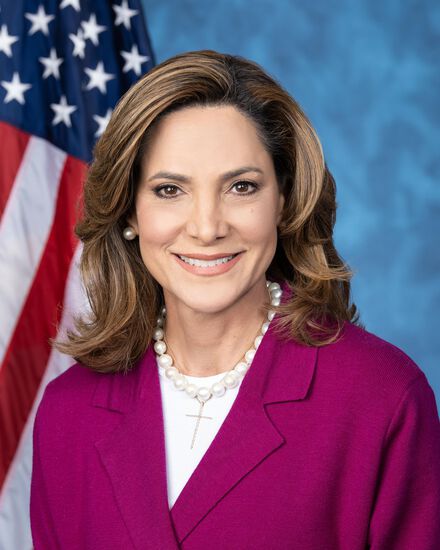
Rep. Maria Elvira Salazar
Sponsored bills
Maddy summaryHR 506, the "Security First Act," allocates $110 million annually (2025-2028) for border security grants to state/local law enforcement through the Operation Stonegarden program, funded by a new trust fund using seized monetary instruments at the border. It requires the State Department to assess whether major Mexican cartels (like Sinaloa and Jalisco New Generation) and gangs (like Tren de Aragua) meet criteria for foreign terrorist organization designation. The bill mandates a detailed technology needs analysis by DHS within one year, evaluating border security tech gaps, new surveillance systems, and infrastructure to address threats like drug trafficking and human smuggling. This analysis must be updated biannually and includes assessing privacy impacts, staffing needs, and coordination with Mexican law enforcement.
Maddy summaryHR 450, the FORCE Act, prevents the U.S. government from removing Cuba from the State Sponsors of Terrorism list. It requires the President to make a specific determination under the 1996 LIBERTAD Act before Cuba can be removed. The bill directly affects Cuba's international designation status and U.S. foreign policy actions toward the country. It does not change existing law but blocks any removal until the specified determination is made. The provision applies to both the President and the Secretary of State.
Maddy summaryThe Combating Global Corruption Act of 2025 requires the State Department to annually rank all foreign countries into three tiers based on anti-corruption efforts: Tier 1 (full compliance with minimum standards), Tier 2 (making progress), and Tier 3 (minimal or no efforts). Countries ranked Tier 3 trigger potential sanctions under the Global Magnitsky Act against corrupt foreign officials and entities. The bill also mandates U.S. embassies in Tier 2 and Tier 3 countries to appoint anti-corruption liaisons to coordinate U.S. anti-corruption programs. This directly affects foreign governments' international standing and targets specific individuals for sanctions based on documented corruption.
Maddy summaryThe REVOCAR Act of 2025 prohibits U.S. persons (including citizens, companies, and individuals in the U.S.) from investing in or conducting business with Venezuela's energy sector - specifically targeting Petroleos de Venezuela, S.A. (PDVSA) and the Maduro regime - until the regime publicly recognizes the results of Venezuela's July 28, 2024, presidential election. The bill bars transactions involving energy sector goods, services, or finance and requires the Treasury Secretary to implement it using existing sanctions authorities. Prohibitions end automatically by December 31, 2027, or sooner if the President certifies Maduro has accepted the election outcome. The President may grant limited 90-day waivers for national security reasons, but must submit detailed reports to Congress explaining the rationale and impact on Venezuela's democratic transition.
Maddy summaryThis bill designates the U.S. Postal Service facility at 290 NW Peacock Boulevard in Port St. Lucie, Florida, as the "Trooper Zachary Fink Post Office Building." It updates all official U.S. government references (including laws, maps, and documents) to use this new name for the facility. The bill directly affects the postal facility and any federal records mentioning its location. As a naming resolution, it has no policy or funding provisions beyond the official designation.
Maddy summaryHR 268, the STOP MADURO Act, increases the maximum reward for information leading to the arrest and conviction of Venezuela's President Nicolás Maduro Moros from $5 million to $100 million under the State Department's rewards program. The bill authorizes this reward using assets already frozen from Maduro and his regime under existing U.S. sanctions, including those from the Foreign Narcotics Kingpin Designation Act and multiple executive orders. It directly affects Maduro and his regime officials by offering a significantly larger financial incentive for their arrest. The key mechanism is redirecting funds from previously seized assets to fund the enhanced reward, with no new appropriations required. This is a procedural change to the rewards program, not a new sanction.
Maddy summaryHR 82, the Social Security Fairness Act of 2023, repeals two provisions that reduce Social Security benefits for certain government workers. It eliminates the Government Pension Offset (GPO), which cuts spousal or survivor benefits for people with pensions from jobs not covered by Social Security (like federal or state government roles), and the Windfall Elimination Provision (WEP), which lowers retirement benefits for those with similar pensions. The law takes effect for benefits paid after December 2023, requiring the Social Security Administration to adjust benefit calculations to remove these reductions. This change directly affects public-sector employees who previously had their Social Security benefits reduced due to their government pensions.
Maddy summaryThe Jackie Robinson Ballpark National Commemorative Site Act designates Jackie Robinson Ballpark in Daytona Beach, Florida, as a National Commemorative Site, making it part of the African American Civil Rights Network. The bill requires the Secretary of the Interior to conduct a special resource study within two years to evaluate the site's national significance and preservation options, without designating it as a unit of the National Park System. This designation does not affect private property rights, local zoning, or current site management by its owners.
Maddy summaryHR 7365, the VETS Safe Travel Act, provides free TSA PreCheck access to veterans with specific service-connected disabilities. It applies to veterans enrolled in VA healthcare who have lost or lost use of an extremity, experience paralysis, or have permanent blindness, requiring mobility aids like wheelchairs or prosthetics. The bill requires TSA and the VA to coordinate implementation within one year, including outreach to veterans about this benefit and reporting to Congress on progress.