

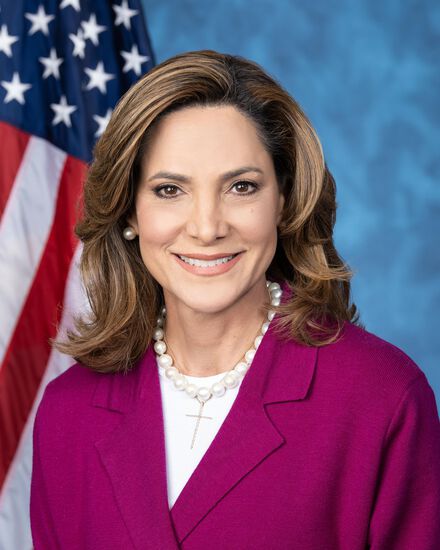
Photo of Maria Elvira Salazar
R United States House · District 27 · Florida On the 2026 ballot

Rep. Maria Elvira Salazar

Compare
Total votes
2,831
all sessions
Attendance
92%
221 missed
Lower than 95% of chamber peers
With party
90%
of cast votes
Near the chamber average
Bipartisan score
5%
crosses aisle rarely
Near the chamber average
Sponsored
1,434
bills & resolutions
Near the chamber average
Committees
7
assignments
1,434 bills and resolutions

Sponsored bills

Total
1,434
Primary
73
Co-sponsor
1,361
This page
1,434
matching current filters
Primary HR 6892
In committee · United States House · Lead sponsor
To authorize the Secretary of the Treasury to subscribe to additional shares of the capital stock of the Inter-American Investment Corporation.

Maddy summaryHR 6892 authorizes the U.S. Treasury Secretary to subscribe to up to 25,124 additional shares of the Inter-American Investment Corporation (IIC), a multilateral development bank focused on Latin America and the Caribbean. This action requires prior approval through annual appropriations bills, meaning Congress must specifically fund this share purchase each year. The bill directly affects U.S. Treasury operations and the IIC's capital structure, enabling the U.S. to maintain or increase its financial stake in the institution. It is a procedural funding measure with no immediate policy changes beyond enabling potential future investment.

In committee Dec 18, 2025 0 co-sponsors
Co-sponsor HR 6809
In committee · United States House · Co-sponsor
Alyssa’s Act of 2025

Maddy summaryAlyssa's Act of 2025 expands the Federal Clearinghouse on School Safety Evidence-based Practices to collect and analyze school safety data, including information on school shootings and emergency response effectiveness. The bill creates a National School Safety Data Center to track incidents, injuries, and response methods, while requiring emergency response maps for schools to meet specific digital standards for accessibility and real-time updates. It also establishes a program to develop and test panic alarm technology for schools, and mandates annual reports on school safety master plans developed by states and local educational agencies. The legislation requires coordination with the U.S. Secret Service's National Threat Assessment Center to align school safety practices with evidence-based approaches.

In committee Dec 18, 2025 1 co-sponsor
Co-sponsor HR 6766
In committee · United States House · Co-sponsor
Essential Caregivers Act of 2025

Essential Caregivers Act of 2025   This bill prohibits certain health care facilities from limiting the access of essential caregivers to residents of those facilities, including during designated emergency periods.   Specifically, the bill generally prohibits Medicare skilled nursing facilities, Medicaid nursing facilities, Medicaid intermediate care facilities, and associated inpatient rehabilitation facilities from restricting the access of essential caregivers to residents of the facilities, including during emergency periods in which visitation rights are otherwise restricted. During emergency periods, facilities may restrict access for an initial period of up to seven days and for one additional maximum seven-day period (if the additional period is approved by the state health department). Facilities may restrict access for a total of 7 days (or 14 days with the approval of the state health department) during an emergency period. Essential caregivers must agree to comply with any safety protocols set by the facility, which may be no more stringent for caregivers compared to those for staff. Caregivers who fail to comply with these requirements may be denied access, subject to an appeals process.

In committee Dec 16, 2025 1 co-sponsor
Primary HR 6763
In committee · United States House · Lead sponsor
Shelter Act

Maddy summaryHR 6763, the Shelter Act, creates a 25% tax credit for both individuals and businesses to offset qualified disaster mitigation expenditures on their primary residences or places of business. For individuals, the credit is capped at $3,750 annually (or $7,500 for joint returns) with a cumulative $15,000 limit per dwelling, while businesses receive a $5,000 annual limit. Qualified expenditures include roof reinforcement, flood barriers, fire-resistant materials, and other measures to protect against natural disasters like hurricanes, floods, and wildfires. The credit phases out for higher-income taxpayers and cannot be claimed for government-funded improvements, applying to expenses incurred after December 31, 2025.

In committee Dec 16, 2025 0 co-sponsors
Co-sponsor HR 6765
In committee · United States House · Co-sponsor
Safe Passages Act of 2025

Maddy summaryHR 6765, the Safe Passages Act of 2025, establishes a global program to reduce maternal and child mortality in low- and lower-middle-income countries by funding life-affirming health interventions. The bill directs $400 million annually to train local providers (including midwives and community health workers) in preventing/treating leading causes of maternal death (like hemorrhage and preeclampsia), provide medical resources, support father involvement, and deliver nutrition care during the first 1,000 days of life. It explicitly prohibits funding for abortion services and requires programs to promote natural fertility awareness methods and "life-affirming care" aligned with respect for life from conception. The Act mandates annual reporting on training outcomes, facility upgrades, mortality data comparisons, and compliance with its restrictions.

In committee Dec 16, 2025 1 co-sponsor
Co-sponsor HR 452
Signed into law · United States House · Co-sponsor
Miracle on Ice Congressional Gold Medal Act

Miracle on Ice Congressional Gold Medal Act This act provides for the award of Congressional Gold Medals to the members of the 1980 U.S. Olympic men's ice hockey team in recognition of the team's achievement at the 1980 Winter Olympic Games.

Signed into law Dec 12, 2025 1 co-sponsor
Co-sponsor HR 6620
In committee · United States House · Co-sponsor
To amend the National Flood Insurance Act of 1968 to allow for the consideration of private flood insurance for the purposes of applying continuous coverage requirements, and for other purposes.

Maddy summaryHR 6620 amends the National Flood Insurance Act of 1968 to allow private flood insurance policies to count toward meeting continuous coverage requirements. This directly affects property owners who purchase private flood insurance, as it ensures periods covered by private policies are treated the same as National Flood Insurance Program (NFIP) coverage for maintaining continuous coverage. The key provision adds a new section to the Act, requiring the Administrator to consider any continuous coverage period from either NFIP or private policies when applying requirements under the Flood Disaster Protection Act of 1973. This change simplifies coverage continuity for homeowners using private insurance without altering NFIP rules.

In committee Dec 11, 2025 1 co-sponsor
Co-sponsor HR 6670
In committee · United States House · Co-sponsor
Temporary Family Visitation Act

Maddy summaryHR 6670 creates a new nonimmigrant visa category ("family purpose visas") allowing relatives of U.S. citizens or lawful permanent residents to visit temporarily for family events. It requires applicants to provide proof of financial support, short-term medical insurance covering U.S. travel, and a sworn statement to depart within 90 days per calendar year. The bill restricts petitioners from previously sponsoring relatives who overstayed their visas, and explicitly states that these visits do not count toward permanent residency eligibility. This directly affects extended family members (including grandparents, siblings, and nieces/nephews) seeking short-term U.S. visits for social or major life events.

In committee Dec 11, 2025 1 co-sponsor
Co-sponsor HR 6575
In committee · United States House · Co-sponsor
CommonGround for Affordable Health Care Act

Maddy summaryHR 6575, the CommonGround for Affordable Health Care Act, extends enhanced premium tax credits for health insurance through 2026, directly benefiting millions of lower and middle-income Americans purchasing coverage through the ACA marketplace. The bill modifies income thresholds for premium subsidies, creating new income tiers that maintain or increase financial assistance for households earning up to 1,000% of the poverty level. It includes provisions to prevent fraud in health insurance exchanges by imposing civil penalties on agents and brokers who provide false information, and requires transparency in pharmacy benefit manager contracts to improve drug pricing accountability. The legislation also extends the annual open enrollment period for health insurance exchanges for the 2026 plan year, allowing more time for people to enroll or change coverage.

In committee Dec 10, 2025 1 co-sponsor
Co-sponsor HR 6501
In committee · United States House · Co-sponsor
Bipartisan Health Insurance Affordability Act

Maddy summaryThe Bipartisan Health Insurance Affordability Act extends and modifies premium tax credit rules to make health insurance more affordable for people with household incomes up to 700% of the poverty line, with specific provisions for different income tiers. The bill requires pharmacy benefit managers to pass through 100% of rebates to health plans, establishes transparency requirements for drug pricing, and creates mechanisms to prevent fraud in health insurance exchanges. It also extends the annual open enrollment period for 2026 and allows qualified Exchange enrollees to establish health savings accounts, with options to prepay annual premiums or direct part of their premium tax credit into a health savings account.

In committee Dec 9, 2025 1 co-sponsor
Showing 131 to 140 of 1,434 bills
Previous 1 … 13 14 15 … 144 Next