

Maddy summaryHR 1750 sets a new minimum standard for pasteurized orange juice, requiring finished products to contain at least 10.0% orange juice soluble solids (excluding any added sweeteners) by weight. This rule directly affects manufacturers producing and selling pasteurized orange juice in the U.S. market. The bill revises existing federal regulations to enforce this minimum juice content level, ensuring a more consistent product definition. It does not change the Secretary of Health and Human Services' existing authority to further adjust these standards.
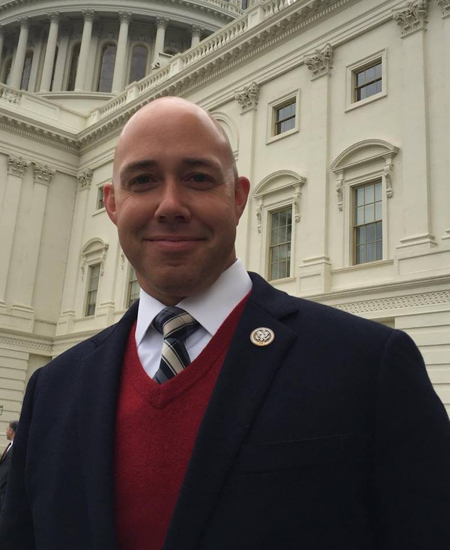
Rep. Brian J. Mast
Sponsored bills
Maddy summaryHR 1690 (ORDER Act) establishes a framework for U.S. diplomatic agreements with Mexico, Honduras, El Salvador, and Guatemala to manage immigration flows in the Western Hemisphere. It requires Mexico to process asylum claims for migrants from other countries within Mexico and accept migrants waiting for U.S. asylum decisions, while also mandating Honduras, El Salvador, and Guatemala to process asylum claims for migrants in their territories. The bill commits the U.S. to accelerating asylum adjudications, supporting asylum capacity in partner countries, and conducting a feasibility study for a U.S. law enforcement center in southern Mexico to combat crime and reduce migration. These provisions directly affect migrants seeking asylum, the governments of the four partner nations, and U.S. immigration enforcement coordination.
Maddy summaryHR 3039, the DRIVE Act, prohibits the Federal Motor Carrier Safety Administration (FMCSA) from requiring speed limiting devices on trucks weighing over 26,000 pounds operating in interstate commerce. This directly affects commercial trucking companies and drivers transporting goods across state lines. The bill's key provision explicitly bans the FMCSA from issuing any rule mandating such devices, which are typically set to limit vehicle speed. The law applies specifically to interstate trucking operations and does not affect state-level regulations.
Maddy summaryThe SAFE Banking Act of 2023 would protect banks and financial institutions that provide services to state-legal marijuana businesses and hemp-related businesses by preventing federal regulators from taking adverse actions against them solely for serving these businesses. It clarifies that income from state-legal marijuana businesses can be considered for mortgage applications, and requires regulators to update guidance on suspicious activity reports related to these businesses. The bill does not require financial institutions to serve these businesses, but ensures they won't face penalties for doing so. It extends similar protections to hemp-related businesses, which have faced banking challenges despite being federally legal under the 2018 Farm Bill.
This resolution urges transatlantic unity on a robust deterrence policy to maintain peace and stability across the Taiwan Strait. The resolution also (1) encourages NATO allies to work with their partners in the Indo-Pacific to address shared global security challenges; and (2) commends the people of Taiwan for their commitment to democracy, civil liberties, and human rights.
Maddy summaryThis bill directs the President to determine within 90 days whether to apply sanctions under existing law against the Iran Airports Company, a state-owned entity that facilitates Mahan Air's operations. Mahan Air, already sanctioned by the Treasury for supporting Iran's Revolutionary Guards and regional destabilization, uses Iran Airports Company's infrastructure for flights. The bill does not create new sanctions but requires a formal presidential assessment of whether the airport company should face penalties under Executive Order 13224, which targets entities aiding terrorism. It directly affects Iran Airports Company as the specific entity under review.
Maddy summaryHR 2928, the Responsible Borrower Protection Act of 2023, blocks the Federal Housing Finance Agency (FHFA) and mortgage enterprises (Fannie Mae and Freddie Mac) from implementing specific changes to mortgage credit fees announced in January 2023. The bill directly affects mortgage borrowers and lenders by reversing a pricing framework update that would have altered fees for single-family mortgages. It prohibits the FHFA from enforcing the January 2023 pricing changes detailed in FHFA's announcement and related lender letters. The bill clarifies that enterprises may still use risk-based pricing for mortgage fees, but the specific fee adjustments from the 2023 framework are canceled. This is a direct policy change to mortgage fee structures, not a broader reform.
Maddy summaryHR 2896, the Oath of Exit Act, adds a voluntary separation oath for members of the U.S. Armed Forces (Army, Navy, Air Force, Marine Corps, Space Force, and Coast Guard) before retirement or separation from service (excluding court-martial separations). The bill amends Title 10 of the U.S. Code to establish this new oath, which asks veterans to promise to "be the keeper of my brothers- and sisters-in-arms," "preserve the values I have learned," "maintain my body and mind," and "seek help from fellow veterans." The oath is intended to support veteran well-being, referencing high veteran suicide rates (20 daily, per VA data) as context. It does not mandate the oath but provides a formal, voluntary ceremony option for service members exiting the military.
Maddy summaryThis bill designates the U.S. Postal Service facility at 2600 Michigan Avenue in Kissimmee, Florida, as the "Robert Guevara Post Office Building." It updates all official references - such as in laws, maps, and documents - to use this new name for the building. The bill directly affects the postal facility and any government records referencing its location. It is a ceremonial naming measure with no policy changes or financial impact.
Gun Rights And Marijuana Act or the GRAM Act This bill removes federal firearms-related restrictions on certain individuals who use or are addicted to marijuana. Currently, federal firearms law prohibits the sale or disposition of a firearm or ammunition to persons who are unlawful users of or addicted to a controlled substance. This bill exempts from the prohibition an adult whose use of or addiction to marijuana is lawful in the state or on the tribal lands where the person resides.