

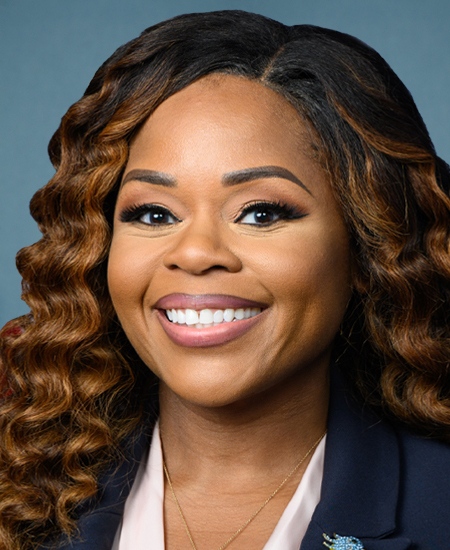
This resolution supports the accession of the African Union into the Group of 20 as a permanent member. It also urges increased representation of African countries in decisionmaking roles within the U.N. and other entities of the global governance system.
Rep. Sheila Cherfilus-McCormick
Sponsored bills
Men's Health Awareness and Improvement Act This bill establishes the Office of Men's Health within the Department of Health and Human Services (HHS) and requires other activities to improve men's health in the United States. The office must support and promote men's health programs and initiatives, including by working with relevant federal agencies (e.g., the Department of Defense and the Department of Veterans Affairs) and consulting with other HHS offices and agencies on activities related to men's health. HHS must issue associated guidance and recommendations on improving men's health outcomes that include short-term and long-term objectives for disease prevention, health promotion, and other areas of concern. The bill also requires studies and reports on men's health topics. The Office of the Assistant Secretary for Health must study men's use of health screenings and services, and the Government Accountability Office must report on the effectiveness of federal outreach related to men's health initiatives.
Maddy summaryHR 4121, the Right to Contraception Act, establishes a federal statutory right for individuals to access contraceptives and contraception services without government restriction or coercion, directly affecting all people seeking reproductive care and health care providers. The bill prohibits state or federal laws that limit access to contraceptives (defined broadly to include devices, drugs, and fertility methods), prevent individuals from obtaining or using them, or allow providers to refuse services based on personal beliefs. It preempts conflicting state laws, requires any restrictions to be justified by "clear and convincing evidence" of advancing access with no less restrictive alternative, and allows private lawsuits to challenge violations. The Act applies nationwide to all health care providers and individuals, protecting access regardless of factors like race, income, or location.
Maddy summaryHR 4184 repeals legal protections for gun manufacturers and sellers under the Protection of Lawful Commerce in Arms Act. It allows victims of gun violence to use gun trace data from the ATF's Firearms Trace System in civil court cases. This data, previously protected from discovery, can now be subpoenaed, admitted as evidence, and relied upon in lawsuits against gun sellers or manufacturers. The bill directly affects victims seeking legal recourse and gun industry defendants in civil litigation.
Maddy summaryHR 4166, the Support UNFPA Funding Act, authorizes annual U.S. funding for the United Nations Population Fund (UNFPA) over five years. It directly supports UNFPA’s global programs serving women and girls in over 150 countries, particularly focusing on reducing preventable maternal deaths, expanding access to contraception, ending gender-based violence, and addressing harmful practices like female genital mutilation and child marriage. The bill specifically directs funding toward UNFPA’s core work in developing nations, humanitarian crises (such as in Ukraine and Yemen), and rebuilding health systems post-pandemic, without altering UNFPA’s existing operations or policies.
Maddy summaryThe American Dream and Promise Act of 2023 would create two pathways to permanent residency for certain immigrants. The "Dream Act" portion would provide conditional permanent resident status to individuals who entered the U.S. as children, have lived continuously in the U.S. since January 1, 2021, and meet educational requirements (such as completing high school, earning a degree, or enrolling in education programs). The "American Promise Act" portion would provide permanent residency to individuals eligible for Temporary Protected Status (TPS) or Deferred Enforced Departure (DED) as of specific dates (January 1, 2017, or January 20, 2021). The bill includes provisions for background checks, fee exemptions for low-income applicants, and processes for removing conditional status after meeting specific criteria like completing higher education or earning income.
Maddy summaryHJRES 72 proposes a constitutional amendment to remove the exception in the Thirteenth Amendment that allows slavery and involuntary servitude as punishment for a crime. If ratified, this amendment would ban the use of forced labor in prisons as a criminal penalty, directly affecting how the U.S. criminal justice system handles sentencing. The resolution clarifies it does not interfere with voluntary work programs in correctional facilities, existing employment protections for incarcerated people, or community service alternatives. This change aims to eliminate a historical loophole that has disproportionately impacted Black Americans since the 1860s.
Maddy summaryThis non-binding resolution expresses the House's support for 10 specific rights of youth in foster care, directly affecting young people aged 18-21 navigating the system. It affirms their right to remain in original schools, access health services (including mental health), live free from abuse, maintain sibling contact, and receive adequate food and housing. The resolution does not create new legal obligations but calls for child welfare agencies to uphold these standards, based on documented challenges like high school graduation gaps and trauma exposure.
Maddy summaryHR 4122, the Henrietta Lacks Congressional Gold Medal Act, authorizes a posthumous Congressional Gold Medal to honor Henrietta Lacks for her contribution to medical science through the HeLa cell line. The bill directs the Treasury to strike the medal recognizing how her cells enabled major medical advances, including the polio vaccine and cancer treatments, without altering any laws or policies. The medal will be displayed at the Smithsonian Institution to commemorate her legacy in scientific research and bioethics. This is a purely commemorative measure with no direct effect on current legislation or affected individuals.
Maddy summaryHR 3962 establishes an Advisory Council to support victims of gun violence, directly affecting individuals impacted by gun violence (including survivors, witnesses, and relatives of victims) and the professionals who assist them. The council, composed of federal agency heads, victims, and victim assistance professionals, will assess needs, review existing programs, and compile accessible resources covering medical, financial, mental health, legal, and housing support. It must publish a public report within 180 days of enactment detailing best practices and gaps, with a follow-up report after two years. The council’s work will be shared online and distributed to congressional offices, state agencies, schools, and local prosecutors, with no new federal funding authorized for implementation.