

Maddy summaryHR 475 creates a federal grant program to help state, tribal, and local governments protect witnesses in serious criminal cases. It authorizes $30 million annually (2024-2028) for competitive grants to fund witness protection programs targeting cases involving homicide, serious violent felonies, drug offenses, gangs, or organized crime. Grants are awarded based on criteria like witness intimidation rates, unprosecuted cases due to intimidation, and local crime statistics. Recipients must report on their programs, leading to the development and nationwide sharing of best practices for witness safety, relocation, and financial/housing assistance.
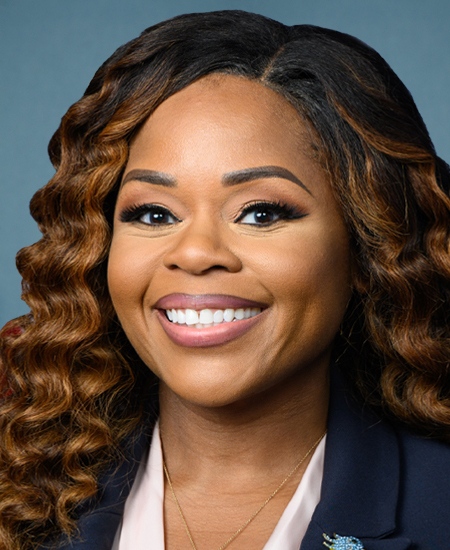
Rep. Sheila Cherfilus-McCormick
Sponsored bills
This resolution condemns the Supreme Court's holding in Dobbs v. Jackson Women's Health Organization (that there is no constitutional right to abortion) and expresses a commitment to instituting judicial reform and supporting access to abortion and the communities affected by the Court's ruling. It also urges the executive branch to advance reproductive justice.
Maddy summaryHR 408 amends the Fair Credit Reporting Act to remove certain eviction records from consumer credit reports. It specifically excludes eviction information (including related debt collection) for actions occurring between March 13, 2020, and 30 days after the end of the federal COVID-19 emergency. This applies to tenants in residential properties whose landlords initiated evictions during that period, excluding mortgage foreclosures. The change affects credit reports issued after the bill's enactment date, preventing these pandemic-era evictions from negatively impacting credit scores.
Maddy summaryHR 286, the Health Care Providers Safety Act of 2023, provides federal grants to healthcare providers to improve security at their facilities. The bill authorizes the Secretary to fund security services and physical/cyber security enhancements, including video surveillance, data privacy measures, and structural improvements. These grants directly help healthcare facilities, personnel, and patients by addressing safety concerns. The law specifies that funds must be used for necessary security costs to ensure safe access to healthcare services. It does not create new mandates but offers financial support for security upgrades.
Maddy summaryThis bill prohibits the export or sale of petroleum products drawn from the U.S. Strategic Petroleum Reserve to specific countries and entities, including China, Russia, North Korea, Iran, and any nation under U.S. sanctions. It also bans exports to entities owned or controlled by these countries or the Chinese Communist Party. The Secretary of Energy must enforce this ban, though they may issue a national security waiver for specific exports. The bill requires the Secretary to issue implementing rules within 60 days of enactment. It directly affects the Secretary of Energy, oil exporters seeking to use the Strategic Petroleum Reserve, and the listed countries/entities.
Triple-Negative Breast Cancer Research and Education Act of 2023 This bill requires research and education activities related to triple-negative breast cancer. The cells of these breast cancers are negative for estrogen receptors, progesterone receptors, and excess HER2 protein, so they do not respond to hormonal therapy medicines or medicines that target the HER2 protein receptors. Specifically, the National Institutes of Health must conduct and support research into the disease. Additionally, the Centers for Disease Control and Prevention and the Health Resources and Services Administration must develop information about triple-negative breast cancer, including information regarding the elevated risk for minority women, for the public and for health care providers.
Maddy summaryHR 396, the Closing the Bump Stock Loophole Act of 2023, defines "bump stock" as any device or modification that increases the firing rate of a semi-automatic weapon to mimic a machine gun. The bill amends federal tax and firearms laws to classify bump stocks as prohibited devices under the National Firearms Act, requiring existing owners to register them within one year of enactment. It directly affects individuals who currently own bump stocks by mandating registration to avoid future possession prohibitions. The law takes effect immediately for new sales but provides a one-year grace period for existing owners to comply with registration requirements.
Maddy summaryHRES 30 is a ceremonial House resolution recognizing two milestones: the 94th anniversary of Dr. Martin Luther King, Jr.'s birth (January 15, 1929) and the 40th anniversary of the federal Martin Luther King, Jr. Holiday (observed January 16, 2023). It contains no policy changes or binding requirements, as it is purely commemorative. The resolution urges the House to observe both dates and encourages the public to honor Dr. King’s legacy and his vision of equality. It does not affect any individuals, groups, or government programs.
Maddy summaryHR 350, the SANTOS Act, requires candidates for the U.S. House of Representatives or Senate to disclose their educational background, military service (if any), and employment history as part of their official campaign filings. This directly affects all federal election candidates by mandating these specific personal details be included in their required campaign designations. Candidates who knowingly provide false information about these details face penalties of up to $100,000 in fines, one year in prison, or both. The law applies to elections held on or after its enactment date.
Maddy summaryHR 308, the Rosa Parks Day Act, would designate Rosa Parks Day as a legal public holiday for federal employees and government operations. The bill amends Title 5 of the U.S. Code to add "Rosa Parks Day" to the list of federal holidays, placing it after Thanksgiving Day. This change would require federal offices to close on this designated day, affecting federal employees and standard government operations. The bill does not create new programs or alter existing laws beyond the holiday designation.