

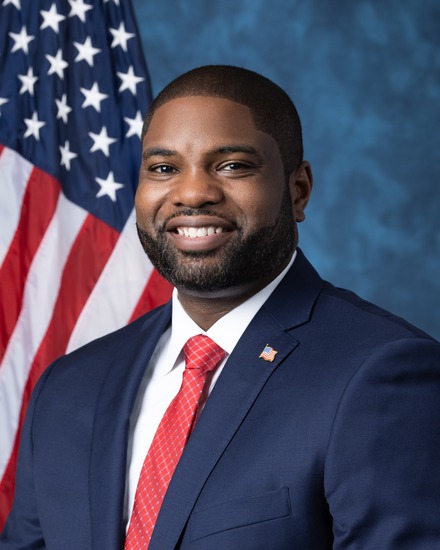
Photo of Byron Donalds
R United States House · District 19 · Florida

Rep. Byron Donalds

Compare
Total votes
2,837
all sessions
Attendance
93%
186 missed
Lower than 93% of chamber peers
With party
90%
of cast votes
Lower than 90% of chamber peers
Bipartisan score
5%
crosses aisle rarely
Higher than 89% of chamber peers
Sponsored
1,462
bills & resolutions
Near the chamber average
Committees
6
assignments
1,462 bills and resolutions

Sponsored bills

Total
1,462
Primary
143
Co-sponsor
1,319
This page
1,462
matching current filters
Co-sponsor HR 1218
In committee · United States House · Co-sponsor
Expediting Israeli Aerial Refueling Act of 2023

Maddy summaryHR 1218, the Expediting Israeli Aerial Refueling Act of 2023, requires the U.S. Air Force to train Israeli pilots and ground personnel to operate KC-46 aircraft within 60 days of enactment, including participation in the U.S. Military Personnel Exchange Program. The bill mandates the rotational deployment of U.S. KC-46 aircraft to Israel for up to five years or until Israel commissions its own KC-46s, with each deployment lasting at least 270 days annually. It directly affects the Israeli Air Force by enabling their use of U.S. refueling capabilities and the U.S. military through specific training and deployment obligations. The law expires ten years after enactment.

In committee Feb 27, 2023 1 co-sponsor
Co-sponsor HR 1200
In committee · United States House · Co-sponsor
National Right-to-Work Act

Maddy summaryHR 1200, the National Right-to-Work Act, prohibits requiring workers to join a union or pay dues as a condition of employment in both private-sector workplaces (covered by the National Labor Relations Act) and railroad industries (covered by the Railway Labor Act). The bill amends key sections of these laws to eliminate provisions that allowed union security agreements, meaning workers in unionized settings would no longer be forced to pay dues to retain their jobs. This directly affects employees in unionized workplaces across the U.S., particularly those in industries with existing union contracts that included mandatory dues. The law changes the legal framework to ensure union membership and dues payment remain voluntary for all workers.

In committee Feb 27, 2023 1 co-sponsor
Co-sponsor HR 597
In committee · United States House · Co-sponsor
Stop the Cartels Act

Maddy summaryThe Stop the Cartels Act (HR 597) aims to disrupt drug trafficking organizations and related criminal activities by requiring enhanced intelligence gathering on cartels in Mexico and Central American countries, mandating improved U.S.-Mexico law enforcement cooperation, and cutting federal funding from jurisdictions that restrict immigration enforcement. The bill creates a "Special Transnational Criminal Organization" designation for major cartels like the Sinaloa Cartel and Jalisco New Generation Cartel, requires monthly reports on migrant encounters at the border, and establishes refugee processing centers in Mexico and Central America. It also increases staffing for immigration courts by 500 judges, prohibits asylum applications from nationals of countries with refugee processing centers, and reauthorizes substance abuse prevention funding at higher levels while repealing several existing drug programs. These provisions directly affect U.S. intelligence and law enforcement agencies, Mexican and Central American governments, local jurisdictions receiving federal funds, and migrants seeking asylum or refugee status.

In committee Feb 27, 2023 1 co-sponsor
Primary HRES 124
In committee · United States House · Lead sponsor
Expressing the sense of the House of Representatives that the United States should support the expansion of domestic nuclear energy and advanced nuclear technology as a viable source of power in order to promote United States nuclear energy leadership and global energy independence.

Maddy summaryHRES 124 is a non-binding House resolution expressing congressional support for expanding domestic nuclear energy and advanced nuclear technology. It states the House believes the U.S. should promote nuclear energy as a reliable, low-carbon power source to enhance energy leadership and independence, citing its high reliability (92% operation rate), carbon reduction benefits (482 million metric tons avoided in 2021), and economic contributions (475,000 jobs supported). The resolution urges actions like streamlining regulations for advanced reactors, securing domestic uranium supply chains, and addressing misinformation about nuclear safety - though it does not create new laws or funding. It serves solely as a statement of policy preference, not a legislative mandate.

In committee Feb 24, 2023 0 co-sponsors
Primary HR 1177
In committee · United States House · Lead sponsor
Financial Freedom Act of 2023

Maddy summaryHR 1177, the Financial Freedom Act of 2023, amends pension plan rules to expand participant control over individual retirement accounts. It allows plan fiduciaries to offer a broad range of investment choices without being required to select specific options, as long as participants can choose how to allocate their funds. The bill specifically protects "self-directed brokerage windows" by preventing regulators from restricting the investments available through them and clarifies that using such options doesn't violate standard fiduciary duties like diversification or prudence. This directly affects workers in defined contribution pension plans with individual accounts who want more direct control over their investment choices.

In committee Feb 24, 2023 0 co-sponsors
Co-sponsor HR 1180
In committee · United States House · Co-sponsor
Billion Dollar Boondoggle Act of 2023

Maddy summaryHR 1180, the "Billion Dollar Boondoggle Act of 2023," requires federal agencies managing large projects to publicly report on cost overruns and delays. It directly affects Executive agencies and independent regulatory agencies that fund projects exceeding $1 billion in cost overruns or being more than five years behind schedule. The bill mandates annual reports including project descriptions, original vs. current costs (adjusted for inflation), reasons for delays, contractor details, and any bonuses awarded. These reports must be submitted to the Office of Management and Budget and made available to the public. The law focuses on transparency around major federal projects without specifying policy changes to project management.

In committee Feb 24, 2023 1 co-sponsor
Co-sponsor HR 1194
In committee · United States House · Co-sponsor
Fighting Presidential Budget Waste Act

Maddy summaryHR 1194, the "Fighting Presidential Budget Waste Act," requires the President and the Office of Management and Budget (OMB) to consider findings from the most recent GAO report on reducing government waste when preparing the annual federal budget. The bill specifically directs them to review the GAO report titled "Additional Opportunities to Reduce Fragmentation, Overlap, and Duplication and Achieve Billions of Dollars in Financial Benefits" (or a successor report). This mandate applies to all budget submissions under Section 1105 of Title 5, U.S. Code. The law does not create new spending or programs but changes the budget preparation process by requiring federal officials to factor in GAO recommendations for cost savings.

In committee Feb 24, 2023 1 co-sponsor
Co-sponsor HR 1171
In committee · United States House · Co-sponsor
Stop CCP Fentanyl Act

Stop CCP Fentanyl Act This bill imposes sanctions on various Chinese government officials and entities. It also establishes a cause of action against China’s government or Chinese government officials for certain harms stemming a fentanyl-related overdose. Specifically, the bill requires the President to impose visa- and property-blocking sanctions on (1) the president of China, (2) the chairman of the Chinese Communist Party (CCP), (3) China’s State Council, and (4) China’s Politburo Standing Committee. The President may waive the sanctions upon certifying that (1) China’s government and the CCP have taken all reasonable measures to prevent the flow of fentanyl produced in China into the United States, and (2) the intelligence community has determined that amount of fentanyl from China and the deaths resulting from overdoses of such fentanyl has dropped 98%. This bill also authorizes a U.S. national or lawful permanent resident to sue certain Chinese government officials or the Chinese government for the death of an immediate family member caused by an overdose by fentanyl (or fentanyl analogue) manufactured using fentanyl precursors from China. Property blocked pursuant to sanctions under this bill may be used to satisfy a judgment from such a lawsuit.

In committee Feb 24, 2023 1 co-sponsor
Co-sponsor HR 1086
In committee · United States House · Co-sponsor
Nuclear Fuel Security Act

Maddy summaryThe Nuclear Fuel Security Act establishes programs to increase domestic production of nuclear fuel, specifically low-enriched uranium (LEU) and high-assay, low-enriched uranium (HALEU), which are critical for advanced nuclear reactors. It requires the Department of Energy to acquire 100 metric tons of LEU annually by 2026 and 20 metric tons of HALEU annually by 2027 through contracts with U.S. nuclear companies. The bill sets specific deadlines for making HALEU available (3 metric tons by 2024, 8 more by 2025, 10 more by 2026) to support advanced reactor developers. It prioritizes using domestically produced uranium but allows partnerships with U.S. allies for HALEU when domestic production isn't available at scale.

In committee Feb 24, 2023 1 co-sponsor
Primary HR 1007
In committee · United States House · Lead sponsor
Nuclear Assistance for America’s Small Businesses Act

Maddy summaryHR 1007, the Nuclear Assistance for America’s Small Businesses Act, delays collection of nuclear regulatory fees for small businesses applying for permits to build or operate advanced nuclear reactors. It allows eligible small businesses (defined as those with NAICS code 221113 that responded to NRC's RIS-20-02) to delay up to 50% of pre-application fees and 35% of post-application fees. The delayed fees must be repaid over 10 years at 10% annually, or accelerated to 25% if the business fails to submit a covered application within 5 years, withdraws it, or faces denial. This applies specifically to applications for construction permits, operating licenses, or combined licenses for advanced nuclear reactors under NRC oversight.

In committee Feb 24, 2023 0 co-sponsors
Showing 871 to 880 of 1,462 bills
Previous 1 … 87 88 89 … 147 Next