

COPS on the Beat Grant Program Reauthorization and Parity Act of 2022 This bill reauthorizes through FY2031 and makes changes to the Community Oriented Policing Services grant program. Among the changes, the bill reduces the required matching contribution for certain rural communities during the first three years of a grant and eliminates the preference for agencies that exceed the matching requirements; allows grant funds to be used to increase wages of career law enforcement officers in states or localities that have a median household income of less than 70% of the national median household income and qualify for a reduced matching contribution; and provides statutory authority for the Office of Community Oriented Policing Services within the Department of Justice. Additionally, the bill requires the Government Accountability Office to report on whether law enforcement workforces are representative of the communities they serve, the percentage of law enforcement employees who live in the community they serve, the average pay of officers compared to the cost of living in the community they serve, and recommendations for improvements.
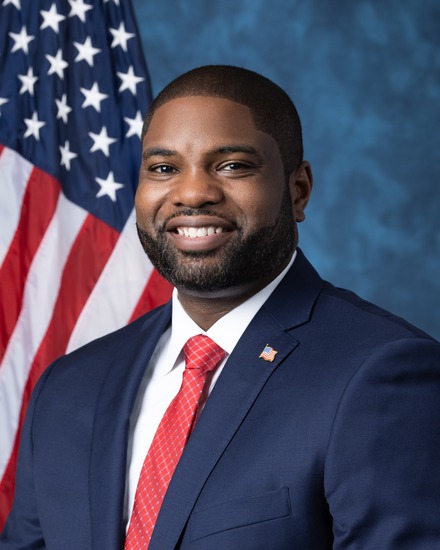
Rep. Byron Donalds
Sponsored bills
Halt All Lethal Trafficking of Fentanyl Act or the HALT Fentanyl Act This bill places fentanyl-related substances as a class into schedule I of the Controlled Substances Act. A schedule I controlled substance is a drug, substance, or chemical that has a high potential for abuse; has no currently accepted medical value; and is subject to regulatory controls and administrative, civil, and criminal penalties under the Controlled Substances Act. Additionally, the bill establishes a new, alternative registration process for schedule I research that is funded by the Department of Health and Human Services or the Department of Veterans Affairs or that is conducted under an investigative new drug exemption from the Food and Drug Administration. The bill also makes several other changes to registration requirements for conducting research with controlled substances, including permitting a single registration for related research sites in certain circumstances, waiving the requirement for a new inspection in certain situations, and allowing a registered researcher to perform certain manufacturing activities with small quantities of a substance without obtaining a manufacturing registration.
Common Sense Standards for Visa Applicants Act This bill provides statutory authority for a Department of Homeland Security (DHS) final rule published August 14, 2019, that made it more likely that an alien will not qualify for lawful permanent resident status due to their potential future use of public benefits. (DHS rescinded the rule in 2021.)
Restoring America's Leadership in Innovation Act of 2021 This bill revises several aspects of patent law. The bill changes the U.S. patent system back to a first-to-invent system, in which the first inventor to conceive of an invention is entitled to a patent. Currently, the first person to file an application that meets all the necessary requirements is entitled to the patent. Several types of administrative patent challenge proceedings are abolished, as well as the Patent and Trademark Office (PTO) body that decides those proceedings. The bill relaxes the standard for what constitutes patent-eligible subject matter. The only ineligible inventions shall be those that exist in nature independent or prior to human activity or that exist solely in the human mind. The bill also makes it easier for a patent owner that has won an infringement case in court to secure a permanent injunction against the infringing defendant. Specifically, there shall be a presumption that further infringement would cause irreparable harm to the prevailing patent owner, and the burden shall be on the infringer to prove otherwise. (Currently, a prevailing patent owner seeking a permanent injunction must prove, among other things, that further infringement would cause irreparable harm.) The bill limits what types of publications shall be treated as prior art that could be used to make an invention be considered to be anticipated or obvious (and therefore not patentable). The bill authorizes the PTO to keep and spend all the fees that it collects.
Illegal Immigrant Payoff Prohibition Act This bill prohibits the payment of a settlement to an alien for a civil action brought against the United States in connection with the alien's inadmissibility to, or unlawful presence in, the United States.
Protect Communities from a Porous Border Act of 2021 This bill requires the Department of Homeland Security (DHS) to notify a state before placing an alien in that state and gives the state final authority to prohibit such a placement. At least 10 business days before placing (e.g., detaining or housing) such an individual in a state, DHS must provide certain information to that state, including (1) the individual's biographic and biometric information, including DNA; and (2) a certification that the biometric and biographic information has been checked in various law enforcement and counterterrorism databases. No federal court shall have jurisdiction to review (1) the requirements and procedures established under this bill, or (2) a decision by a state to prohibit the placement of such an individual in the state. The bill also prohibits any federal official from waiving any of the bill's requirements.
Better Enforcement of Grievous Offenses by unNaturalized Emigrants Act or the BE GONE Act This bill expands, for immigration purposes, the definition of aggravated felony to include sexual abuse, sexual assault, and aggravated sexual violence. (Under current law, a conviction for an aggravated felony is grounds for deportation and may bar an individual from other immigration-related benefits.)
Denying Earnings to the Military Oligarchy in Cuba and Restricting Activities of the Cuban Intelligence Apparatus Act or the DEMOCRACIA Act This bill provides for asset- and visa-blocking sanctions for conduct relating to Cuba. It also establishes an interagency task force to facilitate access to uncensored internet in Cuba. The President must sanction foreign persons that provide financial support to Cuban government sectors involved in human rights abuses or terrorism (e.g., the defense sector). This includes foreign persons that (1) are military contractors or mercenaries operating on behalf of the Cuban government, or (2) violate laws restricting trade with Cuba. Specified transactions, including remittances to immediate family members (subject to some limitations) and payments related to U.S. military and diplomatic sites, are not subject to these sanctions. The President must also sanction (1) foreign persons complicit or engaged in human rights abuses or corruption, (2) foreign persons supporting such conduct, and (3) specified Cuban government officials and their affiliates. The bill provides humanitarian exceptions to these sanctions, for example, donating food or agricultural commodities to organizations or individuals unaffiliated with the Cuban government. The President may not license sanctionable conduct, and U.S. persons seeking to engage in a permitted transaction must submit a written request to the Office of Foreign Asset Control of the Department of the Treasury. The President may waive the sanctions in the interest of U.S. national security. To terminate the sanctions, the President must certify that the Cuban government has legalized all political activities and taken other steps to promote political rights and freedoms. Congress must then enact a joint resolution approving the termination.
Make the Migrant Protection Protocols Mandatory Act of 2021 This bill requires the Department of Justice (DOJ) to remove certain aliens from the United States while such an alien's application for admission is pending. Specifically, if an alien arrived by land from a foreign country bordering the United States and the alien is not clearly and beyond a doubt entitled to admission into the United States, DOJ must return that alien to that bordering foreign country while the alien's application for admission is pending. (Currently, DOJ may choose to detain such an alien or return the alien to the bordering foreign country while the application for admission is pending.)
Securing the Homeland from International Entrants with Life-threatening Diseases Act or the SHIELD Act This bill suspends for one year the admission and parole into the United States of certain categories of individuals who are from or were recently in a country that fails to meet certain criteria related to COVID-19. This restriction applies to certain individuals entering the United States from Mexico or Canada through a port of entry or U.S. Border Patrol station and (1) whose country of origin has not been categorized by the Centers for Disease Control and Prevention as a low-risk country for COVID-19, or (2) who was in such a country at any time in the 30 days before arriving in the United States. The bill exempts certain individuals from this restriction, including U.S. citizens and lawful permanent residents, members of the Armed Forces, and persons from a foreign country who arrive at a designated port of entry with valid travel documents. The Department of Homeland Security shall transport barred individuals to a foreign location, such as an individual's country of origin, to the extent practicable.