

Restoring America's Leadership in Innovation Act of 2021 This bill revises several aspects of patent law. The bill changes the U.S. patent system back to a first-to-invent system, in which the first inventor to conceive of an invention is entitled to a patent. Currently, the first person to file an application that meets all the necessary requirements is entitled to the patent. Several types of administrative patent challenge proceedings are abolished, as well as the Patent and Trademark Office (PTO) body that decides those proceedings. The bill relaxes the standard for what constitutes patent-eligible subject matter. The only ineligible inventions shall be those that exist in nature independent or prior to human activity or that exist solely in the human mind. The bill also makes it easier for a patent owner that has won an infringement case in court to secure a permanent injunction against the infringing defendant. Specifically, there shall be a presumption that further infringement would cause irreparable harm to the prevailing patent owner, and the burden shall be on the infringer to prove otherwise. (Currently, a prevailing patent owner seeking a permanent injunction must prove, among other things, that further infringement would cause irreparable harm.) The bill limits what types of publications shall be treated as prior art that could be used to make an invention be considered to be anticipated or obvious (and therefore not patentable). The bill authorizes the PTO to keep and spend all the fees that it collects.
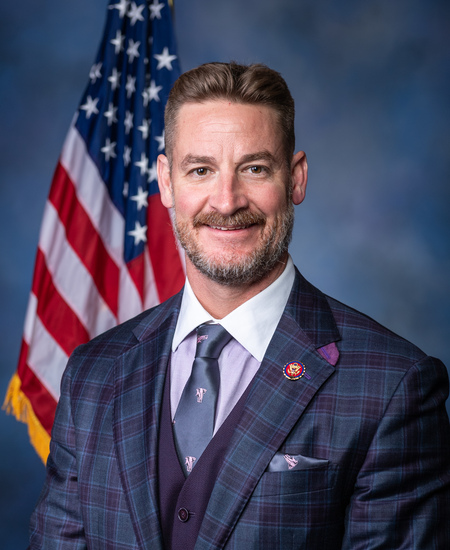
Rep. W. Gregory Steube
Sponsored bills
Keep Food Local and Affordable Act of 2021 This bill freezes the minimum wage for H-2A (temporary agricultural workers) in certain states through December 31, 2022. Specifically, the bill prohibits an increase to the adverse effect wage rate for H-2A workers in any state (1) that had an unemployment rate of not more than 5% in the Bureau of Labor Statistics' August 2021 report; or (2) where the food price index, according to bureau reports, increased by more than 3% between December 2020 and September 2021 and the governor requests a freeze to the adverse effect wage rate. (Generally, the minimum wage for an H-2A worker is the highest of the adverse effect wage rate, the prevailing hourly wage or piece rate, the federal minimum wage, or the applicable state minimum wage.)
Illegal Immigrant Payoff Prohibition Act This bill prohibits the payment of a settlement to an alien for a civil action brought against the United States in connection with the alien's inadmissibility to, or unlawful presence in, the United States.
Better Enforcement of Grievous Offenses by unNaturalized Emigrants Act or the BE GONE Act This bill expands, for immigration purposes, the definition of aggravated felony to include sexual abuse, sexual assault, and aggravated sexual violence. (Under current law, a conviction for an aggravated felony is grounds for deportation and may bar an individual from other immigration-related benefits.)
Stop the Surge of Unsafe Rio Grande Encampments Act of 2021 or the Stop the SURGE Act of 2021 This bill requires the Department of Homeland Security (DHS) to transfer certain aliens who enter the United States unlawfully to new ports of entry. Specifically, if DHS encounters such an individual in certain Border Patrol sectors (generally the sectors covering Texas), DHS must immediately transfer the individual to new ports of entry established under this bill in specified locations, including Greenwich, Connecticut, and Martha's Vineyard, Massachusetts. DHS may not exercise discretion to process such individuals in any location other than the ports of entry created under this bill. These provisions shall be deemed to have taken effect on September 1, 2021.
Foreign Merger Subsidy Disclosure Act of 2021 This bill requires entities to disclose in their premerger notification filings to federal antitrust regulators a detailed accounting of any economic support they received from a foreign state.
Safeguards Ensuring Criminal and Unvetted Refugees don't Enter America Act or the SECURE America Act This bill imposes restrictions on the admission of aliens, including refugees, and addresses related issues. Specifically, no refugees may be admitted until Congress enacts a joint resolution setting the maximum number of refugees allowed to be admitted in a particular fiscal year. Currently, that number is set each fiscal year by the President. The Department of Homeland Security (DHS) must notify Congress at least 30 days before determining that an alien or class of aliens is eligible for refugee status. Congress may nullify the determination by enacting a joint resolution of disapproval. Further, an alien shall be inadmissible for holding certain beliefs, such as (1) believing that a system of religious law should be implemented in the United States, (2) believing that the alien does not need to learn English if the alien is not already fluent, or (3) any belief that the Department of State determines is incompatible with the principles of the United States. DHS may not parole into the United States an alien who does not have status under immigration law. Currently, DHS may provide parole in certain instances, including for urgent humanitarian reasons. Federal agencies must notify a state at least 30 days before resettling a refugee in that state. The refugee may not be resettled in that state if the state expresses disapproval. An alien who has committed a crime of violence (generally one involving the use or threat of physical violence against person or property) may not be eligible for refugee status and must be removed.
Taliban Rare Earth Minerals Sanctions Act This bill requires the President to impose sanctions on foreign individuals and entities that knowingly engage in a significant transaction that concerns the rare earth mineral sector of Afghanistan. The President must impose property-blocking sanctions on such foreign individuals and entities, as well as visa-blocking sanctions on the individuals.
Teleabortion Prevention Act of 2021 This bill restricts the use of telehealth for chemical abortions (also known as medication abortions). Specifically, it requires a provider who dispenses or prescribes medication for a chemical abortion to physically examine the patient, be physically present at the location of the chemical abortion, and schedule a follow-up visit. The bill provides an exception for a chemical abortion that is necessary to save the life of a mother whose life is endangered by a physical disorder, illness, injury, or condition. The bill establishes criminal penalties—a fine, a prison term of up to two years, or both—for a provider who does not comply with the requirements. A patient who undergoes a chemical abortion may not be prosecuted.
Open Schools Responsibly Act This bill limits civil liability for elementary and secondary schools and institutions of higher education relating to any harm arising from exposure to, or infection by, COVID-19 suffered by a student, employee, or visitor. Specifically, a school or institution shall not be liable for such harm if the school or institution was in compliance with applicable state requirements. However, a school or institution may be liable for acts or omissions that constitute willful or criminal misconduct, gross negligence, reckless misconduct, or a conscious flagrant indifference to the rights or safety of the individual harmed.