

Maddy summaryHR 4294 would require the President to annually designate one month as "Fidelity Month," focused on promoting values like faith, family, and patriotism. The bill directs the President to use this observance to encourage Americans to reaffirm these values, based on the bill's findings about their perceived decline. This is a procedural resolution with no new funding or regulations; it only mandates a presidential designation. The bill directly affects the President's authority and indirectly invites public participation in a national observance.
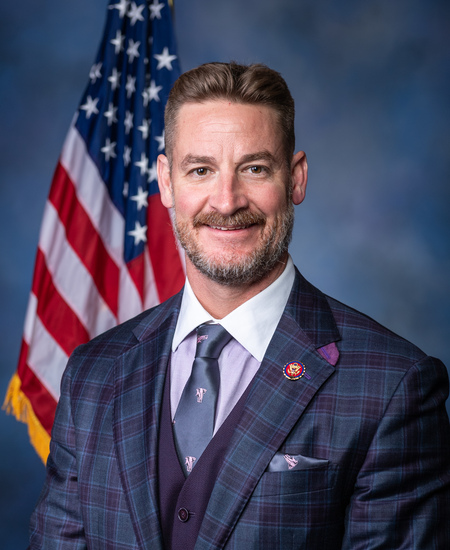
Rep. W. Gregory Steube
Sponsored bills
Maddy summaryHR 4305, the Shelter Act, creates a 25% nonrefundable tax credit for individuals and businesses to offset costs of qualifying disaster mitigation improvements. Individuals can claim up to $2,500 annually for home upgrades like reinforced roofs, flood barriers, fire-resistant materials, or storm shelters, provided the property is in a federally designated disaster area and meets specific safety standards. Businesses may claim up to $5,000 for similar safety upgrades at their locations in disaster-prone zones. The credit phases out for higher-income taxpayers (individuals over $100,000 AGI, businesses over $5 million average gross receipts) and requires documentation proving compliance with building codes. The provisions apply to taxable years beginning after December 31, 2023.
Maddy summaryThis bill increases criminal penalties for non-citizens who reenter the U.S. after being deported or excluded. It specifically targets individuals with prior convictions for drug offenses, violent crimes, or multiple prior removals, imposing stricter fines and longer prison terms. For example, those convicted of an aggravated felony or two prior illegal reentries face mandatory minimum sentences of 5 years in prison, up to 20 years. The law also expands penalties for those who reenter without Homeland Security's permission after being removed under certain provisions.
Maddy summaryHR 277 would require Congress to approve major federal regulations before they take effect. Major rules are defined as those with significant economic impact ($100 million+ annually), major cost increases for consumers or industries, or significant adverse effects on competition, employment, or innovation. Agencies must submit detailed information about these rules to Congress, including cost-benefit analyses, before they can take effect. Congress would have 70 session days to approve the rule with a joint resolution; if they don't act within that timeframe, the rule would not take effect. This would increase congressional oversight of federal regulations and require more detailed information about proposed rules before they become law.
Protecting Consumers from Abusive Mortgage Leads Act This bill prohibits a credit reporting agency from providing a consumer's credit report to a third party in connection with a mortgage transaction unless (1) the third party provides documentation certifying that it has the consumer's consent, or (2) the third party has a current financial service relationship with the consumer.
Maddy summaryThis bill requires all U.S. flags displayed on federal property or purchased by federal agencies to be 100% made in the United States, meaning all materials and manufacturing must occur domestically. It directly affects federal agencies (including military departments, legislative/judicial branches, and U.S.-owned corporations) and their procurement of flags for display on government property. Key provisions include a 90-day implementation for new flag purchases and a 2-year phase-in for display requirements, with a separate mandate for the FTC to study and report on country-of-origin labeling enforcement for flags within one year. The bill does not apply to private entities or flags displayed off federal property.
Maddy summaryHR 4076 establishes a joint U.S.-Israel program to fund health technology development, authorizing $4 million annually (2024-2026) through the U.S. Health and Human Services Department. It requires Israel to match U.S. funding and focuses on collaborative projects in artificial intelligence, vaccines, telemedicine, diagnostic tests, and data-driven personalized medicine for emerging infectious diseases. The program can either build on an existing U.S.-Israel agreement or create a new one under a 2008 science cooperation framework. This bill directly affects U.S. federal health agencies and the Israeli government, with funds restricted to joint projects meeting specific technological and health priorities.
Maddy summaryThis bill prohibits providing, facilitating, or possessing wireless devices (like cell phones) in U.S. detention facilities (e.g., prisons, jails) if such actions violate existing federal or state laws. It imposes civil fines up to $50,000 per violation (capped at $1 million total) or criminal fines up to $50,000 for intentional violations. The law explicitly excludes lawful law enforcement activities and state enforcement powers, and defines "detention facility" broadly to include all correctional and penal institutions. It applies to conduct occurring after enactment.
Maddy summaryHRES 518 is a non-binding House resolution expressing support for parental rights in education and sports. It opposes labeling parents as "extreme" for seeking age-appropriate school curriculum (like avoiding sexual orientation discussions for young children) and for wanting biological males excluded from women’s sports. The resolution also states opposition to weakening Title IX protections and affirms that parents - not government - should have final say in their children’s education. As a procedural resolution, it does not create new laws but formally states the House’s position on these issues.
This bill includes phosphate and potash on the Department of the Interior's final list of critical minerals. (Under current law, Interior and other departments are required to conduct a variety of efforts to ensure a secure and reliable supply chain of critical minerals.) Interior must evaluate current policies relating to permitting and leasing of projects to develop critical minerals and issue recommendations to Congress to support domestic production of such commodities.