

Protect Our Police Act This bill provides statutory authority for Executive Order 13809, which was issued on August 28, 2017. The order revoked a 2015 executive order establishing an interagency working group to recommend improvements to the process through which state, local, and tribal law enforcement agencies acquire controlled equipment (e.g., firearms or military-style equipment) from the federal government.
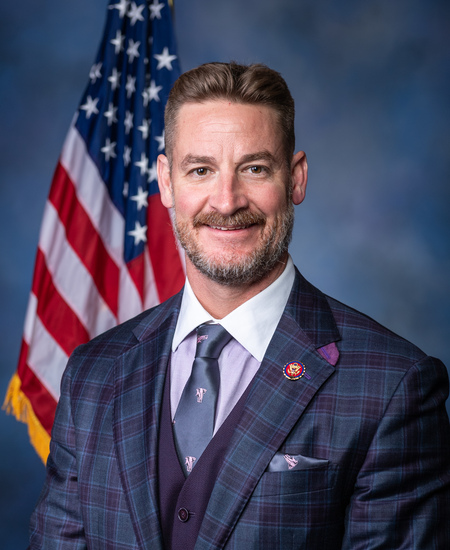
Rep. W. Gregory Steube
Sponsored bills
Camp Lejeune Justice Act of 2021 This bill allows certain individuals to sue and recover damages for harm from exposure to contaminated water at Camp Lejeune in North Carolina between August 1, 1953, and December 31, 1987. This action is available only to individuals who were exposed to contaminated water for at least 30 days. The bill prohibits the U.S. government from asserting specified immunity from litigation in response to such a lawsuit. The bill also prohibits an individual who brings such an action from bringing a separate tort action against the United States based on the same harm.
Child Interstate Abortion Notification Act This bill creates new federal crimes related to transporting a minor across state lines for an abortion. Specifically, the bill makes it a crime to knowingly transport a minor across a state line to obtain an abortion without satisfying the requirements of a parental involvement law in the minor's resident state. A parental involvement law requires parental consent or notification, or judicial authorization, for a minor to obtain an abortion. The bill prohibits an individual who has committed incest with a minor from knowingly transporting the minor across a state line to receive an abortion. Finally, the bill makes it a crime for a physician to knowingly perform or induce an abortion on an out-of-state minor without first notifying the minor's parent.
Criminalize Fleeing from Immigration Enforcement Act of 2021 This bill revises the federal criminal offense involving flight from an immigration checkpoint or other law enforcement checkpoint at high speed in a motor vehicle. Specifically, the bill retains the existing prohibition on flight from an immigration or other law enforcement checkpoint, but it removes the qualifier that such flight must be at high speed in a motor vehicle. The bill also expands the scope of unlawful flight offenses to include flight from a law enforcement officer who is enforcing immigration laws. An unlawful flight offense is generally punishable by a fine, a prison term of up to five years, or both. However, an unlawful flight offense that involves high-speed flight in a motor vehicle is punishable by a fine, prison term of up to eight years, or both.
Iran Human Rights and Accountability Act of 2021 This bill requires certain reports and determinations with respect to actions by Iran (and designated Iranian officials) that violate human rights. Specifically, the President must determine whether specified Iranian officials meet certain criteria for the application of sanctions based on their responsibility for, or complicity in, human rights abuses. The Department of State must report on human rights abuses in relation to protests in Iran since 2017 and determine whether certain actions by Iran, Hezbollah, and Iranian-backed militias constitute genocide or war crimes. Further, the State Department must report on the estimated net worth and known sources of income (including from corrupt or illicit activities) of Iranian Supreme Leader Ayatollah Ali Khamenei and his family members.
Sanctioning Iranian-Backed Militia Terrorists Act This bill requires the President to impose property- and visa-blocking sanctions with respect to Kata'ib Sayyid al-Shuhada and any foreign person that is a member, agent, or affiliate of, or owned or controlled by, Kata'ib Sayyid al-Shuhada. Kata'ib Sayyid al-Shuhada is an Iranian-backed Iraqi militia that has worked with groups that have been designated as foreign terrorist organizations and has deployed forces to Syria to engage in military operations supporting the Syrian government.
Prohibiting IRS Financial Surveillance Act This bill prohibits the Department of the Treasury from requiring a financial institution to report the transfers into and out of a financial account. This prohibition does not apply to laws or regulations in effect on October 1, 2021.
Stabilizing Medicare Access to Rehabilitation and Therapy Act or the SMART Act This bill modifies the application of a certain Medicare payment methodology for outpatient physical therapy services and outpatient occupational therapy services that are furnished by a therapy assistant. Under current law, effective January 1, 2022, payment for such services is 85% of the otherwise applicable rate. The bill delays this effective date by one year and excludes services that are furnished in rural or medically underserved areas from this payment methodology. The bill also specifies that supervision requirements for outpatient physical therapy services that are furnished through private practice may not be more stringent for purposes of Medicare coverage than under state law.
This resolution requests the President and directs the Department of State to transmit to the House of Representatives, not later than 14 days after the adoption of this resolution, copies of both classified and unclassified documents that refer or relate to certain information on the withdrawal of the United States from Afghanistan, including reactions, concerns, or objections expressed by certain allies and partners; any agreement reached with the Taliban related to the evacuation of specified individuals; and numbers of specified individuals in contact with the State Department to request evacuation assistance from Afghanistan, from July 30, 2021, to the present.
Animal Freedom from Testing, Experiments, and Research Act of 2021 or the AFTER Act of 2021 This bill requires federal research facilities to facilitate the adoption or nonlaboratory placement of certain warm-blooded animals (e.g., dogs, cats, monkeys, guinea pigs, hamsters, and rabbits) with animal rescue organizations, animal sanctuaries, animal shelters, or individuals. In order to be adopted or placed, the animals must (1) no longer be needed for research; (2) be suitable for release; (3) not be birds, rats, or mice.