

Fairness for Federal Contractors Act of 2021 This bill prohibits executive agencies from requiring contractors to receive a COVID-19 vaccination. The bill also requires the Government Accountability Office to study the degree to which Executive Order 14042 (Ensuring Adequate COVID Safety Protocols for Federal Contractors) caused disruptions to federal contracts, supply chains, and transportation systems.
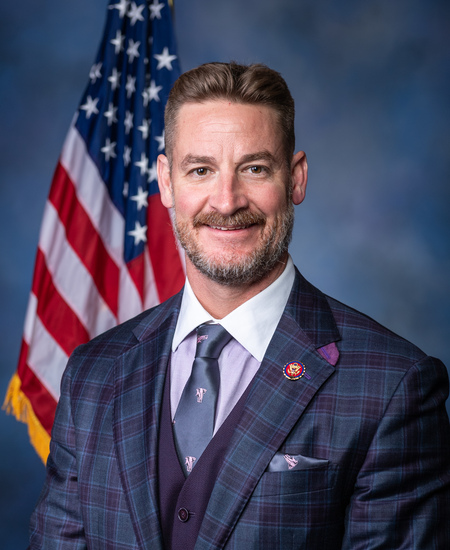
Rep. W. Gregory Steube
Sponsored bills
This joint resolution nullifies a Department of Labor emergency temporary standard for preventing the transmission of COVID-19 in employment settings. Under the standard issued on November 5, 2021, employers with 100 or more employees must require their onsite employees to either be fully vaccinated against COVID-19 or undergo weekly COVID-19 testing.
This resolution prohibits consideration of a bill or joint resolution, or a related amendment or conference report, that includes reconciliation language prior to the committee of jurisdiction receiving the cost analysis for that legislation from the Congressional Budget Office.
This resolution offers sincere gratitude and appreciation for the nation's law enforcement officers. It also recognizes the sacrifices of law enforcement officers and rejects efforts to defund and dismantle law enforcement agencies.
This resolution expresses the sense of the House of Representatives that (1) U.S. policy should be to strengthen the Second Amendment rights of Americans, and (2) Congress should never stop fighting to protect the Second Amendment.
Maddy summaryHRES 386 is a symbolic resolution introduced in the U.S. House of Representatives that expresses support for recognizing "National Police Week" each year. The resolution acknowledges law enforcement officers' sacrifices, particularly during the pandemic, and encourages the public to honor their service. As a non-binding statement, this resolution does not create new law or change policy but serves as a formal expression of support for law enforcement officers across the United States.
Federal Initiative to Guarantee Health by Targeting Fentanyl Act This bill places fentanyl-related substances as a class into schedule I of the Controlled Substances Act. A schedule I controlled substance is a drug, substance, or chemical that has a high potential for abuse; has no currently accepted medical value; and is subject to regulatory controls and administrative, civil, and criminal penalties under the Controlled Substances Act. Additionally, the bill prohibits the application of a mandatory minimum prison term for certain drug offenses involving fentanyl-related substances.
Federal Firearms Licensee Protection Act This bill modifies provisions related to theft of firearms. Under current law, it is unlawful to steal a firearm from a licensed importer, manufacturer, or dealer, or from their business premises. This bill broadens the scope of unlawful conduct to also prohibit stealing a firearm from a gun range that rents firearms or a shooting club. An attempt to commit an offense is subject to the same penalties as a substantive offense. The bill modifies these penalties by increasing the maximum prison term.
Lawless Cities Accountability Act of 2021 This bill prohibits federal funding for a jurisdiction that is a lawless jurisdiction. The term lawless jurisdiction means a state or political subdivision of a state that does one of the following: forbids law enforcement from intervening to restore order during widespread violence or destruction, withdraws law enforcement protection from an area or structure that law enforcement officers are lawfully entitled to access, disempowers or defunds law enforcement agencies, or refuses to accept law enforcement assistance from the federal government amid widespread violence or destruction.
Ending Sanctuary Cities Act of 2021 This bill makes state or local governments that violate immigration laws ineligible for federal financial assistance. A governmental entity shall be ineligible if it(1) violates federal law by prohibiting its officials from communicating with the Department of Homeland Security (DHS) about the immigration status of any individual, (2) restricts compliance with DHS detainer requests, or (3) has any laws or policies that violate immigration laws. (A DHS detainer request is an order or request to a state or local government to temporarily hold or transport an alien for transfer into federal custody or notify DHS before releasing an alien from custody.) A government or law enforcement officer that complies with a DHS detainer request shall be acting under the color of federal authority, for the purposes of liability or immunity in a lawsuit filed by the detained individual. The bill makes it unlawful for a state or local government to discharge or discriminate against one of its law enforcement officers for complying with a DHS detainer request.