Invest to Protect Act of 2022 This bill directs the Office of Community Oriented Policing Services within the Department of Justice to award grants to local and tribal governments that employ fewer than 125 law enforcement officers. Grant funds may be used for various activities, including to provide de-escalation training and improve recruitment and retention.
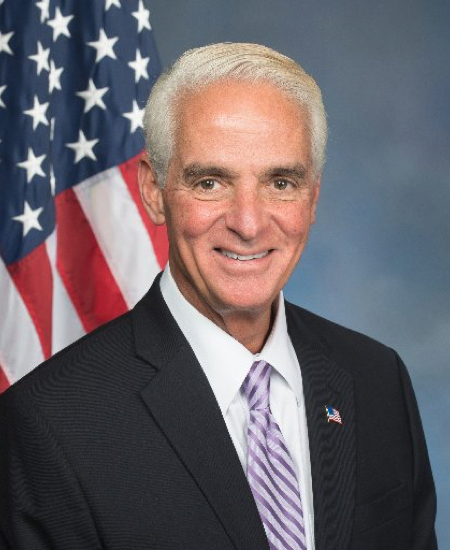
Rep. Charlie Crist
Sponsored bills
Violent Incident Clearance and Technological Investigative Methods Act of 2022 or VICTIM Act of 2022 This bill directs the Department of Justice to establish a grant program for state, tribal, or local law enforcement agencies or prosecuting offices (or groups of tribal agencies or offices) to establish, implement, and administer violent incident clearance and technological investigative methods.
Little Manatee Wild and Scenic River Act This bill designates a specified segment of the Little Manatee River in Florida for potential addition to the National Wild and Scenic Rivers System. The Department of the Interior shall complete a study of the Little Manatee River and submit the results to Congress.
Working to Integrate Networks Guaranteeing Member Access Now Act or the WINGMAN Act This bill directs the Department of Veterans Affairs (VA) to provide veterans with the option to grant read-only access to their records in the databases of the Veterans Benefits Administration to covered congressional employees. The covered congressional employees must be employed in the office of the Member of Congress who represents the district where the veteran resides. Under the bill, a covered congressional employee is (1) a permanent, full-time employee of a Member of Congress who is responsible for assisting constituents with federal agencies and departments; (2) designated by the Member; and (3) someone who satisfies the criteria required by the VA for recognition as an agent or attorney. However, the bill specifies that a covered congressional employee may not be recognized as an agent or attorney with respect to veterans' benefit claims.
Social Security Fairness Act of 2021 This bill repeals provisions that reduce Social Security benefits for individuals who receive other benefits, such as a pension from a state or local government. The bill eliminates the government pension offset , which in various instances reduces Social Security benefits for spouses, widows, and widowers who also receive government pensions of their own. The bill also eliminates the windfall elimination provision , which in some instances reduces Social Security benefits for individuals who also receive a pension or disability benefit from an employer that did not withhold Social Security taxes. These changes are effective for benefits payable after December 2021.
Improving Seniors' Timely Access to Care Act of 2022 This bill establishes several requirements and standards relating to prior authorization processes under Medicare Advantage (MA) plans. Specifically, MA plans must (1) establish an electronic prior authorization program that meets specified standards, including the ability to provide real-time decisions in response to requests for items and services that are routinely approved; (2) annually publish specified prior authorization information, including the percentage of requests approved and the average response time; and (3) meet other standards, as set by the Centers for Medicare & Medicaid Services, relating to the quality and timeliness of prior authorization determinations.
Reese's Law This act requires the Consumer Product Safety Commission (CPSC) to establish a product safety standard with respect to batteries that pose an ingestion hazard (i.e., button cell or coin batteries) and consumer products containing the batteries. Specifically, the batteries and consumer products with these batteries must include a warning label that clearly identifies the hazard of ingestion and instructs consumers to keep the batteries out of the reach of children, seek immediate medical attention if a battery is ingested, and follow any other consensus medical advice. Consumer products containing the batteries must also include a battery compartment that eliminates or adequately reduces the risk of injury from battery ingestion by children who are six years of age or younger. Additionally, such batteries, if sold separately or included separately with a product, must comply with federal child-resistant packaging regulations. The act exempts from these requirements (1) toy products that are in compliance with certain existing battery accessibility and labeling requirements, and (2) batteries that are in compliance with the marking and packaging provisions of the American National Standards Institute (ANSI) Safety Standard for Portable Lithium Primary Cells and Batteries. The act also provides for compliance with the requirements by relying on a voluntary standard that is approved by the CPSC before it establishes the standard required by this act.
Harriet Tubman Bicentennial Commemorative Coin Act This bill directs the Department of the Treasury to mint and issue 50,000 $5 gold coins, 400,000 $1 silver coins, and 750,000 half-dollar clad coins emblematic of the legacy of Harriet Tubman as an abolitionist. The Secretary may issue coins under this bill only during the period of January 1, 2024, through December 31, 2024. All surcharges received by Treasury from the sale of such coins must be paid equally to the National Underground Railroad Freedom Center in Cincinnati, Ohio, and The Harriet Tubman Home, Inc. in Auburn, New York, for the purpose of accomplishing and advancing their missions.
Assault Weapons Ban of 2022 This bill makes it a crime to knowingly import, sell, manufacture, transfer, or possess a semiautomatic assault weapon (SAW) or large capacity ammunition feeding device (LCAFD). The prohibition does not apply to a firearm that is (1) manually operated by bolt, pump, lever, or slide action, except for certain shotguns; (2) permanently inoperable; (3) an antique; (4) only capable of firing rimfire ammunition; or (5) a rifle or shotgun specifically identified by make and model. The bill also exempts from the prohibition the following, with respect to a SAW or LCAFD: importation, sale, manufacture, transfer, or possession related to certain law enforcement efforts, or authorized tests or experiments; importation, sale, transfer, or possession related to securing nuclear materials; and possession by a retired law enforcement officer. The bill permits continued possession, sale, or transfer of a grandfathered SAW, which must be securely stored. A licensed gun dealer must conduct a background check prior to the sale or transfer of a grandfathered SAW between private parties. The bill permits continued possession of, but prohibits sale or transfer of, a grandfathered LCAFD. Newly manufactured LCAFDs must display serial number identification. Newly manufactured SAWs and LCAFDs must display the date of manufacture. The bill also allows a state or local government to use Edward Byrne Memorial Justice Assistance Grant Program funds to compensate individuals who surrender a SAW or LCAFD under a buy-back program.

Securing and Enabling Commerce Using Remote and Electronic Notarization Act of 2022 or the SECURE Notarization Act of 2022 This bill allows a notary public commissioned under state law to remotely notarize electronic records and perform notarizations for remotely located individuals. The bill provides technical requirements for such notarizations, including the creation and retention of video and audio recordings and the use of communication technologies (i.e., video chat). Additionally, the bill requires U.S. courts and states to recognize notarizations—including remote notarizations of electronic records and notarizations of remotely-located individuals—that occur in or affect interstate commerce and are performed by a notary public commissioned under the laws of other states. The bill also allows a notary public to remotely notarize electronic records involving an individual located outside of the United States, subject to certain requirements.