

Growing Renewable Energy and Efficiency Now Act of 2021 or the GREEN Act of 202 1 This bill provides tax incentives for investment in renewable energy resources and energy efficiency programs. Among other provisions, the bill extends for five years the tax credit for production of electricity from certain renewable resources (e.g., wind facilities, biomass, landfill trash facilities), allows an election to treat certain tangible property as energy property for purposes of the energy tax credit, and modifies certain provisions of the energy tax credit and expands the credit for four years; expands the 30% energy tax credit to include energy storage technology or qualified biogas property; extends for one year the tax credit for carbon oxide sequestration; allows elective payments in lieu of certain energy-related tax credits; modifies the phaseout provisions of the income and excise tax credits for biodiesel and renewable diesel and alternative fuels and extends the termination date for such credits; extends and increases the tax credits for nonbusiness energy property and the new energy efficient home tax credit; extends for five years the residential energy efficient property tax credit; increases the tax deduction for energy efficient commercial buildings; modifies the limitations on new qualified plug-in electric drive motor vehicles tax credit and allows a new credit for such vehicles that are previously-owned; allows a new tax credit for zero emission heavy vehicles (vehicles with a gross weight rating of not less than 14,000 pounds and not powered by an internal combustion engine); extends for five years the tax credits for qualified fuel cell motor vehicles and alternative fuel cell refueling property; provides for additional allocations of the advanced energy project tax credit; allows a new tax credit for the labor costs of installing mechanical insulation property; allows a new tax credit to promote environmental justice programs (programs to improve health and economic outcomes of individuals residing in low-income areas or areas populated disproportionately by racial or ethnic minorities); and requires the Department of the Treasury to report on the utility of data from the Greenhouse Gas Reporting Program for determining the amount of greenhouse gases emitted by taxpayers for purposes of imposing a fee on them for such emissions.
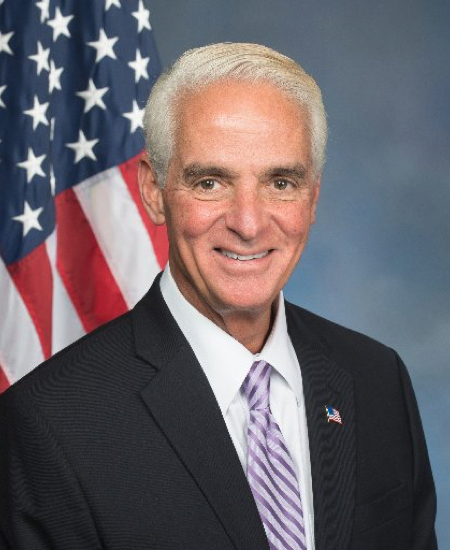
Rep. Charlie Crist
Sponsored bills
Scientific Integrity Act This bill revises provisions regarding the release of scientific research results by federal agencies. Each agency that funds, conducts, or oversees scientific research must (1) adopt and enforce a scientific integrity policy that includes requirements such as that scientific conclusions are not based on political considerations, and (2) submit such policy to the Office of Science and Technology Policy (OSTP) for approval. Each agency must make such policy available to the public and submit such policy to Congress. Agencies and the OSTP must periodically review the policies. The Government Accountability Office shall review implementation of the policies. Each agency shall (1) appoint a Scientific Integrity Officer, (2) establish a process for dispute resolution consistent with the scientific integrity policy, and (3) establish a specified training program for current and new employees.
USPS Fairness Act This bill repeals the requirement that the U.S. Postal Service annually prepay future retirement health benefits.
Global Health, Empowerment and Rights Act This bill establishes that a foreign nongovernmental organization shall not be disqualified from receiving certain U.S. international development assistance solely because the organization provides medical services using non-U.S. government funds if the medical services are legal in both the United States and the country in which they are being provided. Such foreign organizations shall not be subject to requirements relating to their use of non-U.S. funds for advocacy or lobbying activities, other than those that apply to U.S. nongovernmental organizations. Current U.S. policy prohibits various foreign assistance from going to a foreign nongovernmental organization unless it agrees to not perform or actively promote abortions.
Special Districts Provide Essential Services Act This bill makes special districts eligible for the Coronavirus Relief Fund and the Municipal Liquidity Facility program. Specifically, the bill makes special districts eligible for payments from amounts paid to states from any new appropriations to the fund. A special district must submit a request for payment to the state with information demonstrating that the special district has experienced or is likely to experience during the COVID-19 (i.e., coronavirus disease 2019) emergency reduced revenue or operational funding derived from provided services, taxes, fees, or other sources of revenue; reduced indirect funding from the federal government, the state, or a unit of general government below the state level; or as a result of the COVID-19 emergency, increased expenditures necessary to continue operations. The Board of Governors of the Federal Reserve System shall include special districts as eligible issuers in the Municipal Liquidity Facility program, which was created in response to the COVID-19 emergency to buy municipal securities.
Officer Brian D. Sicknick Congressional Gold Medal Act This bill requires the Speaker of the House of Representatives and the President pro tempore of the Senate to arrange for the presentation of a Congressional Gold Medal commemorating Officer Brian D. Sicknick for giving his life to protect the Capitol and Members and staff of Congress on January 6, 2021. Following its award, the medal shall be given to Officer Sicknick's parents, Charles and Gladys Sicknick.
Raise the Wage Act of 2021 This bill increases the federal minimum wage for regular employees over a 5-year period, for tipped employees, and for newly hired employees who are less than 20 years old. The bill sets forth a schedule of annual increases in the federal minimum wage for individuals with disabilities. The Department of Labor shall no longer issue special certificates for the payment of subminimum wages to such individuals after the final wage increase under this bill for such individuals takes effect. Labor shall provide, upon request, technical assistance and information to employers to (1) help them transition their practices to comply with wage increases and other requirements under this bill for individuals with disabilities, and (2) ensure continuing employment opportunities for such individuals. The bill eliminates the separate minimum wage requirements for tipped, newly hired, and disabled employees. After a specified period, these employees shall be paid the same minimum wage as regular employees. Labor must publish any increase in the minimum wage in the Federal Register and on its website 60 days before it takes effect.
Health Care Fairness for Military Families Act of 2021 This bill modifies the extension of dependent coverage under TRICARE by allowing a dependent under the age of 26 to be covered without an additional premium. Additionally, the bill authorizes such coverage of dependents without a premium regardless of whether they are eligible to enroll in an employer sponsored plan.
Civics Learning Act of 2021 This bill expands the use of American History and Civics Education—National Activities grants to prioritize innovative civics learning and teaching. Specifically, the bill expands the allowable uses of these grants to include before-, during-, and after-school activities and extracurricular activities; activities that include service learning and community service projects that are linked to school curriculum; activities that encourage and support student participation in school governance; and online and video game-based learning. Further, the Department of Education must ensure that specified percentages of grant funds are awarded on a diverse basis to eligible entities (e.g., institutions of higher education) that serve students and teachers at elementary schools, middle schools, and high schools.
Transparent Representation Upholding Service and Trust in Congress Act or the TRUST in Congress Act This bill requires a Member of Congress, as well as any spouse or dependent child of a Member, to place specified investments into a qualified blind trust (i.e., an arrangement in which certain financial holdings are placed in someone else's control to avoid a possible conflict of interest) until 180 days after the end of their tenure as a Member of Congress.