

Nurse Staffing Standards for Patient Safety and Quality Care Act of 2021 This bill requires hospitals to implement and submit to the Department of Health and Human Services (HHS) a staffing plan that complies with specified minimum nurse-to-patient ratios by unit. Hospitals must post a notice regarding nurse-to-patient ratios in each unit and maintain records of actual ratios for each shift in each unit. The bill also requires hospitals to follow certain procedures regarding how ratios are determined and other staff are prohibited from performing nurse functions unless specifically authorized within a state's scope of practice rules, among other requirements. HHS must adjust Medicare payments to hospitals to cover additional costs attributable to compliance with these ratios. Nurses may object to, or refuse to participate in, an assignment if it would violate minimum ratios or if they are not prepared by education or experience to fulfill the assignment without compromising the safety of a patient or jeopardizing their nurse's license. Hospitals may not (1) take adverse actions against a nurse based on the nurse's reasonable refusal to accept an assignment; or (2) discriminate against individuals for good faith complaints relating to the care, services, or conditions of the hospital or related facilities. HHS may impose civil monetary penalties on hospitals violating the ratio requirements and must publish the names of such hospitals. The bill provides stipends to the nurse workforce loan repayment and scholarship program and expands the nurse retention grant program to include nurse preceptorship and mentorship projects.
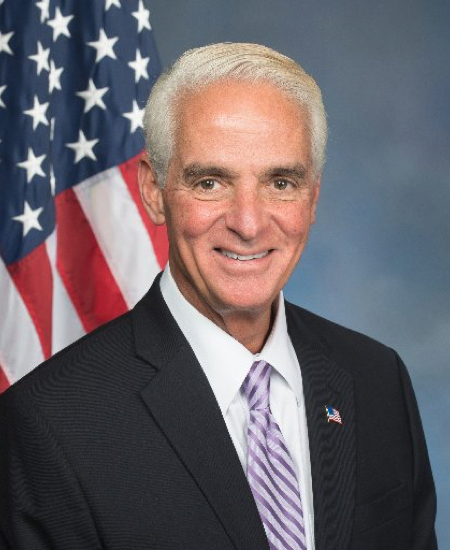
Rep. Charlie Crist
Sponsored bills
Clean Ocean And Safe Tourism Anti-Drilling Act or the COAST Anti-Drilling Act This bill prohibits the Department of the Interior from authorizing the exploration, development, or production (i.e., offshore drilling) of oil or natural gas in specified planning areas of the Outer Continental Shelf along the Atlantic Coast, including the Straits of Florida.
Florida Coastal Protection Act This bill prohibits the Bureau of Ocean Energy Management from offering any tract for oil and gas leasing or preleasing in the following areas: the Eastern Gulf of Mexico Planning Area that is within 125 miles of the coastline of Florida, the South Atlantic Planning Area that is south of 30 degrees 43 minutes North Latitude, or the Straits of Florida Planning Area.
Enhance Access To SNAP Act of 2021 or the EATS Act of 20 21 This bill expands eligibility for the Supplemental Nutrition Assistance Program to students attending institutions of higher education.
Protecting Moms Who Served Act This bill requires the Department of Veterans Affairs (VA) to implement the maternity care coordination program. The VA must provide community maternity care providers (i.e., non-VA maternity care providers) with training and support with respect to the unique needs of pregnant and postpartum veterans, particularly regarding mental and behavioral health conditions in relation to the service of the veterans in the Armed Forces. Additionally, the Government Accountability Office must report on maternal mortality and severe maternal morbidity among pregnant and postpartum veterans, with a focus on racial and ethnic disparities in maternal health outcomes for veterans.
Suicide Training and Awareness Nationally Delivered for Universal Prevention Act of 20 21 or the STANDUP Act of 2021 This bill requires state, tribal, and local educational agencies that receive grant funding for priority mental-health needs, including through the Project AWARE State Education Agency Grant Program, to establish and implement evidence-based suicide awareness and prevention training policies. In addition, the Substance Abuse and Mental Health Services Administration, in coordination with the Department of Education and Bureau of Indian Education, must provide educational agencies with best practices for these trainings.
Northern Rockies Ecosystem Protection Act This bill designates specified National Forest System lands, National Park System lands, and public lands in Idaho, Montana, Oregon, Washington, and Wyoming as wilderness and as components or additions to existing components of the National Wilderness Preservation System. The Department of the Interior and the Department of Agriculture (USDA) must accept donations of leases or permits authorizing grazing on specified public or National Forest System lands. The bill also designates (1) specified federal lands as biological connecting corridors and as special corridor management areas; (2) segments of specified rivers and creeks in Idaho, Montana, and Wyoming as components of the National Wild and Scenic Rivers System; and (3) specified areas as wildland recovery areas. USDA shall develop a wildland recovery plan for each recovery area. A panel of independent scientists shall study roadless lands greater than 1,000 acres that are within the National Forest System in the Wild Rockies bioregion in Idaho, Montana, Oregon, Washington, or Wyoming and that are not designated as components of the National Wilderness Preservation System for their role in maintaining biological diversity in the Northern Rockies and as part of the overall forest reserve system. Any new road construction or reconstruction or timber harvest is prohibited in those lands after the evaluation without an act of Congress. Oil or gas leasing, mining, or other development which impairs the natural and roadless qualities of the land is also prohibited.
Save Hotel Jobs Act This bill requires the Department of the Treasury to award grants to hotel owners and operators to assist with payroll costs. Applicants for a grant must provide Treasury with certain assurances, including that (1) the hotel, if in operation, experienced at least a 40% decline in revenue during a three-month period in calendar year 2020 as compared to the corresponding period in 2019; and (2) the hotel owner or operator has a policy to offer employees who have been laid off during the COVID-19 public health emergency any same or similar positions that become available as a result of receiving a grant. All grant funds must be expended during the 270-day period beginning on the date the funds are disbursed. If the hotel owner or operator receives loans through the Paycheck Protection Program, the grant must be reduced by the amount of such loans that are forgiven under the program, including loans received on or before enactment of this bill. For federal tax purposes, the grants are not included as part of the gross income of the hotel owner or operator. The bill also establishes a tax credit equal to 50% of the expenses a hotel owner or operator incurs for qualified personal protective equipment (up to a maximum of $25,000).
This concurrent resolution (1) affirms, on the 400th anniversary of the arrival of the first slave ship, that the nation owes a debt of remembrance not only to those who lived through the injustices of slavery but also to their descendants; and (2) urges the establishment of a U.S. Commission on Truth, Racial Healing, and Transformation to properly acknowledge, memorialize, and be a catalyst for progress, including toward permanently eliminating persistent racial inequities.
Do No Harm Act This bill prohibits the application of the Religious Freedom Restoration Act of 1993 (RFRA) to specified federal laws or the implementation of such laws. Currently, RFRA prohibits the government from substantially burdening a person's exercise of religion even if the burden results from a rule of general applicability, except in furtherance of a compelling governmental interest when using the least restrictive means. Under the bill, RFRA is inapplicable to laws or the implementation of laws that protect against discrimination or the promotion of equal opportunity (e.g., the Civil Rights Act of 1964); require employers to provide wages, other compensation, or benefits, including leave; protect collective activity in the workplace; protect against child labor, abuse, or exploitation; or provide for access to, information about, referrals for, provision of, or coverage for, any health care item or service. The bill prevents RFRA from being used to deny (1) goods or services the government has contracted, granted, or made an agreement to provide to a beneficiary of or participant in a program or activity funded by such government contract, grant, agreement, or other award; or (2) a person's full and equal enjoyment of a government-provided good, service, benefit, facility, privilege, advantage, or accommodation. In order for a person to assert a RFRA claim or defense in a judicial proceeding, the government must be a party to the proceeding.