

Respect for Marriage Act This act provides statutory authority for same-sex and interracial marriages. Specifically, the act replaces provisions that define, for purposes of federal law, marriage as between a man and a woman and spouse as a person of the opposite sex with provisions that recognize any marriage between two individuals that is valid under state law. (The Supreme Court held that the current provisions were unconstitutional in United States v. Windsor in 2013.) The act also replaces provisions that do not require states to recognize same-sex marriages from other states with provisions that prohibit the denial of full faith and credit or any right or claim relating to out-of-state marriages on the basis of sex, race, ethnicity, or national origin. (The Supreme Court held that state laws barring same-sex marriages were unconstitutional in Obergefell v. Hodges in 2015; the Court held that state laws barring interracial marriages were unconstitutional in Loving v. Virginia in 1967.) The act allows the Department of Justice to bring a civil action and establishes a private right of action for violations. The act does not (1) affect religious liberties or conscience protections that are available under the Constitution or federal law, (2) require religious organizations to provide goods or services to formally recognize or celebrate a marriage, (3) affect any benefits or rights that do not arise from a marriage, or (4) recognize under federal law any marriage between more than two individuals.
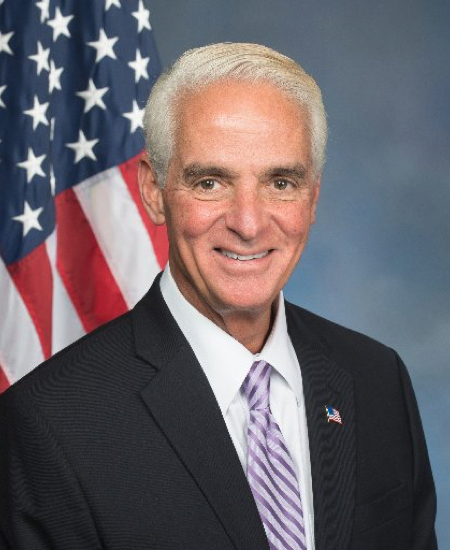
Rep. Charlie Crist
Sponsored bills
Truth and Healing Commission on Indian Boarding School Policies Act This bill establishes the Truth and Healing Commission on Indian Boarding School Policies in the United States and sets forth its powers, duties, and membership. Among other duties, the commission must investigate the impacts and ongoing effects of the Indian Boarding School Policies (federal policies under which American Indian, Alaska Native, and Native Hawaiian children were forcibly removed from their family homes and placed in boarding schools). Further, the commission must develop recommendations on ways to (1) protect unmarked graves and accompanying land protections; (2) support repatriation and identify the tribal nations from which children were taken; and (3) discontinue the removal of American Indian, Alaska Native, and Native Hawaiian children from their families and tribal communities by state social service departments, foster care agencies, and adoption agencies.
Save Oak Flat Act This bill repeals the requirement for the Department of Agriculture to convey the 2,422 acres of Forest System land located in Tonto National Forest in Pinal County, Arizona, known as Oak Flat, to Resolution Copper Mining, LLC, in exchange for various parcels of land owned by Resolution Copper. Oak Flat is withdrawn from (1) entry, appropriation, or disposal under the public land laws; (2) location, entry, and patent under the mining laws; and (3) disposition under all laws pertaining to mineral and geothermal leasing or mineral materials.
Preventing Health Emergencies And Temperature-related Illness and Deaths Act of 2021 or the Preventing HEAT Illness and Deaths Act of 2021 This bill provides statutory authority for, and otherwise revises, the National Integrated Heat Health Information System Program to improve the capacity of the United States to prepare for, adapt to, and mitigate health risks of extreme heat. The Office of Oceanic and Atmospheric Research of the National Oceanic and Atmospheric Administration (NOAA) must carry out this program. (Currently, the program is jointly administered by NOAA and the Centers for Disease Control and Prevention.) Under the bill, the program may provide financial assistance for projects to increase awareness, education, and research about extreme heat events and mitigate the human health impacts of those events. In awarding the assistance, the program must prioritize historically disadvantaged communities and communities with significant heat disparities associated with race or income. Other components of the program include grants for research on climate and health and a study of relevant policy, research, and data gaps concerning extreme heat information and response. The bill also establishes an interagency committee within the White House Office of Science and Technology Policy to develop a strategic plan and otherwise coordinate federal activities related to the program.
Lymphedema Treatment Act This bill provides for Medicare coverage of lymphedema compression treatment items. Specifically, the bill provides for coverage of standard and custom fitted gradient compression garments and other approved items that are prescribed by a physician or other specified health care professional to treat lymphedema.
Prevent All Soring Tactics Act of 2022 or the PAST Act of 2022 This bill addresses the practice of soring horses. The soring of horses includes various actions taken on horses' limbs to produce higher gaits that may cause pain, distress, inflammation, or lameness. Specifically, the bill expands soring regulation and enforcement at horse shows, exhibitions, sales, and auctions, including by establishing a new system for inspecting horses for soring. In addition, the bill increases penalties for violations.
Asunción Valdivia Heat Illness and Fatality Prevention Act of 2022 This bill directs the Occupational Safety and Health Administration to promulgate a standard that requires employers to implement certain measures for protecting workers from heat stress and related illnesses or injuries. Heat stress refers to the load of heat that a person experiences due to sources of heat or heat retention (including metabolic heat, environmental factors, and clothing or personal protective equipment) or the presence of heat in a work setting. Further, if an employer cannot reduce exposure to heat stress below hazardous levels through engineering controls (e.g., heat shields and insulation) or personal protective equipment (e.g., heat reflective clothing), the employer must implement a program that mitigates such exposure through access to appropriate hydration and cool-down spaces, acclimatization policies, and periodic paid rest breaks. Additionally, the bill establishes requirements concerning judicial review, implementation, enforcement, recordkeeping, and whistle-blower protections related to the standard. The bill also requires the Department of Labor to include questions about heat-related illness and injury in the National Agricultural Workers Survey (an employment-based, random-sample survey of U.S. crop workers that collects demographic, employment, and health information).
This resolution expresses the sense of the House of Representatives that (1) lesbian, gay, bisexual, transgender, queer, intersex, and asexual (LGBTQIA+) rights are human rights and protected by the U.S. Constitution; (2) LGBTQIA+ Pride Month should be celebrated; and (3) all Americans should be treated equally regardless of sexual orientation or gender identity.
This resolution expresses the sense of the House of Representatives that the proposed constitutional amendment known as the Equal Rights Amendment has been duly proposed by Congress and ratified by the states and is therefore valid as the Twenty-Eighth Amendment to the Constitution. (The proposed amendment prohibits the United States or any state from denying or abridging equal rights under the law on account of sex.)
This resolution expresses support for the principles of Transgender Day of Remembrance, memorializing the lives lost to anti-transgender violence this year.