Harlem Hellfighters Congressional Gold Medal Act This bill provides for the award of a Congressional Gold Medal to the 369th Infantry Regiment, commonly known as the Harlem Hellfighters, in recognition of their bravery and outstanding service during World War I.
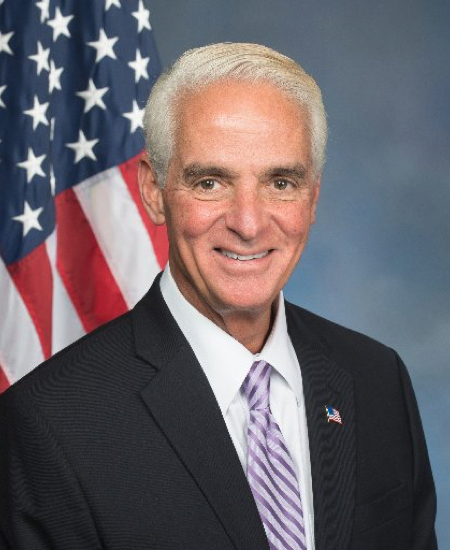
Rep. Charlie Crist
Sponsored bills
This resolution establishes a House Permanent Select Committee on Aging.
9/11 Responder and Survivor Health Funding Correction Act This bill increases funding for and otherwise modifies a federal program that provides medical monitoring and treatment to responders and survivors who suffer from health conditions related to the September 11, 2001, attacks on the World Trade Center. Among the changes, the bill allows certain health care providers other than physicians to determine whether an individual's health condition is related to the attacks, and it establishes a research program to study the impacts of the attacks on health and educational outcomes of individuals who were 21 years of age or younger when the attacks occurred.
Children's Mental Health Infrastructure Act of 2021 This bill provides funding through FY2026 to the Health Resources and Services Administration for grants to improve the capacity of children's hospitals to provide pediatric behavioral health services, including by modernizing sites of care and enhancing telehealth capabilities.
This resolution condemns the assassination of Haitian President Jovenel Moise on July 7, 2021, and extends condolences to his family and the people of Haiti.
Patient Accessibility and Access To Community Healthcare Act or the PAATCH Act This bill allows a hospital that was designated as a sole community hospital on or before March 13, 2020, to retain this status for a 10-year period beginning on the date of the bill's enactment. Sole community hospitals are rural hospitals or hospitals that are the sole source of inpatient care in a certain geographic area. Such hospitals receive specialized treatment with respect to Medicare payment, the 340B drug discount program, and other health care programs.
Marine Mammal Research and Response Act of 2021 This bill provides support for efforts to protect marine mammals. Specifically, the bill reauthorizes through FY2026 and generally revises the John H. Prescott Marine Mammal Rescue Assistance Grant Program, including by renaming the program as the John H. Prescott Marine Mammal Rescue and Response Grant Program. The bill also establishes the Joseph R. Geraci Marine Mammal Rescue and Rapid Response Fund for providing emergency financial assistance for certain stranded or entangled marine mammals and otherwise provides support for marine mammals.
Closing the Meal Gap Act of 202 1 This bill revises the requirements for calculating Supplemental Nutrition Assistance Program (SNAP) benefits. The bill increases the minimum SNAP benefit and requires benefits to be calculated using the value of a low-cost food plan. The Department of Agriculture (USDA) must determine the requirements for the low-cost food plan, which is the diet required to feed a family of four, consisting of a man and a woman 19-50 years of age, a child 6-8 years of age, and a child 9-11 years of age. USDA must (1) reevaluate and publish the market baskets of the plan by January 1, 2027, and every five years thereafter, based on current food prices, food composition data, consumption patterns, and dietary guidance; and (2) make adjustments to the plan to account for household size, changes in the cost of the diet, and the costs of food in specified areas. The bill modifies the requirements for calculating household income to determine SNAP eligibility by (1) authorizing a standard medical expense deduction for households containing an elderly or disabled member, and (2) eliminating the cap on the excess shelter expense deduction. The bill eliminates certain work requirements for SNAP. The requirements apply to able-bodied adults who are ages 18-49 and have no dependent children. The bill allows Puerto Rico, American Samoa, and the Northern Mariana Islands to participate in SNAP. Currently, the three territories receive block grants instead of participating in SNAP.

STEM K to Career Act This bill provides for loan forgiveness and tax credits related to science, technology, engineering, or mathematics (STEM) education and addresses work-study for students employed in STEM fields. The bill requires the Department of Education to forgive student loan obligations of borrowers employed as full-time teachers of STEM in elementary or secondary schools in which the number of low-income children exceeds a certain percentage. Portions of the student loan debt, including interest, shall be forgiven on the basis of years of service, with 100% forgiven for five years of teacher service. The bill allows (1) an increased tax deduction for expenses of elementary and secondary school teachers for STEM education supplies; (2) a tax credit for the employment of STEM interns; and (3) a tax credit for employment of individuals who participated in an apprenticeship program in a STEM field, with the amount determined according to the degree of completion of the program. Beginning with FY2022, an institution of higher education must use at least 7% of federal work-study funds to compensate students employed in STEM fields.
Methane Emissions Reduction Act of 2021 This bill requires the Department of the Treasury to estimate annual methane emissions from each oil and natural gas producing basin and levy a fee for such emissions on each company that produces, gathers, processes, or transmits oil or natural gas. The fees must be used to provide grants through the National Coastal Resilience Fund of the National Fish and Wildlife Foundation.