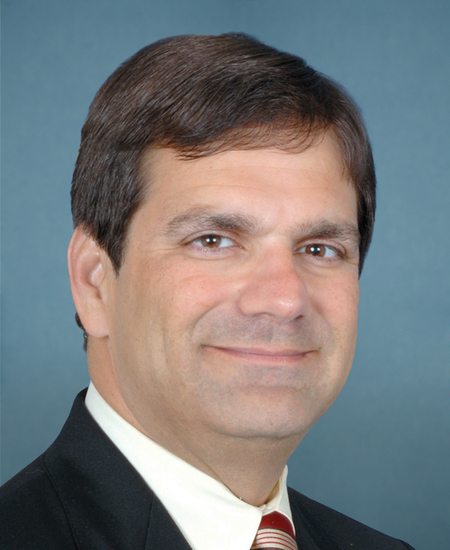
Photo of Gus M. Bilirakis
R United States House · District 12 · Florida On the 2026 ballot

Rep. Gus M. Bilirakis

Compare
Total votes
2,837
all sessions
Attendance
97%
78 missed
Near the chamber average
With party
96%
of cast votes
Higher than 81% of chamber peers
Bipartisan score
2%
crosses aisle rarely
Lower than 82% of chamber peers
Sponsored
1,259
bills & resolutions
Near the chamber average
Committees
4
assignments
1,259 bills and resolutions

Sponsored bills

Total
1,259
Primary
99
Co-sponsor
1,160
This page
1,259
matching current filters
Co-sponsor HJRES 8
In committee · United States House · Co-sponsor
Proposing an amendment to the Constitution of the United States to require that the Supreme Court of the United States be composed of nine justices.

Maddy summaryHJRES 8 proposes a constitutional amendment to permanently set the Supreme Court's size at nine justices. The bill would require any future changes to the Court's composition to follow this specific number, locking in the current structure. It does not alter the existing Court size (which has been nine since 1869) but aims to prevent future adjustments through legislative action. The amendment must be ratified by three-fourths of state legislatures within seven years to take effect. This is a procedural proposal focused on constitutional structure, not a direct policy affecting citizens or programs.

In committee Jan 9, 2023 1 co-sponsor
Co-sponsor HR 24
In committee · United States House · Co-sponsor
Federal Reserve Transparency Act of 2023

Maddy summaryHR 24, the Federal Reserve Transparency Act of 2023, requires a comprehensive audit of the Federal Reserve System's Board of Governors and Federal Reserve banks within 12 months of the bill's enactment. The Congressional auditor (Comptroller General) must then submit a detailed report to Congress within 90 days, including findings, conclusions, and recommendations for improving transparency. This bill directly affects the Federal Reserve System by mandating greater oversight of its operations and financial activities. The key provision repeals a prior limitation that prevented audits of certain Fed programs, aiming to clarify which activities are subject to audit under existing law.

In committee Jan 9, 2023 1 co-sponsor
Co-sponsor HR 25
In committee · United States House · Co-sponsor
FairTax Act of 2023

FairTax Act of 2023 This bill imposes a national sales tax on the use or consumption in the United States of taxable property or services in lieu of the current income taxes, payroll taxes, and estate and gift taxes. The rate of the sales tax will be 23% in 2025, with adjustments to the rate in subsequent years. There are exemptions from the tax for used and intangible property; for property or services purchased for business, export, or investment purposes; and for state government functions. Under the bill, family members who are lawful U.S. residents receive a monthly sales tax rebate (Family Consumption Allowance) based upon criteria related to family size and poverty guidelines. The states have the responsibility for administering, collecting, and remitting the sales tax to the Treasury. Tax revenues are to be allocated among (1) the general revenue, (2) the old-age and survivors insurance trust fund, (3) the disability insurance trust fund, (4) the hospital insurance trust fund, and (5) the federal supplementary medical insurance trust fund. No funding is authorized for the operations of the Internal Revenue Service after FY2027. Finally, the bill terminates the national sales tax if the Sixteenth Amendment to the Constitution (authorizing an income tax) is not repealed within seven years after the enactment of this bill.

In committee Jan 9, 2023 1 co-sponsor
Co-sponsor HR 38
In committee · United States House · Co-sponsor
Concealed Carry Reciprocity Act

Maddy summaryThis bill establishes nationwide recognition for valid concealed carry permits. It allows permit holders from any state to carry concealed handguns in states that either issue such permits or don't ban concealed carry, provided they carry a photo ID and their valid permit. Key provisions include making presentation of a valid permit and ID prima facie evidence of compliance, shifting the burden of proof to prosecutors if challenged, and requiring courts to award attorney fees to successful defendants. It does not override state laws prohibiting concealed carry on private property or government lands, nor does it affect restrictions on federal lands like national parks.

In committee Jan 9, 2023 1 co-sponsor
Co-sponsor HR 130
In committee · United States House · Co-sponsor
Thin Blue Line Act

Maddy summaryHR 130, the Thin Blue Line Act, amends federal death penalty law to add a new consideration for sentencing. It specifies that killing or targeting a law enforcement officer (including firefighters and other first responders) while they are performing official duties, because of their duties, or due to their status as a public official qualifies as an aggravating factor. This change directly affects defendants convicted of such killings, making the death penalty a potential sentence in these specific cases. The bill does not alter sentencing ranges but adds this circumstance as a factor judges must weigh during sentencing.

In committee Jan 9, 2023 1 co-sponsor
Co-sponsor HR 53
In committee · United States House · Co-sponsor
FIND Act

Maddy summaryHR 53 (FIND Act) requires federal contractors to certify they do not refuse to work with firearm manufacturers, dealers, ammunition sellers, or related safety device companies based on bias. It prohibits main contractors from awarding subcontracts exceeding 10% of a contract’s value to entities that fail to make this certification, and bans efforts to circumvent the rule through complex subcontract tiers. The law applies to all federal procurement contracts, directly affecting businesses bidding on government work. Violations risk contract termination and suspension from future government contracts.

In committee Jan 9, 2023 1 co-sponsor
Co-sponsor HR 8152
In committee · United States House · Co-sponsor
American Data Privacy and Protection Act

American Data Privacy and Protection Act This bill establishes requirements for how companies, including nonprofits and common carriers, handle personal data, which includes information that identifies or is reasonably linkable to an individual. Specifically, the bill requires most companies to limit the collection, processing, and transfer of personal data to that which is reasonably necessary to provide a requested product or service and to other specified circumstances. It also generally prohibits companies from transferring individuals' personal data without their affirmative express consent. The bill establishes consumer data protections, including the right to access, correct, and delete personal data. Prior to engaging in targeted advertising, the bill requires companies to provide individuals with a means to opt out of such advertising. The bill also provides additional protections with respect to personal data of individuals under the age of 17. It further prohibits companies from using personal data to discriminate based on specified protected characteristics. Additionally, companies must implement security practices to protect and secure personal data against unauthorized access, and the Federal Trade Commission (FTC) may issue regulations for complying with this requirement. The bill provides for enforcement of these requirements by the FTC and state attorneys general. Beginning two years after the bill takes effect, individuals may, subject to certain notification requirements, bring civil actions for violations of the bill. Finally, the bill preempts state laws that are covered by the provisions of the bill except for certain categories of state laws and specified laws in Illinois and California.


In committee Dec 30, 2022 1 co-sponsor
Co-sponsor HR 3681
In committee · United States House · Co-sponsor
Sinkhole Mapping Act of 2021

Sinkhole Mapping Act of 2021 This bill directs the United States Geological Survey (USGS) to establish a program to map zones that are at greater risk of sinkhole formation. Specifically, the USGS must study the short-term and long-term mechanisms that cause sinkholes, including extreme storm events, prolonged droughts causing shifts in water management practices, aquifer depletion, and other major changes in water use; and develop maps depicting the zones that are at greater risk of forming sinkholes. The USGS must establish a public website that displays such maps and other relevant information critical for use by community planners and emergency managers.

In committee Dec 30, 2022 1 co-sponsor
Co-sponsor HR 7638
Signed into law · United States House · Co-sponsor
To designate the facility of the United States Postal Service located at 6000 South Florida Avenue in Lakeland, Florida, as the "U.S. Marine Corporal Ronald R. Payne Jr. Post Office".

This act designates the facility of the United States Postal Service located at 6000 South Florida Avenue in Lakeland, Florida, as the U.S. Marine Corporal Ronald R. Payne Jr. Post Office.

Signed into law Dec 27, 2022 1 co-sponsor
Co-sponsor HR 6064
Signed into law · United States House · Co-sponsor
To direct the Secretary of Veterans Affairs to seek to enter into an agreement with the National Academies of Sciences, Engineering, and Medicine for a review of examinations, furnished by the Secretary, to individuals who submit claims to the Secretary for compensation under chapter 11 of title 38, United States Code, for mental and physical conditions linked to military sexual trauma.

This act requires the Department of Veterans Affairs (VA) to seek to enter into an agreement with the National Academies of Sciences, Engineering, and Medicine (NASEM) to conduct a comprehensive review of VA medical examinations provided to individuals who submit claims for compensation for a service-connected disability related to military sexual trauma. Specifically, NASEM must review VA examinations that are provided for mental and physical conditions linked to military sexual trauma and are conducted to assess the impairments of individuals arising from such trauma. NASEM must report on its review, and the VA must report on its plans to implement actions based on NASEM's findings and recommendations.

Signed into law Dec 27, 2022 1 co-sponsor
Showing 831 to 840 of 1,259 bills
Previous 1 … 83 84 85 … 126 Next