

Extreme Risk Protection Order Act of 2021 This bill establishes grants to support the implementation of extreme risk protection order laws at the state and local levels, extends federal firearms restrictions to individuals who are subject to extreme risk protection orders, and expands related data collection. Extreme risk protection order laws, or red flag laws, generally allow certain individuals (e.g., law enforcement officers or family members) to petition a court for a temporary order that prohibits an at-risk individual from purchasing and possessing firearms. Among its provisions, the bill directs the Office of Community Oriented Policing Services within the Department of Justice to establish a grant program to help states, local governments, Indian tribes, and other entities implement extreme risk protection order laws; extends federal restrictions on the receipt, possession, shipment, and transportation of firearms and ammunition to individuals who are subject to extreme risk protection orders; and requires the Federal Bureau of Investigation to compile (and later destroy) records from federal, tribal, and state courts and other agencies that identify individuals who are subject to extreme risk protection orders.
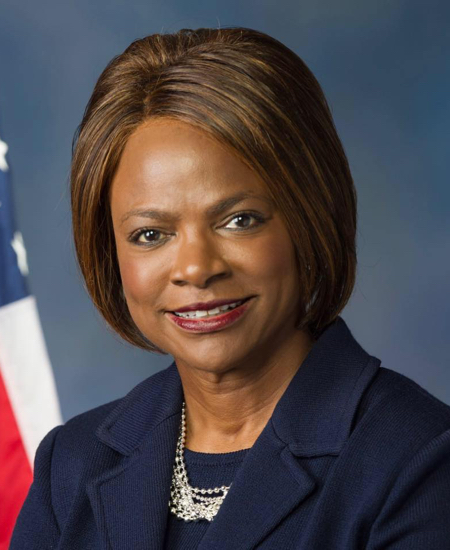
Rep. Val Butler Demings
Sponsored bills
No Stolen Trademarks Honored in America Act This bill modifies the bar against U.S. courts enforcing or validating trademarks that were confiscated by the Cuban government. The bill prohibits U.S. courts from enforcing or validating such confiscated trademarks if the mark had been used in connection with a confiscated business or asset. Currently, the prohibition applies only if the confiscated trademark is being asserted in the United States by a Cuban national. Under the bill, the prohibition shall not apply if the original trademark owner, or a successor, has expressly consented to the enforcement action. The prohibition shall apply only if the entity asserting the trademark rights knew or should have known, when it acquired the rights, that the mark was the same or substantially similar to one connected to a confiscated business or asset.
Original National Domestic Violence Awareness Month Resolution of 2022 This resolution supports the goals and ideals of National Domestic Violence Awareness Month. Further, it expresses the sense of the House of Representatives that Congress should continue to raise awareness of and support programs to end domestic violence.
Major Richard Star Act This bill provides that combat-disabled uniformed services retirees with fewer than 20 years of creditable service may concurrently receive, without reduction, veterans' disability compensation and retired pay or combat-related special compensation.
Keep Americans Safe Act This bill establishes a new criminal offense for the import, sale, manufacture, transfer, or possession of a large capacity ammunition feeding device (LCAFD). The bill does not prohibit certain conduct with respect to an LCAFD, including the following: importation, sale, manufacture, transfer, or possession related to certain law enforcement efforts, or authorized tests or experiments; importation, sale, transfer, or possession related to securing nuclear materials; and possession by a retired law enforcement officer. The bill permits continued possession of, but prohibits sale or transfer of, a grandfathered LCAFD. Newly manufactured LCAFDs must display serial number identification and the date of manufacture. Additionally, the bill allows a state or local government to use Edward Byrne Memorial Justice Assistance Grant Program funds to compensate individuals who surrender an LCAFD under a buy-back program.
Global Malnutrition Prevention and Treatment Act of 2021 This act sets out programs and otherwise directs the U.S. Agency for International Development (USAID) to carry out activities to prevent and treat malnutrition globally. Specifically, USAID may leverage resources to address malnutrition through the Global Nutrition Coordination Plan (an interagency effort to strengthen the impact of U.S. investments in nutrition) and its role on the board of directors of the U.S. International Development Finance Corporation. USAID must also select countries based on specified malnutrition-related indicators for purposes of targeting malnutrition prevention and treatment programs and update the selection within five years. Additionally, USAID may establish the Nutrition Leadership Council to coordinate federal government activities to prevent and treat malnutrition; and target resources and nutrition interventions to the populations most susceptible to severe malnutrition and otherwise support efforts to prevent and treat malnutrition globally. The act also requires USAID to provide to Congress an implementation plan and annual reports concerning its programs for treating and preventing malnutrition. The act's provisions terminate seven years after its enactment.
Ralph David Abernathy, Sr. National Historic Site Act This bill establishes the Ralph David Abernathy, Sr. National Historic Site in Georgia as a unit of the National Park System. The site shall preserve, protect, and interpret the area where the Reverend Dr. Abernathy served as pastor during the height of the modern civil rights movement and his role as an internationally recognized civil rights leader.
Visit America Act This bill implements measures to support the U.S. travel and tourism industry and to address the declining percentage of international visitors to the United States. Specifically, the bill requires the Department of Commerce to develop a 10-year travel and tourism strategy with annual goals for the number of international visitors to the United States and for tourism commerce. The bill also establishes the role of Assistant Secretary of Commerce for Travel and Tourism, whose responsibilities shall include setting an annual goal for the number of international visitors to the United States and facilitating international business travel to the United States. Further, the assistant secretary must develop and implement a COVID-19 pandemic recovery strategy to assist the recovery of the U.S. travel and tourism industry. The bill also provides statutory authority for the United States Travel and Tourism Advisory Board, which shall aid the assistant secretary in developing and implementing the COVID-19 pandemic recovery strategy.
This bill designates the facility of the United States Postal Service located at 3900 Crown Road Southwest in Atlanta, Georgia, as the John R. Lewis Post Office Building.
Maximizing Outcomes through Better Investments in Lifesaving Equipment for (MOBILE) Health Care Act This bill allows a health center that currently receives funding through a Health Resources & Services Administration Health Center Program grant to use a New Access Point grant to set up a mobile unit regardless of whether the health center also establishes a permanent health care delivery site. New Access Point grants help health centers establish new delivery sites to provide comprehensive primary care to medically underserved populations. Under current law, health centers may only use the grants to set up a mobile unit if they also establish a permanent site.