

Equity in Neuroscience and Alzheimer's Clinical Trials Act of 2021 or the ENACT Act of 2021 This bill sets out activities and requirements to increase the participation of underrepresented populations in research and clinical trials for Alzheimer's disease and related dementias. Specifically, the National Institute on Aging (NIA) must establish and provide technical assistance to Alzheimer's research centers located in areas with higher concentrations of minority groups. These centers must establish diagnostic and treatment clinics designed to serve minority, rural, and other underserved populations; operate clinical trials; and carry out public outreach to encourage members of minority populations to participate in clinical trials and research. Additionally, the NIA must disseminate information to members of minority populations about participating in clinical trials and take other actions to enhance diversity with respect to the Alzheimer's research that it conducts or supports. The bill also directs the NIA to increase diversity among Alzheimer's researchers by encouraging the participation of individuals who are from groups that are underrepresented in clinical, behavioral, and social sciences.
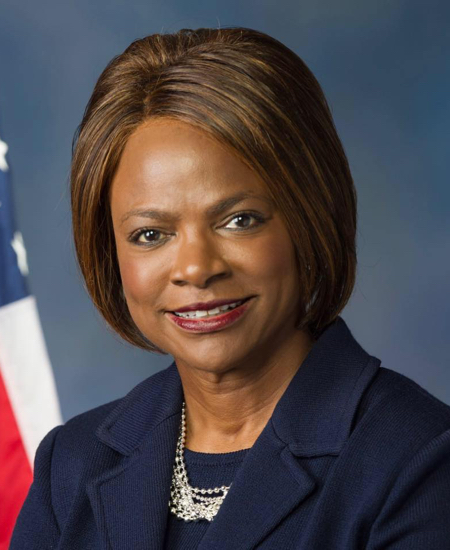
Rep. Val Butler Demings
Sponsored bills
Save Hotel Jobs Act This bill requires the Department of the Treasury to award grants to hotel owners and operators to assist with payroll costs. Applicants for a grant must provide Treasury with certain assurances, including that (1) the hotel, if in operation, experienced at least a 40% decline in revenue during a three-month period in calendar year 2020 as compared to the corresponding period in 2019; and (2) the hotel owner or operator has a policy to offer employees who have been laid off during the COVID-19 public health emergency any same or similar positions that become available as a result of receiving a grant. All grant funds must be expended during the 270-day period beginning on the date the funds are disbursed. If the hotel owner or operator receives loans through the Paycheck Protection Program, the grant must be reduced by the amount of such loans that are forgiven under the program, including loans received on or before enactment of this bill. For federal tax purposes, the grants are not included as part of the gross income of the hotel owner or operator. The bill also establishes a tax credit equal to 50% of the expenses a hotel owner or operator incurs for qualified personal protective equipment (up to a maximum of $25,000).
Helping to Encourage Real Opportunities (HERO) for Youth Act of 2021 This bill modifies the work opportunity tax credit to (1) change the credit for summer youth employees to a credit for youth employees who will be employed for not more than 20 hours per week during any period between September 16 and April 30 in which the youth employee is attending any secondary school, (2) increase the amount of the credit for youth employees, and (3) expand the credit to include disconnected youth. The bill defines disconnected youth to include any individual who (1) is certified as having attained age 16 but not age 25 on the hiring date; and (2) has self-certified as not having regularly attended any secondary, technical, or post-secondary school during the 6-month period preceding the hiring date, has not been regularly employed during such period, and is not readily employable due to a lack of basic skills. The term also includes individuals who have been certified (1) as having attained age 16 but not age 21 on the hiring date, and (2) as eligible foster children in foster care during the 12-month period ending on the hiring date.
Community Broadband Act of 2021 This bill prohibits states from blocking the provision of broadband by public providers, public-private partnership providers, or cooperatively organized providers. Further, public providers and state or local entities participating in a partnership must administer applicable ordinances and rules without discrimination against competing private providers.
This resolution (1) expresses support for the designation of Motorcycle Safety Awareness Month; (2) recognizes the contribution of motorcycles to the transportation mix; (3) encourages motorcycle awareness by all road users; (4) recognizes that motorcyclists have a right to the road and that all motorists should safely share the roadways; (5) encourages rider safety education, training, and proper gear for safe motorcycle operation; and (6) supports the goals of Motorcycle Safety Awareness Month.
Transform, Heal, and Renew by Investing in a Vibrant Economy Act or the THRIVE Act This bill establishes a program to address the economy, racial justice, and climate change. The President must establish a board to advise the President and the heads of federal departments and agencies regarding the implementation of this bill. The President, in consultation with the board, must establish a 10-year plan to create a society that enables and supports greater racial, Indigenous, gender, environmental, and economic justice; work opportunities; healthy communities; a stable climate; and healthy ecosystems. In addition, the President, in consultation with the board, must implement a program that provides support to public or private entities that carry out qualified programs. The programs must meet certain labor, equity, and environmental conditions and support infrastructure, including to expand access to pollution-free, renewable, and affordable energy; care workers and social infrastructure (e.g., health care infrastructure); expanded access to housing; efforts to protect and restore biodiversity or natural habitats and efforts to remediate pollution in communities harmed by environmental, economic, or socioeconomic injustice; agriculture, including agricultural workers; or the development and transformation of the U.S. industrial base, including by expanding manufacturing of clean technologies.
Accessible Voting Act of 2021 This bill addresses voting accessibility for individuals with disabilities and older individuals. First, the bill establishes the Office of Accessibility within the Election Assistance Commission (EAC). The office must serve as the advocate on behalf of voters with access needs, ensure state and local election officials are maintaining voting systems that meet Department of Justice accessibility standards, and make payments to states to implement the accessibility requirements outlined by the bill. In addition, the office must establish and operate a National Resource Center on Accessible Voting to provide state and local election officials, poll workers, and volunteers with the information and technical assistance needed to provide accessible voting. The office must also work with state and local election officials to collect data and administer a public national voter accessibility website. The bill requires each state to (1) ensure election websites are accessible and meet specified requirements, (2) designate a single office to provide information on federal elections to individuals with disabilities and older individuals, (3) notify the public of changes to voting practices, (4) expand access to absentee registration procedures and no-excuse mail-in absentee voting in federal elections, and (5) ensure all polling places and voter drop boxes are accessible. The EAC must coordinate with specified agencies to make grants to eligible entities to study, test, and develop accessible voting options. The bill also permanently reauthorizes and expands a Department of Health and Human Services grant program for increasing accessibility to polling places.
Creating Opportunities Now for Necessary and Effective Care Technologies (CONNECT) for Health Act of 2021 or the CONNECT for Health Act of 2021 This bill expands coverage of telehealth services under Medicare. Among other provisions, the bill allows the Centers for Medicare & Medicaid Services (CMS) to waive certain restrictions, such as restrictions on the types of technology that may be used; permanently removes geographic restrictions on originating sites (i.e., the location of the beneficiary) and allows the home of the beneficiary to serve as the originating site for all services; permanently allows federally qualified health centers and rural health clinics to serve as the distant site (i.e., the location of the health care practitioner); and allows the CMS to generally waive coverage restrictions during any public health emergency. Additionally, the CMS must report on the effects of expanded telehealth services during the COVID-19 public health emergency, including with respect to the utilization, quality, and outcomes of services. The Center for Medicare and Medicaid Innovation may also test alternative payment models relating to expanded telehealth services.
Mark Takai Atomic Veterans Healthcare Parity Act This bill includes veterans who participated in the cleanup of Enewetak Atoll in the Marshall Islands between January 1, 1977, and December 31, 1980, as radiation-exposed veterans for purposes of the Department of Veterans Affairs presumption of service-connection for specified cancers. Under a presumption of service-connection, specific conditions diagnosed in certain veterans are presumed to have been caused by the circumstances of their military service. Health care benefits and disability compensation may then be awarded.
This concurrent resolution (1) affirms, on the 400th anniversary of the arrival of the first slave ship, that the nation owes a debt of remembrance not only to those who lived through the injustices of slavery but also to their descendants; and (2) urges the establishment of a U.S. Commission on Truth, Racial Healing, and Transformation to properly acknowledge, memorialize, and be a catalyst for progress, including toward permanently eliminating persistent racial inequities.