

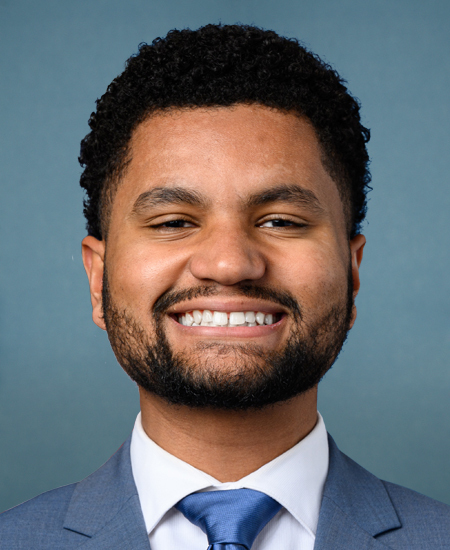
Photo of Maxwell Frost
D United States House · District 10 · Florida On the 2026 ballot

Rep. Maxwell Frost

Compare
Total votes
1,879
all sessions
Attendance
99%
15 missed
Higher than 85% of chamber peers
With party
95%
of cast votes
Near the chamber average
Bipartisan score
3%
crosses aisle rarely
Near the chamber average
Sponsored
1,059
bills & resolutions
Higher than 83% of chamber peers
Committees
7
assignments
1,059 bills and resolutions

Sponsored bills

Total
1,059
Primary
47
Co-sponsor
1,012
This page
1,059
matching current filters
Co-sponsor HR 4900
In committee · United States House · Co-sponsor
Fair College Admissions for Students Act

Maddy summaryHR 4900, the Fair College Admissions for Students Act, bans colleges receiving federal financial aid from favoring applicants based on family connections to donors or alumni. Specifically, it amends the Higher Education Act to prohibit institutions from giving preferential treatment in admissions to students whose parents or relatives donated money to the school or are alumni. This applies to all colleges participating in federal student aid programs under the Higher Education Act. The rule takes effect for the second award year starting after the bill's enactment date.

In committee Jul 26, 2023 1 co-sponsor
Co-sponsor HR 4919
In committee · United States House · Co-sponsor
Oligarch Act of 2023

Maddy summaryThis bill would impose a progressive wealth tax on high-net-worth individuals and certain trusts, targeting those with substantial assets above a defined threshold. The tax would be calculated on the net value of taxable assets exceeding a threshold amount (1,000 times the greater of $50,000 or median household wealth), with rates increasing from 2% to 8% as asset value rises. The bill includes specific provisions for trusts, deceased individuals, non-residents, and expatriates, and would require new information reporting from financial institutions to enforce the tax. It would apply to calendar years beginning after the bill's enactment date. The legislation defines "taxable assets" as all property minus debts, with certain exclusions for assets under $50,000.

In committee Jul 26, 2023 1 co-sponsor
Co-sponsor HR 1776
In committee · United States House · Co-sponsor
End Tuberculosis Now Act of 2023

Maddy summaryHR 1776, the End Tuberculosis Now Act of 2023, would amend U.S. foreign assistance law to strengthen global tuberculosis (TB) programs. The bill requires U.S. assistance to align with the World Health Organization's End TB Strategy, aiming to reduce TB deaths by 95% and incidence by 90% by 2035. It mandates annual reporting on TB diagnosis and treatment progress, prioritizes research for new diagnostics and treatments, and emphasizes integrating TB services into primary health care. The legislation affects U.S. government agencies, global health partners, and countries with high TB burdens, particularly focusing on low- and middle-income nations.

In committee Jul 26, 2023 1 co-sponsor
Co-sponsor HR 4844
In committee · United States House · Co-sponsor
Improving Training for School Food Service Workers Act

Maddy summaryThis bill amends the Child Nutrition Act to require school food service training programs to be scheduled during regular paid work hours whenever possible. If training must occur outside work hours, schools must compensate staff for attending, explain the necessity, and not penalize staff for missing it. Training must also be offered in-person with hands-on components when appropriate. The law directly affects school food service workers and their employers, mandating specific scheduling and compensation practices for required training.

In committee Jul 25, 2023 1 co-sponsor
Co-sponsor HR 4870
In committee · United States House · Co-sponsor
Wall Street Tax Act of 2023

Maddy summaryHR 4870, the Wall Street Tax Act of 2023, imposes a 0.1% tax on most securities transactions occurring on U.S. exchanges or involving U.S. persons. It directly affects financial institutions, brokers, and investors participating in covered transactions like stock, bond, and derivative trades. The tax applies to the fair market value of transactions (excluding initial security issuances and short-term debt under 100 days), with payment responsibility falling on U.S. exchanges, brokers, or U.S. parties depending on the transaction type. Exceptions include certain real property contracts, insurance products, and derivatives used in normal business operations. The tax takes effect for transactions after December 31, 2023.

In committee Jul 25, 2023 1 co-sponsor
Co-sponsor HR 4889
In committee · United States House · Co-sponsor
Raise the Wage Act of 2023

Maddy summaryHR 4889, the Raise the Wage Act of 2023, would gradually increase the federal minimum wage for most workers to $15.50 per hour by 2027, with specific annual targets: $9.50 starting in 2023, rising to $11.00 after one year, $12.50 after two years, and $15.50 after four years. It would also phase out the separate lower minimum wage for tipped employees (starting at $6.00/hour) by aligning their pay with the regular minimum wage by 2028, while requiring employers to let workers keep all tips. The bill includes similar phased increases for workers under 20 and transitions toward fairer wages for workers with disabilities under special certificates, which would sunset after 2028. Future annual increases after 2028 would tie the minimum wage to the median hourly wage of all workers.

In committee Jul 25, 2023 1 co-sponsor
Co-sponsor HRES 608
In committee · United States House · Co-sponsor
Recognizing the importance of diversity, equity, and inclusion efforts in higher education.

Maddy summaryHRES 608 is a non-binding House resolution recognizing the value of diversity, equity, and inclusion (DEI) efforts at colleges and universities. It affirms that DEI initiatives help create supportive learning environments where all students, faculty, and staff thrive, and specifically supports programs like implicit bias training and cultural competence resources. The resolution emphasizes that DEI efforts strengthen institutions’ ability to recruit diverse talent and align with academic freedom principles. It also notes concerns about state-level efforts to restrict DEI programs and states that such restrictions threaten campus inclusivity. As a symbolic resolution, it does not create new laws or funding but expresses congressional support for DEI work in higher education.

In committee Jul 20, 2023 1 co-sponsor
Co-sponsor HR 4817
In committee · United States House · Co-sponsor
SHADE Act

Maddy summaryThe SHADE Act creates a federal grant program to plant trees in historically disadvantaged neighborhoods, primarily targeting redlined areas (former HOLC "hazardous" zones) and overburdened areas (where at least 35% of households are low-income, or 40% identify as minority/tribal, or 40% are limited English proficiency). Eligible entities - like cities, tribes, or nonprofits - must submit applications with 5-year plans, community input strategies, and evidence of housing policies preventing displacement. Grants cover tree planting, maintenance for 5 years, and training, with $50 million annually authorized through 2034. The bill directly affects communities facing environmental inequities by linking tree planting to neighborhood revitalization efforts.

In committee Jul 20, 2023 1 co-sponsor
Co-sponsor HR 4780
In committee · United States House · Co-sponsor
Language Access to Gun Violence Prevention Strategies Act of 2023

Maddy summaryThis bill requires the Department of Justice and Health and Human Services to translate key gun violence prevention materials - including extreme risk protection orders and safe storage resources - into the 10 most common non-English languages in the U.S. (like Spanish, Mandarin, and Korean) for limited English proficient communities. It mandates that community-based organizations with ties to these language groups review translations for cultural appropriateness before publication. The bill also prioritizes grant applications that include targeted outreach plans for limited English proficient populations when funding gun violence prevention programs. These changes aim to improve access to evidence-based safety strategies for communities where language barriers might otherwise limit participation.

In committee Jul 20, 2023 1 co-sponsor
Co-sponsor HR 4728
In committee · United States House · Co-sponsor
Transportation for Reentry Act

Transportation for Reentry Act This bill requires certain Federal Transit Administration (FTA) grant recipients to provide free public transportation to returning individuals (i.e., individuals who have been incarcerated for at least one year in federal or state prison).  Specifically, the bill requires recipients of FTA financial assistance under the Urbanized Area Formula Grants Program and the Formula Grants for Rural Areas Program to carry out a reentry service program. A grantee must provide reentry service for a one-year period beginning on the returning individual's release date. The bill also establishes certain program requirements for grantees (e.g., to create an enrollment system for returning individuals). The Department of Transportation (DOT) may reimburse a grantee for the cost of providing the reentry service, including for indirect costs (e.g., the costs to develop and implement the program and operational costs). DOT must issue such regulations as necessary to carry out these requirements. This includes regulations that (1) promote the coordination of providing technical assistance to grantees, (2) promote the marketing of the reentry service, and (3) clarify the treatment of a returning individual who resides in different locations. The bill also directs the Government Accountability Office to submit a report to Congress on the implementation of the reentry service program.

In committee Jul 20, 2023 1 co-sponsor
Showing 831 to 840 of 1,059 bills
Previous 1 … 83 84 85 … 106 Next